Is Composite Deck Installation a Good DIY Project?
Composite deck installation is absolutely achievable for a motivated homeowner — here’s the short answer on how it works:
How to install composite decking (quick overview):
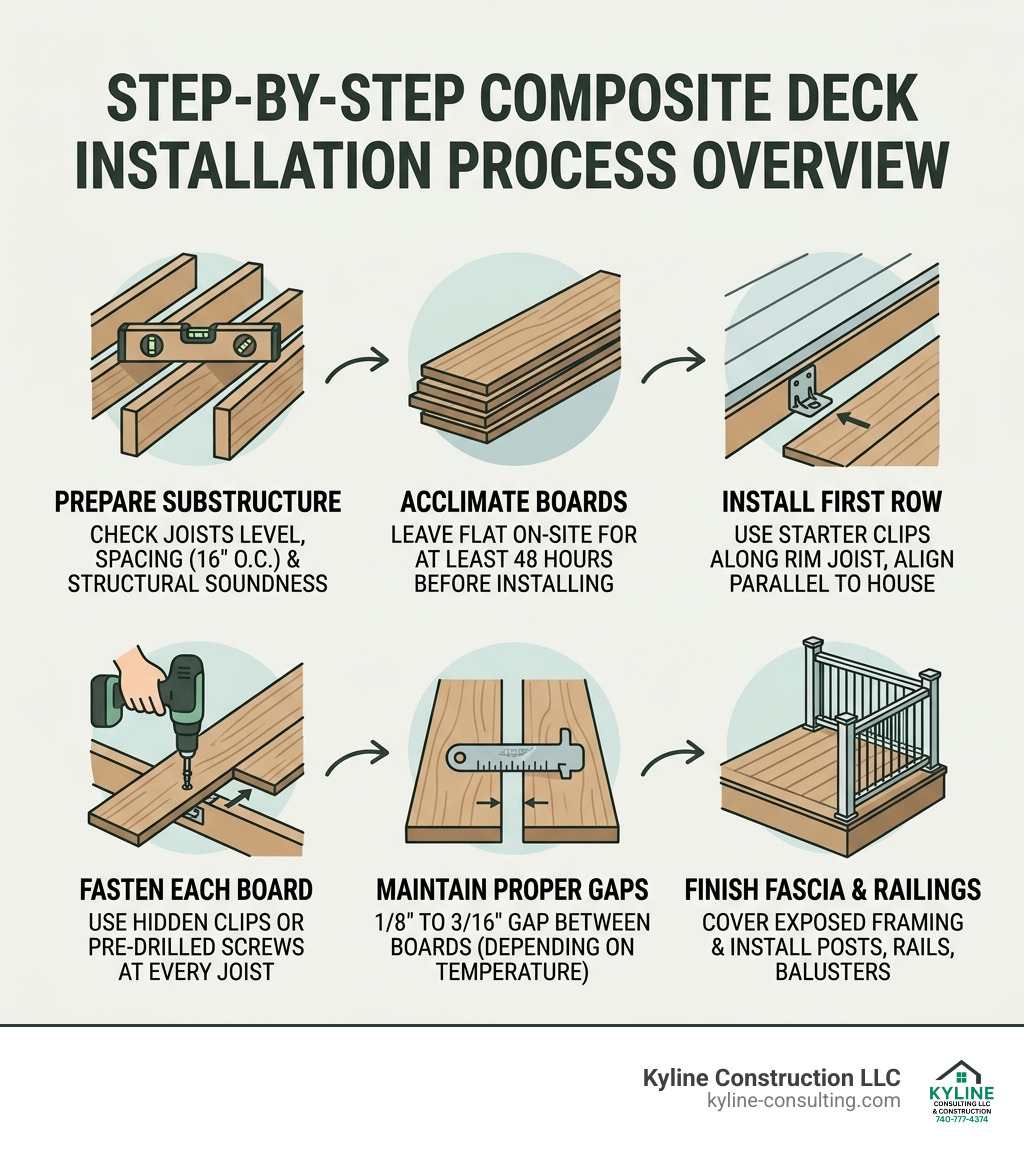
- Prepare the substructure — check joists for level, spacing (16″ on center), and structural soundness
- Acclimate your boards — leave them flat on-site for at least 48 hours before installing
- Install the first row — use starter clips along the rim joist and align parallel to the vinyl siding
- Fasten each board — use hidden clips (like CONCEALoc or T-Clips) or pre-drilled screws at every joist
- Maintain proper gaps — 1/8″ to 3/16″ between boards depending on temperature
- Finish with fascia and railings — cover exposed framing and install posts, rails, and balusters
Composite decking has become one of the most popular outdoor upgrades for Central Ohio homeowners — and for good reason. Unlike wood, a properly installed composite deck can last 25 to 50 years with minimal upkeep, standing up to Ohio’s freeze-thaw winters and humid summers without warping, rotting, or splintering.
But getting that kind of longevity out of your deck starts with getting the installation right. Small mistakes — wrong gaps, skipped pre-drilling, improper joist spacing — can void your warranty and cause real problems down the road.
I’m Shawn, owner of Kyline Consulting LLC and a lifelong construction professional based in Circleville, Ohio. I’ve spent my entire career building and remodeling homes across Central Ohio, specializing in vinyl siding exteriors. I am a ‘real contractor’—not a ‘paper contractor’—meaning I am on-site, tools in hand, ensuring the job is done right. I’ve completed plenty of composite deck installation projects where quality craftsmanship was the only priority. In the sections below, I’ll walk you through everything you need to know to do this job right — whether you’re going DIY or just want to know what your contractor should be doing.
Composite deck installation definitions:
Essential Tools and Materials for Composite Deck Installation
Before you head to the lumber yard in Columbus or Circleville, you need to realize that composite isn’t wood. It’s denser, heavier, and behaves differently under a saw blade. You can’t just hack away at it with a dull blade and expect a professional finish.
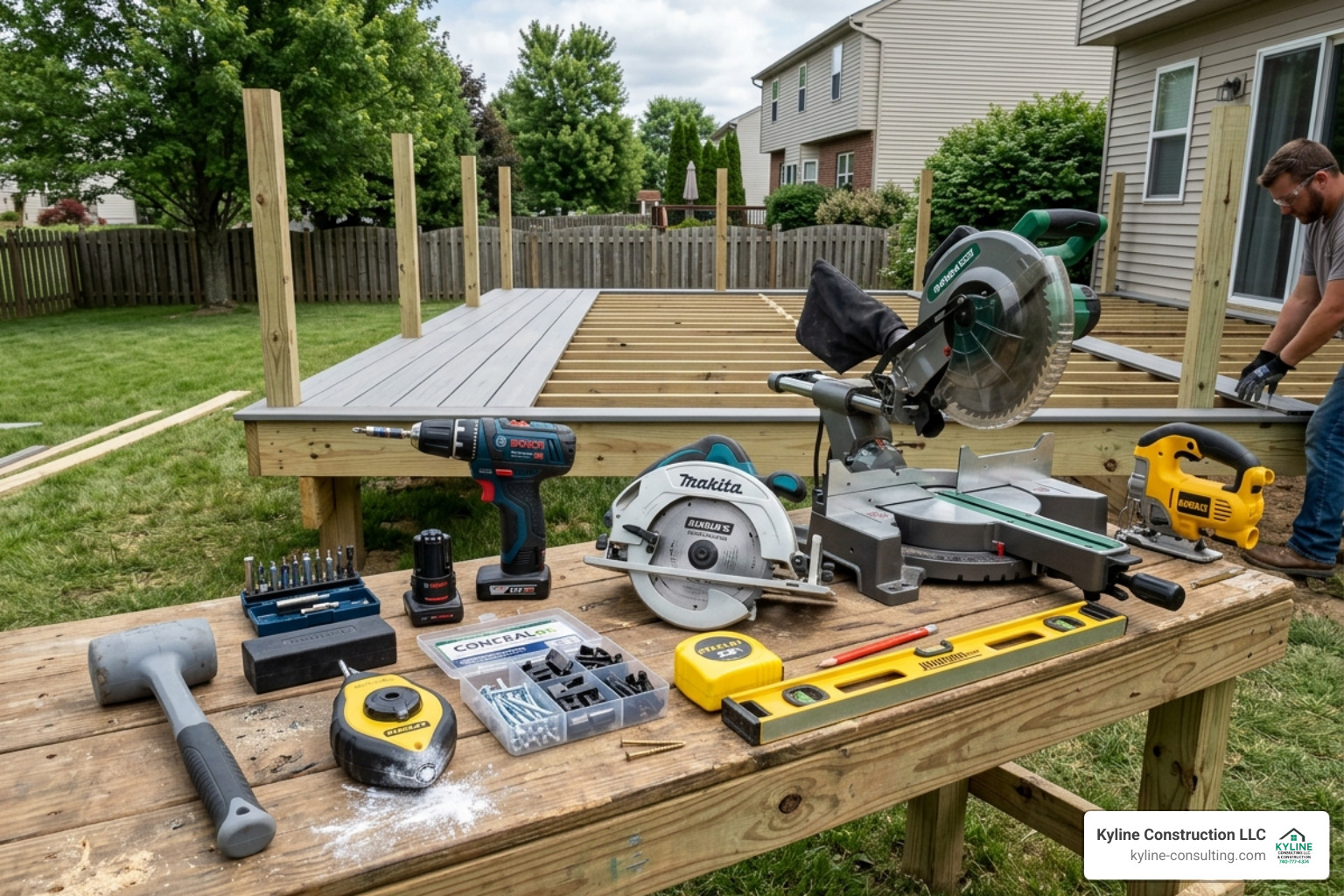
To get a clean, splinter-free finish, we always use a circular saw equipped with a fine-toothed, carbide-tipped blade (usually 60 to 100 teeth). Standard wood blades will chew up the plastic-wood blend and leave you with ragged edges. You’ll also need a high-quality cordless driver, a chalk line (stick to white chalk—blue or red can permanently stain some boards), and a jigsaw for cutting around posts.
One of the most overlooked steps in composite deck installation is board acclimation. I’ve seen DIYers pull boards straight off a hot truck and screw them down immediately. That is a recipe for disaster. You must follow the 48-hour rule: lay your boards flat on a level surface at the job site for at least two days before you start cutting. This allows the material to reach equilibrium with our Central Ohio humidity and temperature. If you skip this, your gaps will be all over the place by next July.
According to This Old House, using the right tools—like a tapping block and a rubber mallet—ensures you don’t mar the surface of these expensive boards while trying to snug them into place.
Proper Gapping Requirements for Composite Deck Installation
Thermal expansion is the “silent killer” of beautiful decks. Composite boards grow and shrink significantly as the temperature changes. If you butt them tight against your vinyl siding in April, they’ll be buckling and popping screws by August.
| Installation Temperature | Side-to-Side Gap | Butt Joint Gap | Structure Clearance |
|---|---|---|---|
| 32°F and below | 3/16″ | 3/16″ | 1/4″ |
| 33°F – 74°F | 1/8″ | 1/8″ | 1/8″ |
| 75°F and above | 1/16″ | 1/32″ | 1/16″ |
Always maintain at least a 1/8″ to 3/16″ gap side-to-side to allow for drainage and expansion. When it comes to butt joints (where two board ends meet), the gap depends entirely on the temperature during installation. In the heat of a Columbus summer, you can gap them tighter because they’ve already expanded. In the winter, you need a wider gap so they have room to grow when it warms up.
Hidden Fasteners vs. Visible Screws
Most homeowners today want a “fastener-free” look. This is achieved using hidden fastener systems like CONCEALoc, T-Clips, or TurboClip. These clips slide into a groove on the side of the board and screw directly into the joist, automatically setting your side-to-side gap. It’s a clean look and much easier on your bare feet.
However, for the first and last boards, or for stairs, you’ll likely need to use visible screws. Pro tip from Shawn: Always pre-drill your holes. Composite material is so dense that driving a screw without a pilot hole often causes “mushrooming”—where the material bulges up around the screw head—or even splits the board end. Use high-quality stainless steel screws to prevent rust streaks. If you’re curious about which board types work best with these fasteners, check out more info about deck options.
Preparing the Substructure and Joist Spacing
A deck is only as good as the “bones” underneath it. If your frame is wavy, your composite surface will look like a roller coaster. Composite is flexible; it follows every dip and peak in your joists.
Before starting your composite deck installation, inspect your pressure-treated frame. If you’re building a new deck, residential joist spacing should be 16 inches on center. If you’re planning to lay your boards diagonally (at a 45-degree angle), you must tighten that spacing to 12 inches on center. The same 12-inch rule applies to commercial decks and stair treads to prevent “bouncy” boards.
Ventilation is also critical. You need at least 4 inches of clear airflow under the deck. Without it, moisture builds up, causing the substructure to rot and the composite boards to swell. If you’re installing decking for a floating deck, ensure the ground is sloped for drainage and use joist tape on top of the wood to protect it from trapped water.
Step-by-Step Guide to Composite Deck Installation
- The First Row: Start at the vinyl siding. Use starter clips or “start/stop” strips. Align this first board perfectly parallel to the vinyl siding. If this board is crooked, the whole deck will be crooked.
- The Main Field: Slide your hidden clips into the groove of the first board and screw them down. Slide the next board onto the clips. Use a “beater board” (a scrap piece of 2×4) and a mallet to tap the boards tight against the clips.
- The Middle: Continue this process. If your deck is wider than your longest board, you’ll need to use breaker boards or butt joints.
- The Final Board: Usually, the last board won’t fit perfectly. You’ll need to “rip” it (cut it lengthwise) using your circular saw to fit the remaining space.
For more creative layout ideas, take a look at these inspiring deck renovation ideas.
Handling Butt Joints and Double Joists
Never try to land two board ends on a single 1.5-inch joist. There simply isn’t enough “meat” for the fasteners, and the boards will eventually pull loose. Instead, we always “sister” the joists at butt joints. This means adding a second joist or a blocking piece so each board end has its own solid surface to screw into. Leave a small drainage gap (about 5mm) between these sister joists so water doesn’t sit and rot the wood.
Working with expert deck builders in Ohio can help ensure these structural details are handled correctly, protecting your 25-50 year investment.
Finishing Touches: Fascia, Stairs, and Railings
The “jewelry” of the deck is the fascia and railing. Fascia boards are the vertical boards that cover the rim joists. They are thinner than deck boards and require specific fasteners. We recommend using a fascia tool that pre-drills a hole slightly larger than the screw to allow the board to move as it expands. Space your screws no more than 12 inches apart to prevent “oil-canning” or warping.
For stairs, composite treads require more support than wood. Most manufacturers require stringers to be spaced every 9 to 12 inches. When mounting railing posts, we always bolt them to the inside of the rim joist using heavy-duty carriage bolts. This provides the structural integrity needed to meet Ohio building codes. If you’re dealing with an older deck that needs an upgrade, check out Ohio’s best deck repair pros for advice on reinforcing your frame for composite.
Why a “Real Contractor” Matters in Central Ohio
Look, I’ll be honest with you. There is a massive, fundamental divide in the Columbus and Circleville market between ‘paper contractors’ and ‘real contractors.’ This distinction is the difference between a deck that lasts 50 years and one that fails in five. A paper contractor is essentially a salesman with a clipboard and a polished pitch. They outsource everything to the cheapest labor available and often lack the technical knowledge to even identify a mistake, let alone fix it. If your project hits a snag—like a complex vinyl siding transition—a paper contractor is stuck because he doesn’t actually know how to build.
At Kyline Construction LLC, we are real contractors. This means I possess the physical skills and decades of experience to pick up the tools and finish the job personally. We understand the nuances of composite deck installation better than any salesman ever could. We don’t just manage the project from an office; we master it on-site. This hands-on expertise is why we specialize in homes with vinyl siding, ensuring every flashing and connection is watertight and structurally sound. Don’t settle for a middleman; hire a craftsman who knows the trade inside and out.
Frequently Asked Questions about Composite Decks
What is the maximum joist spacing for composite boards?
For standard residential use with boards laid perpendicular to the joists, the maximum spacing is 16 inches on center. If you are installing boards at an angle or building a commercial space, you must reduce this to 12 inches on center.
How do I clean and maintain my composite deck?
Even though it’s “low maintenance,” it’s not “no maintenance.” Sweep off leaves and debris regularly. For a deeper clean, use soapy water and a soft-bristle nylon brush. Avoid pressure washers, as they can etch the surface of the boards and ruin the finish.
Can I install composite boards over an existing wood deck?
Technically yes, but I usually advise against it unless the frame is in perfect condition. Composite boards last 25-50 years, but your old pressure-treated frame might only have 5 years left. It’s usually better to start fresh or thoroughly reinforce the old frame.
Conclusion
A successful composite deck installation is a game of details. From the 48-hour acclimation period to the precise thermal gapping, every step matters if you want a deck that looks as good in year 20 as it does on day one. With a lifespan of up to 50 years, composite is a fantastic investment for your Central Ohio home.
If you’re feeling overwhelmed by the technical requirements or just want the peace of mind that comes with a ‘real contractor’ who actually knows the trade—unlike the ‘paper contractors’ who just manage subcontracts—Kyline Construction LLC is here to help. We bring 40+ years of experience to every backyard in Circleville and Columbus.
Ready to upgrade your outdoor living space? Start your project with a free estimate today and let Shawn and the team build a deck that stands the test of time.