Why Proper Corner Installation Makes or Breaks Your Siding Project
Installing corners on vinyl siding is one of the most critical steps in achieving a professional-looking exterior. Get the corners right, and your home looks sharp, stays protected from the elements, and maintains its value for decades. Get them wrong, and you’ll face buckled panels, water infiltration, and a finish that screams “amateur hour.”
Quick Answer: Installing Corners on Vinyl Siding
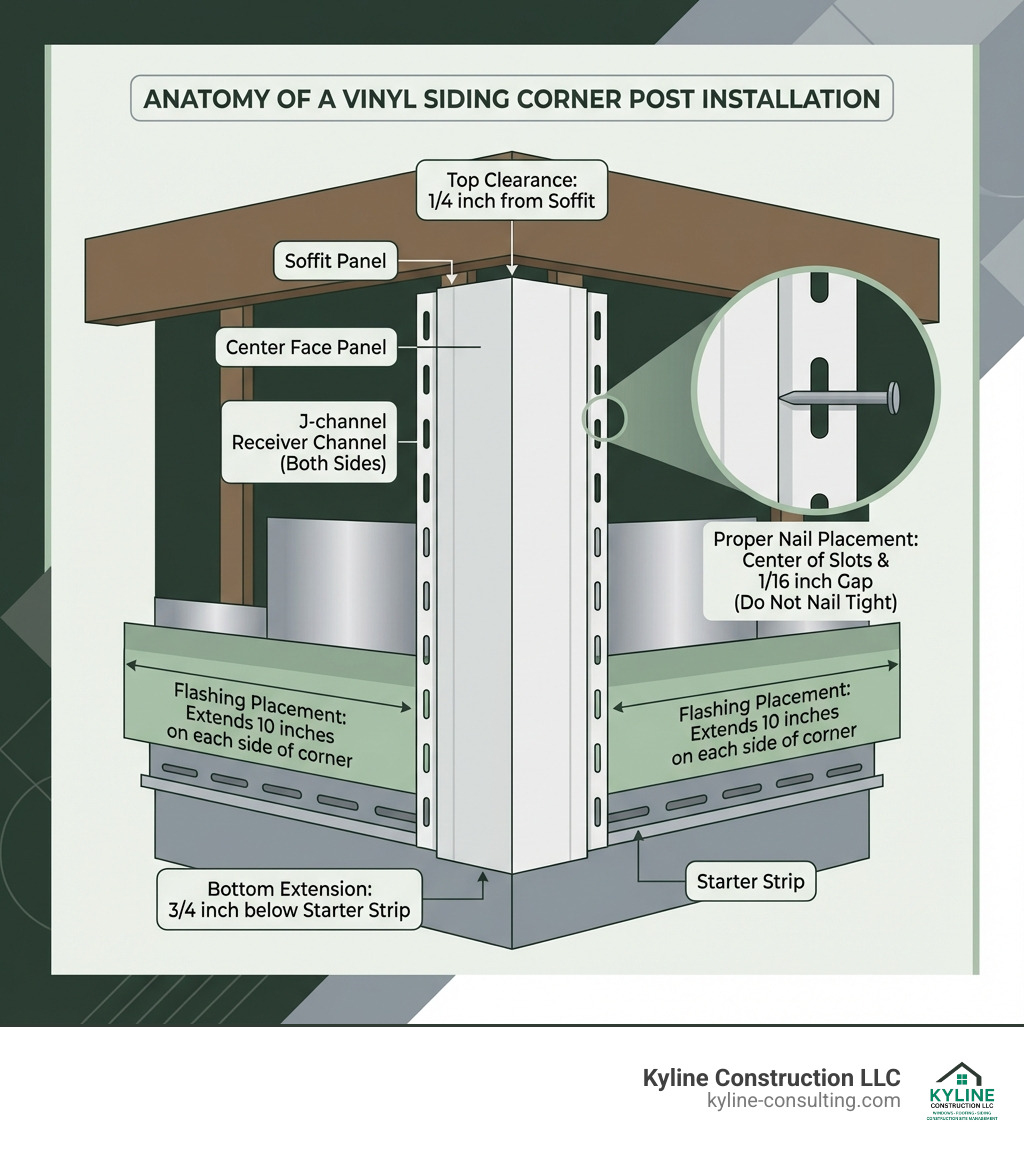
- Measure and cut the corner post to length, leaving 1/4″ gap at the top and extending 3/4″ below the starter strip
- Flash the corner with water-resistant material (minimum 10″ on each side)
- Hang the post by placing the first nail at the top of the uppermost slot
- Nail loosely in the center of slots, spaced 8-12″ apart, leaving 1/16″ gap between nail head and post
- Never nail tightly – vinyl must move freely to accommodate expansion and contraction
The research makes it clear: more than half of all vinyl siding installation problems trace back to improper nailing. And corners? They’re ground zero for these mistakes. As one forum user found, when standard 10-foot corner pieces proved too short for 11-foot walls, the visible overlap looked “tacky” – a problem that could have been avoided with proper planning.
Corners serve as your home’s first line of defense against weather. They channel water away from vulnerable wall joints, provide a clean transition between wall planes, and lock your siding panels securely in place. But they only work if installed correctly, with proper allowance for the expansion and contraction that can reach up to 3/8 inch per panel as temperatures swing from summer heat to winter cold.
I’m Shawn, of Kyline Construction LLC, and I’ve spent my entire working career in construction, with extensive hands-on experience installing corners on vinyl siding throughout Ohio. Over the years, I’ve seen how proper corner installation separates lasting quality from costly callbacks.
Pre-Installation: Gathering Tools and Prepping the Area
Before we even think about cutting or nailing, a successful vinyl siding corner installation begins with meticulous planning and preparation. Think of it as laying the groundwork for a masterpiece – you wouldn’t paint on a dirty, uneven canvas, would you? The same principle applies to your home’s exterior. Our goal is to achieve a flawless finish that stands the test of time, and that starts with the right tools and a properly prepped wall surface. This foundational work is crucial for any siding services we provide.
Essential Tools and Materials
Having the right arsenal of tools makes all the difference. It saves time, reduces frustration, and ensures a cleaner, more accurate installation. Here’s what you’ll need in your toolkit when installing corners on vinyl siding:
- Tape Measure: For precise measurements, naturally.
- Level: A good 4-foot level (or even longer) is essential for ensuring your corner posts are perfectly plumb.
- Chalk Line: To establish straight, level reference lines for starter strips and corner posts. A water level can also be useful for marking level points around the house, especially across openings.
- Hammer: For driving those corrosion-resistant roofing nails.
- Tin Snips/Aviation Snips: Ideal for cutting and notching vinyl cleanly.
- Utility Knife: Great for scoring and snapping vinyl, particularly for rip cuts.
- Speed Square: For marking accurate 90-degree cuts.
- Snap Lock Punch: This handy tool creates “ears” or tabs on cut vinyl edges to help them lock into trim.
- Nail Slot Punch: Useful for elongating nailing slots if you need to hit a stud in an inconvenient spot.
- Corrosion-Resistant Roofing Nails: Galvanized or stainless steel nails (minimum 1-1/4″ penetration into nailable material, 5/16″ minimum head diameter, 1/8″ shank diameter) are a must. They must be able to hold up to Ohio’s varied weather.
- Outside Corner Posts: The star of our show for exterior corners.
- Inside Corner Posts or J-Channel: For those interior transitions.
- House Wrap/Weather-Resistive Barrier: A critical underlayment for moisture management.
- Flashing Material: Water-resistive materials to protect vulnerable areas.
Preparing the Wall Surface
The condition of your wall surface directly impacts the final look of your vinyl siding. Vinyl siding, as we always say, can only be as straight and stable as what lies under it.
- New Construction vs. Existing Siding:
- New Construction: Ensure you have a smooth, rigid sheathing that provides a flat surface. Vinyl siding should never be installed over open studs.
- Existing Siding (Residing): If we’re installing over older siding, especially in older homes common in Circleville and Columbus, we first inspect for any rotten or damaged wood and replace it. Loose boards are nailed down. While some older sidings like asbestos can be sided over, it’s often recommended to remove them for a better, flatter surface and to avoid issues like asbestos breaking apart. If leaving existing siding, ensure it’s sealed well at wall penetrations.
- Smooth and Level Surface: The more level and even the wall surface, the better the finished installation will look. We’ll use furring strips if necessary to create a flat plane and prevent waviness in the new siding.
- Removing Obstructions: Before starting, remove anything attached to the exterior walls that might get in the way: shutters, downspouts, light fixtures, and old caulking.
- Installing a Weather-Resistive Barrier (WRB): This is non-negotiable. Housewrap acts as a secondary line of defense against moisture. It’s required by code in many areas and is essential for a weather-tight home. We ensure it’s installed correctly, overlapping seams and integrating with window and door flashing.
- Flashing Corners: Before installing any corner posts, we apply water-resistive flashing material to both inside and outside corners. This flashing should extend a minimum of 10 inches on each side of the corner. This is a crucial step to prevent water intrusion, ensuring a dry and healthy wall cavity.
The Core Technique: Installing Outside Vinyl Siding Corners
The outside corner post is like the sturdy bookend of your vinyl siding system. It provides a clean, finished edge and a channel for the siding panels to tuck into. Getting this right is paramount for durability and curb appeal.
Measuring and Cutting the Corner Post
Precise measurements and cuts are vital for a professional look and proper functionality. Vinyl expands and contracts, so we always build in room for movement!
- Top Clearance:
- For corner posts 12 feet long or less, we position the top of the post 1/4 inch from the underside of the eave or soffit.
- For longer corner posts (over 12 feet, which might be needed for taller sections of homes in Ohio), we increase this clearance to 3/8 inch from the underside of the eave. This extra space accounts for greater expansion over a longer length.
- Bottom Extension: The corner post should extend approximately 3/4 inch below the bottom of your starter strip. This ensures the siding panels are fully supported and helps direct any water away from the foundation.
- Temperature Considerations: When cutting, keep the ambient temperature in mind. Vinyl will be more flexible in warmer temperatures. If it’s cold, the material is more brittle and prone to snapping, so careful cutting is even more important.
- Cutting with Snips: Aviation snips are excellent for precise cuts and notches.
- Cutting with a Saw: For cross-cuts, a circular saw with a fine-tooth plywood blade installed backward (to prevent chipping) can make quick, clean cuts. Just be sure to wear eye protection!
Best Practices for Fastening Vinyl Siding Corners
This is where the rubber meets the road, or rather, the nail meets the vinyl. Proper fastening is the single most important factor in preventing common vinyl siding problems.
- Expansion and Contraction: The Golden Rule: Vinyl siding can expand and contract significantly – up to 3/8 inch per panel, or even 1/2 inch over a 12-foot length. If it’s nailed too tightly, it can’t move, leading to buckling, waviness, and stress cracks. This is why we always “hang, don’t pin.”
- First Nail at Top of Slot: When you begin fastening an outside corner post, place the very first nail at the top of the uppermost nail slot on each side of the corner. This effectively “hangs” the corner post, allowing it to expand downward freely.
- Center Nails in Slots: For all subsequent nails down the length of the corner post, drive them through the center of the elongated nail slots. This provides maximum room for horizontal movement.
- Nail Spacing: Space your nails approximately every 8 to 12 inches along the nailing hem.
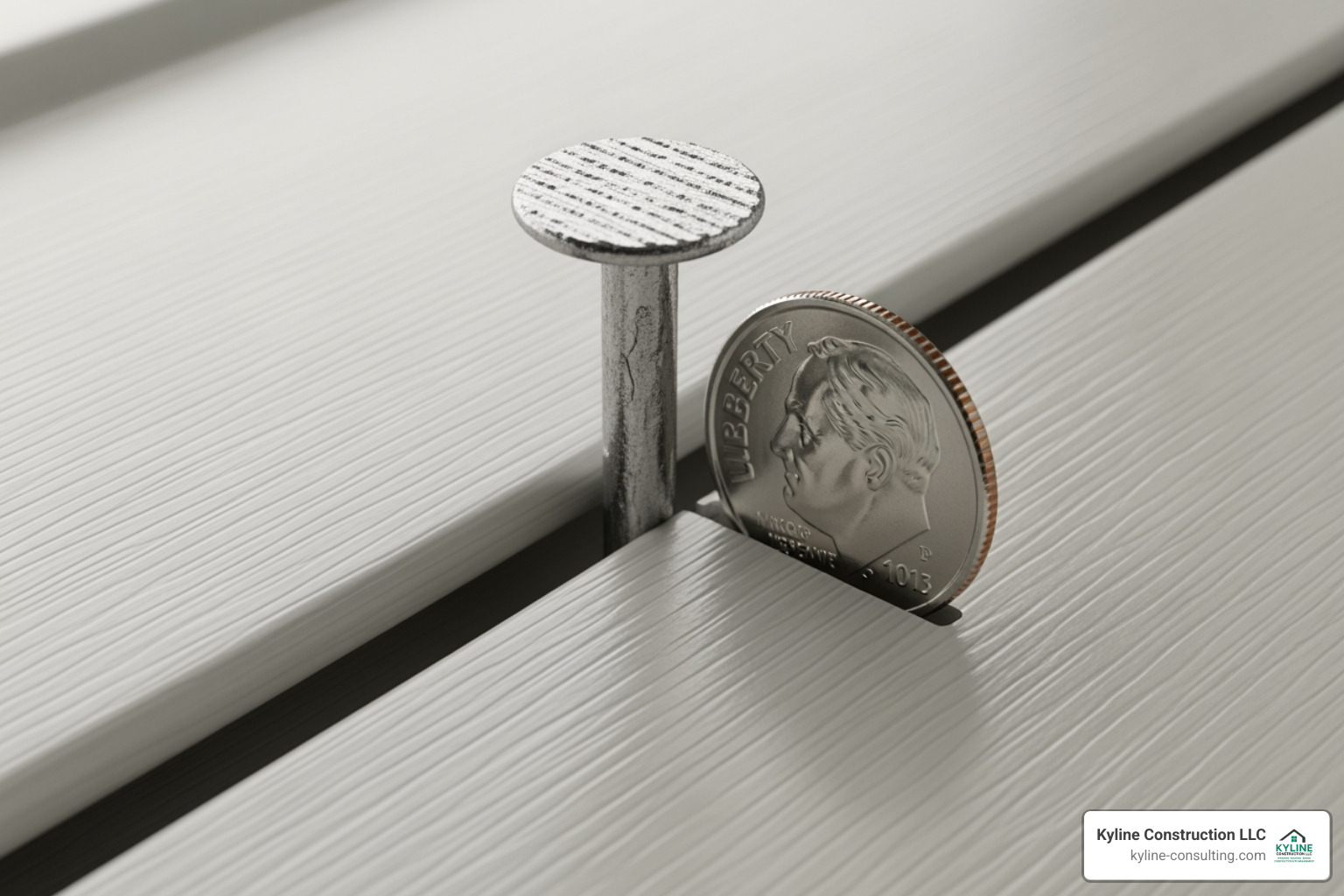
- Nail Head Gap: This is crucial! Never drive the nail head tight against the vinyl. Leave a small gap – about 1/16 inch to 1/8 inch, or roughly the thickness of a dime or nickel – between the nail head and the corner post. This allows the vinyl to slide freely underneath the nail as it expands and contracts.
Splicing Corners on Multi-Story Walls
Sometimes, a single 10-foot or 12-foot corner post isn’t long enough for a tall wall, especially on multi-story homes common in Columbus, Ohio. When this happens, we need to splice two pieces together. The key is to do it cleanly and correctly to avoid that “tacky” look mentioned earlier.
- When to Splice: You’ll typically need to splice when your wall height exceeds the standard length of your corner posts (e.g., an 11-foot wall with 10-foot posts).
- Overlapping Pieces: The top piece of the corner post will overlap the bottom piece. To prepare for this, we perform a clever little trick.
- Cutting the Lower Post’s Nailing Flange: On the lower corner piece, measure up about 1 inch from the top of where it will meet the upper piece. Cut away this 1-inch section of the nailing flange on all but the outer face. This creates a clean edge for the upper piece to lay over.
- Overlapping Top Piece: Lap the upper corner piece over the lower one by approximately 3/4 inch.
- Expansion Gap: Crucially, leave a 1/4-inch gap between the end of the upper post and the top of the lower post. This allows for the necessary expansion and contraction. We also try to position these splices in less conspicuous areas, if possible, to maintain the aesthetic appeal.
Mastering Inside Corners and Variations
While outside corners define the exterior edges of your home, inside corners handle the transitions where two walls meet at an inward angle. These require just as much attention to detail for both aesthetics and weather protection.
How to Install Inside Vinyl Siding Corners
Just like their outside counterparts, inside corners need proper flashing and fastening to perform their job effectively. There are a few common methods we employ:
- Dedicated Inside Corner Post: This is often the simplest and most common method. These one-piece posts offer a clean, finished look and provide a channel for the siding panels.
- Installation: Flash the inside corner with water-resistive material first. Position the inside corner post, allowing for the same 1/4 inch (or 3/8 inch for longer posts) top clearance from the eave and extending 3/4 inch below the starter strip. Hang the post by nailing at the top of the uppermost slot, then center subsequent nails in the slots, maintaining that crucial 1/16-inch gap.
- Single J-Channel Method: For a more minimalist look, or when a dedicated inside corner post isn’t available, you can use a single J-channel.
- Installation: Two J-channels are installed back-to-back, one on each wall, with a small gap between them. The siding panels then tuck into these channels. Flashing is particularly important here to ensure water doesn’t penetrate the seam.
- Double J-Channel Method: This involves using two J-channels, one on each side of the inside corner, with a slight overlap.
- Installation: When using two J-channels for an inside corner, we often remove the bottom 3/4 inch of the nailing flange on the inner J-channel to prevent it from showing below the siding. This method can offer a slightly wider and more robust channel for the siding.
- Flashing Importance: Regardless of the method chosen, proper flashing behind the inside corner trim is absolutely critical. Water has a sneaky way of finding its way into any gap, and a well-flashed corner directs it away from the wall structure.
Understanding Different Corner Types
Beyond the basic inside and outside corners, vinyl siding systems offer variations that cater to different aesthetic preferences and installation scenarios. It’s worth understanding the choices available when installing corners on vinyl siding.
| Feature | One-Piece Corner Posts (Inside/Outside) | J-Channel Method (for Inside Corners) |
|---|---|---|
| Appearance | Integrated, uniform, often wider and more pronounced. | Slimmer, can appear more subtle. |
| Ease of Installation | Generally faster and simpler, especially for outside corners. | Requires more precision to ensure a tight, weather-resistant seam. |
| Cost | Can be slightly higher per piece, but saves labor time. | Potentially lower material cost, but higher labor for careful fitting. |
| Versatility | Less versatile; designed for specific corner types. | More adaptable for custom or unusual angles with careful cutting. |
| Weather Protection | Excellent when properly flashed and installed with expansion in mind. | Relies heavily on meticulous flashing and sealing behind the channels. |
| Expansion Allowance | Built-in channels designed to accommodate movement. | Achieved by leaving gaps between J-channels and siding. |
- Pre-assembled vs. Custom-cut Corners:
- Advantages of Pre-assembled: They save time by eliminating the need to measure and cut two separate pieces of trim. They contribute to a cleaner, more polished finished look and are designed for optimal performance. Products like LP® SmartSide® ExpertFinish® Outside Corners, for instance, are pre-assembled and prefinished, making installation faster.
- Disadvantages of Pre-assembled: Less flexibility for non-standard angles or very unique architectural features. Limited in lengths, which can necessitate splicing on taller structures.
- Advantages of Custom-cut (e.g., using J-channel for inside corners): Offers more flexibility for unusual angles. Potentially lower material cost if using standard J-channel.
- Disadvantages of Custom-cut: More labor-intensive, requiring precise cuts and careful flashing to ensure weather-tightness and a good aesthetic.
- Universal Installation Principles: Regardless of the specific corner type or method, several principles remain universal:
- Allow for Movement: Always account for thermal expansion and contraction by nailing loosely and leaving appropriate gaps. This is the cornerstone of successful vinyl siding installation.
- Proper Flashing: Protect the underlying structure from moisture.
- Straight and Plumb: Ensure all corner posts are installed straight and true for a professional finish.
- Manufacturer’s Guidelines: Always consult the specific manufacturer’s installation manual. While universal principles apply, there can be subtle differences. Polymeric Exteriors offers useful insights in their How To Replace Vinyl Siding & Corner Posts | PEPA guide, emphasizing proper installation for longevity.
Avoiding Common Mistakes for a Professional Finish
Even with the best intentions, mistakes can happen. But when installing corners on vinyl siding, common errors can lead to expensive repairs and a less-than-stellar appearance. Our 40+ years of experience in Ohio homes have taught us a thing or two about what not to do, and how to fix it!
Top Mistakes When Installing Corners on Vinyl Siding
- Nailing Too Tightly: This is the absolute cardinal sin of vinyl siding installation. Vinyl expands and contracts. If you nail it tight, you’re pinning it to the wall, which restricts its movement. When temperatures change, the vinyl has nowhere to go, leading to unsightly buckling, waviness, and even cracking. We’ve seen homes in Circleville and Columbus suffer from this during extreme temperature swings.
- Prevention: Always leave that crucial 1/16 to 1/8-inch gap (dime or nickel thickness) between the nail head and the vinyl. Nail in the center of the slots, and for the very first nail at the top of a corner post, use the top of the slot to allow downward movement.
- Forgetting Expansion Gaps: Beyond nailing, vinyl needs room to expand and contract where it butts against other fixed elements, like windows, doors, and other trim. If you don’t leave a gap, the siding will push against these elements, causing buckling or bowing.
- Prevention: Leave a 1/4-inch gap where siding butts against J-channel or other fixed points when the temperature is above 40°F. If installing in colder Ohio weather (below 40°F), increase this gap to 3/8-inch.
- Crooked Installation: A crooked corner post immediately screams “DIY gone wrong.” It throws off the entire aesthetic of the siding.
- Prevention: Always use a long level to ensure your corner posts are perfectly plumb (vertically straight) before fastening. Use chalk lines as guides.
- Improper Splicing: As discussed, splicing is sometimes necessary. But if done poorly, it can be very noticeable and detract from the home’s appearance. An overlap that’s too small, too large, or not properly notched will look messy.
- Prevention: Follow the precise splicing technique: cut 1 inch off the nailing flange of the lower piece, lap the upper piece by 3/4 inch, and leave a 1/4-inch expansion gap. Position splices in less visible areas if possible.
- Skipping Flashing: Flashing is your home’s unsung hero against water damage. Neglecting to properly flash corners is an open invitation for moisture to get behind your siding, leading to wood rot, mold, and structural issues.
- Prevention: Always install water-resistive flashing material (minimum 10 inches on each side) behind both inside and outside corner posts before installation.
- Preventing Waviness: Waviness or “oil canning” in vinyl siding is often a result of nailing too tightly or installing over an uneven substrate. While some slight waviness can be normal, especially when viewing vinyl siding at certain angles (it’s vinyl, not wood!), excessive waviness indicates a problem.
- Prevention: Ensure the underlying wall surface is as smooth and flat as possible. Use furring strips if necessary. Always nail loosely and in the center of the slots. Consistent nailing technique is key.
Ensuring a Clean, Weather-Tight Result
Achieving a clean, aesthetically pleasing, and weather-tight finish is the ultimate goal when installing corners on vinyl siding. It’s the mark of quality craftsmanship.
- Aesthetically Pleasing Finish:
- Staggering Laps: For horizontal siding panels, avoid lining up the vertical seams. Stagger laps horizontally by a minimum of 2 feet, and ensure you don’t “repeat” an overlap vertically for at least 3 courses. This creates a more natural and visually appealing pattern.
- Planning Overlaps: When possible, plan your siding panel overlaps so they face away from high-traffic areas or the primary viewing angles of your home. Work from corners to doors on front walls and from rear to front on side walls.
- Clean Cuts: Use sharp tools for clean cuts. A backward-mounted fine-tooth saw blade or sharp snips will prevent jagged edges that can detract from the finish.
- Long-Term Maintenance: Vinyl siding is renowned for its low maintenance, but “low” doesn’t mean “no.” A little care goes a long way in ensuring your corners (and the rest of your siding) look great for years.
- Annual Inspection: We recommend an annual visual inspection of your siding, paying close attention to corners. Look for any signs of damage, loose panels, or compromised caulking around windows and doors. Catching small issues early prevents them from becoming big problems.
- Cleaning Mildew and Dirt: Over time, dirt, dust, and even mildew can accumulate, especially in shaded areas.
- General Cleaning: A simple garden hose and a soft-bristled brush are often sufficient. For stubborn dirt, a solution of 1/3 cup detergent, 2/3 cup trisodium phosphate (TSP), and 1 gallon of water works wonders.
- Mildew Cleaning: If you spot mildew, substitute 1 quart of 5% sodium hypochlorite (bleach) for 1 quart of water in the general cleaning formula.
- Technique: Always wash from the bottom up, rinsing frequently to prevent streaking. Allow cleaning solutions to stand for several minutes before rinsing thoroughly. Avoid cleaning on days when temperatures are near or below freezing.
Frequently Asked Questions about Installing Vinyl Siding Corners
We often get questions from homeowners in Ohio about the nuances of vinyl siding installation, especially concerning corners. Here are some of the most common ones we hear:
How far should a vinyl corner post hang below the siding?
A corner post should extend approximately 3/4 inch below the bottom edge of the starter strip. This ensures that the siding panels are fully supported and helps to direct any water away from the foundation, preventing moisture buildup at the base of your home.
Do you caulk vinyl siding corners?
No, you should never apply caulk where the siding panels meet the corner post’s receiving channel. That gap is intentionally left open. Vinyl siding is designed to expand and contract with temperature changes, and caulking these channels would restrict that movement. This restriction would lead to buckling, waviness, and potential damage to your siding. The necessary weather-tight seal comes from the proper installation of house wrap and flashing behind the corner post, not from caulking the visible gaps.
How do you overlap two pieces of vinyl corner post?
When a single corner post isn’t long enough for a tall wall, we splice two pieces together. Here’s the recommended method:
- Prepare the lower piece: Measure up approximately 1 inch from the top of where the lower corner piece will meet the upper piece. Cut away this 1-inch section of the nailing flange on all but the outer face. This creates a clean, stepped profile.
- Lap the upper piece: Position the upper corner piece to lap over the prepared lower piece by approximately 3/4 inch.
- Leave an expansion gap: Crucially, leave a 1/4 inch gap between the end of the upper post and the top of the lower post. This allows for the necessary thermal expansion and contraction of the vinyl.
Conclusion
Installing corners on vinyl siding is far more than just attaching trim pieces; it’s an art that combines precision, an understanding of material science, and a keen eye for detail. From meticulous wall preparation and careful measurements to the critical practice of loose nailing and proper splicing, each step contributes to a home exterior that is not only beautiful but also robust and weather-resistant. We’ve seen how these best practices make all the difference, changing a house into a truly protected and aesthetically pleasing home.
For homeowners in Ohio seeking a flawless, professional installation for their siding project, the experienced team at Kyline Construction LLC ensures a durable and beautiful result. With over 40 years of expertise, we bring quality and safety to every job, offering free, no-obligation estimates. Let us put our seasoned craftsmanship to work for your home.