Why Understanding Deck Permits Matters Before You Build
Deck building permits are required when your deck exceeds certain height and size thresholds—typically when it’s more than 18-30 inches above ground, attached to your home, or larger than 108-200 square feet. Most municipalities require permits to ensure your deck meets safety codes, but exact requirements vary by location.
Quick Permit Checklist:
- Height: Permits usually required if deck is >18-30″ above ground
- Size: Often required if area exceeds 108-200 sq ft
- Attachment: Decks connected to your home typically need permits
- Location: Roof decks and environmentally critical areas always require permits
- Cost: Expect to pay $225-$500 for permit fees
- Timeline: Plan for 5-10 business day review periods
So you’ve decided on your deck design and built a project budget. Maybe you’ve even decided on the color and deck materials you like best, and all that’s left to do is purchase the supplies and get started building. But before you break ground, there’s a critical step many Ohio homeowners overlook: obtaining the proper permits.
Building permits aren’t just bureaucratic red tape. They’re your protection—ensuring your deck is structurally sound, meets safety codes, and won’t create problems when you sell your home or file an insurance claim. Since most decks connect to a home, you’ll likely need a building permit (and potentially a zoning permit too) for a new or replacement deck.
The consequences of skipping this step can be severe. Cities can find unpermitted work through neighbor reports, property tax assessments, or future inspections. You could face fines, lawsuits, or even be asked to demolish the structure. Homeowners are liable for any damages from faulty construction, and homeowners insurance may not cover costs for unpermitted work. Lenders may not approve mortgages for homes with unpermitted work, making resale difficult.
The good news? Understanding the permit process doesn’t have to be complicated. Whether you’re planning a simple ground-level deck or an liftd outdoor living space, knowing when you need a permit, what documentation is required, and how the inspection process works will save you time, money, and headaches down the road.
Why a Deck Permit is Your Project’s Foundation
When we talk about deck building permits, we’re not just discussing paperwork; we’re talking about the very foundation of a safe, legal, and valuable home improvement project. A building permit is an official authorization issued by your local government agency (like your city’s building department or county’s planning office) that allows you or your contractor to proceed with a construction project, ensuring it complies with local building codes, zoning laws, and safety standards.
Why is this so important? First and foremost, permits ensure safety. Building codes are developed to protect public health, safety, and general welfare. They dictate everything from the size of your deck’s joists and beams to the depth of its footings and the height of its railings. Without a permit, there’s no guarantee your deck meets these crucial safety standards, potentially putting your family and guests at risk.
Beyond safety, permits ensure legal compliance. Building without one can lead to significant legal headaches. It also impacts your home’s insurance coverage and its resale value. Imagine trying to sell your beautiful home, only to find out the deck you poured your heart into was built illegally!

The Risks of Building Without a Permit
We’ve all heard stories, or perhaps even joked, about “just building it” without bothering with permits. But the reality of building a deck without a permit is far from amusing. The consequences can range from inconvenient to financially devastating:
- Fines and Penalties: Your local municipality in Ohio (be it Circleville, Columbus, or Pickaway County) can impose hefty fines for unpermitted construction. These aren’t just one-time fees; they can be daily penalties until the issue is resolved.
- Stop-Work Orders: If finded during construction, a building inspector can issue a stop-work order, halting your project immediately. This means delays, potential material spoilage, and additional costs.
- Forced Demolition: In the worst-case scenario, if your unpermitted deck is deemed unsafe or in violation of zoning laws, you could be ordered to demolish it at your own expense. Ouch!
- Homeowner Liability: If someone is injured on your unpermitted deck, you, the homeowner, could be held personally liable. Homeowners insurance often won’t cover accidents on structures built without proper permits or inspections.
- Voided Insurance Claims: Speaking of insurance, if your deck is damaged by a storm or fire, your insurance company might deny your claim if they find it was built without a permit.
- Difficulty Selling Your Home: When it comes time to sell, unpermitted additions are a major red flag for potential buyers and their lenders. They can delay or even derail the sale, as buyers will often demand that permits be obtained retroactively (which can be a complicated and expensive process) or that the structure be removed.
Protecting Your Investment
For us at Kyline Construction LLC, we believe your deck is an investment in your home and lifestyle. Obtaining the necessary deck building permits is how we protect that investment.
- Ensuring Structural Integrity: The permit process requires detailed plans to be reviewed by experts, ensuring your deck’s design and materials are appropriate for the load it will bear and the local climate conditions in Ohio.
- Verifying Contractor Work: For homeowners who hire a contractor, permits provide an extra layer of accountability. Inspectors will check that the work is being done according to the approved plans and codes. This is why we always handle the permit process for our clients, ensuring everything is above board.
- Peace of Mind: Knowing your deck is safe, legal, and up to code provides invaluable peace of mind. You can enjoy your outdoor space without worry, and rest assured that it adds real value to your home.
We take pride in our precision craftsmanship and our commitment to quality and safety. If you’re looking for experienced professionals to build or renovate your deck in Ohio, we’re here to help. Learn about our professional deck services and how we ensure every project is built to last and compliant with all regulations.
When is a Building Permit Required for a Deck?
This is the million-dollar question, and the answer, like a good Ohio summer day, can vary! While there are general guidelines, the exact requirements for deck building permits depend heavily on your specific municipality in Ohio. What applies in Columbus might differ slightly from Circleville or Pickaway County. This is why our first piece of advice is always: check with your local building department.
Many municipalities often require permits for renovations that change a home’s size or structure, or change its electrical or plumbing. Since most decks connect to a home, you’ll likely need a building permit (and potentially a zoning permit too) for a new or replacement deck.
Height and Size Thresholds
The most common triggers for a deck building permit are the deck’s height above the adjacent ground and its overall size. While specific thresholds vary, many municipalities across the country and in Ohio look at these factors:
Height Above Grade:
- A permit is often required for decks that are more than 18 inches above the ground.
- We also frequently see requirements for decks more than 30 inches above the ground.
- Some codes specify a permit is needed for decks that are more than 600 mm (approximately 24 inches) above the adjacent grade, especially if the deck is adjacent to or attached to the house.
- Even liftd decks providing principal access to a building often require a permit, regardless of their walking surface area.
Total Deck Area:
- A permit might be required for decks that are independent from the house (freestanding decks) if they have a walking surface greater than 10 square meters (approximately 108 square feet) in area, and their walking surface is more than 600 mm (24 inches) above the adjacent grade.
- Some regulations state that low-lying island decks that aren’t attached to a structure, are fewer than 200 square feet, and under 30 inches above grade may not need a permit. However, this is a “may not,” not a “will not,” so it’s always best to verify locally.
Location and Structural Factors
Beyond height and size, several other factors can trigger the need for a deck building permit:
- Attachment to House: Decks attached to the house almost always require a permit due to the structural implications and potential for water intrusion if not properly flashed and secured.
- Roof Decks: If you’re planning a deck on top of part of your building (a roof deck), a permit will definitely be required. This often falls under an “addition or alteration construction permit” due to the complex structural considerations.
- Environmentally Critical Areas (ECAs): If your property is located in an environmentally critical area (e.g., landslide-prone or flood-prone areas), a permit will be required, and the application process will likely be more involved, potentially requiring professional engineering assessments. While Ohio might not have the same ECAs as Seattle, similar environmental considerations can exist in certain areas.
- Property Line Setbacks: Your deck’s proximity to property lines is a significant zoning concern. For example, if your deck is more than 18 inches above the ground, some regulations state you can’t build it within 20 feet of the front property line, or within 5 feet of either side property line in neighborhood residential zones. Similar rules apply to rear property lines. These setback requirements are crucial in Ohio as well, and vary by local zoning ordinances.
- Lot Coverage Percentage: In many areas, structures count towards a maximum allowable “lot coverage” percentage. If your deck is more than 36 inches above the ground, it often counts toward this percentage, which can limit the overall size of structures on your property. This is another area where local Ohio zoning laws will have specific numbers.
For comprehensive guidance on these structural and zoning provisions, we always recommend consulting the official regulations. For our Ohio clients, a great resource to understand the foundational requirements for deck construction is the 2019 Residential Code of Ohio for decks. This document provides crucial information on joist size, beam size, foundation requirements, guard requirements, and more, which forms the basis of local compliance in Columbus, Circleville, and surrounding areas.
Your Step-by-Step Guide to Getting Deck Building Permits
Navigating the permit application process might seem daunting, but it’s a straightforward series of steps once you know what to expect. Think of it as a roadmap to a successful and compliant deck project.
Gathering Your Documentation
When applying for deck building permits, the local building department will require several key documents to review your project’s scope and ensure it meets code. While the specifics can vary slightly between Columbus, Circleville, or Pickaway County, here’s a general list of what you’ll typically need:
- Application Form: The official request for a permit. This will ask for property details, owner information, and a description of the proposed work. While you’ll need your local Ohio form, you can view an example of what a comprehensive form looks like with this Application for a Permit to Construct or Demolish from Ontario.
- Site Plan: A bird’s-eye view of your property showing the deck’s location relative to your house, property lines, and other structures.
- Deck Construction Plans: Detailed drawings outlining the deck’s structural components, dimensions, and materials.
- Materials List: A specification of the materials you plan to use for framing, decking, railings, and fasteners.
- Contractor Information: If you’re hiring us, we’ll provide our licensing and insurance details. If you’re doing it yourself, you might need to sign an owner-builder affidavit.
- Professional Stamps: For complex designs, decks in environmentally sensitive areas, or very high decks (e.g., more than 8 feet above ground or with long beams), engineering calculations or architectural stamps may be required.
Creating Your Deck and Site Plans
This is where the rubber meets the road, or rather, the pencil meets the paper! Accurate and detailed plans are crucial for a smooth permit approval process.
Site Plan Requirements: Your site plan should be drawn to scale and include:
- Property lines and dimensions.
- Location of existing buildings and other structures on your lot.
- The proposed location and dimensions of your new deck.
- Distances (setbacks) from the deck to property lines and existing structures.
- Easements, utilities (like septic systems or wells), and significant trees.
- A summary of zoning provisions that apply to your property, such as lot area, allowable coverage, and grade elevations.
Deck Plan Details: These are the blueprints for your deck’s construction. They should be legible, drawn to a conventional scale, fully dimensioned, and include:
- Footings: Size, spacing, depth (typically below the frost line in Ohio), height above grade, and frost protection details.
- Columns/Posts: Sizes, locations, and connections.
- Beams: Sizes, locations, spans, and connections to posts.
- Joists: Sizes, spacing, spans, and connections to beams and the ledger board (if attached to the house).
- Decking: Type of material and fastening methods.
- Railings/Guards: Height, post spacing, picket spacing (typically no more than 4 inches), and attachment details.
- Stairs: Rise, run, tread depth, width, stringer details, and handrail height and fastening.
- Installation Notes: Specific instructions for ledger board attachment, flashing details, and other critical construction methods.
To give you an idea of what a detailed plan looks like, you can refer to this checklist and sample plan provided by the City of Ottawa. While it’s not for Ohio, it illustrates the level of detail your local Ohio building department will expect.
Understanding Costs, Timelines, and Contractor Roles
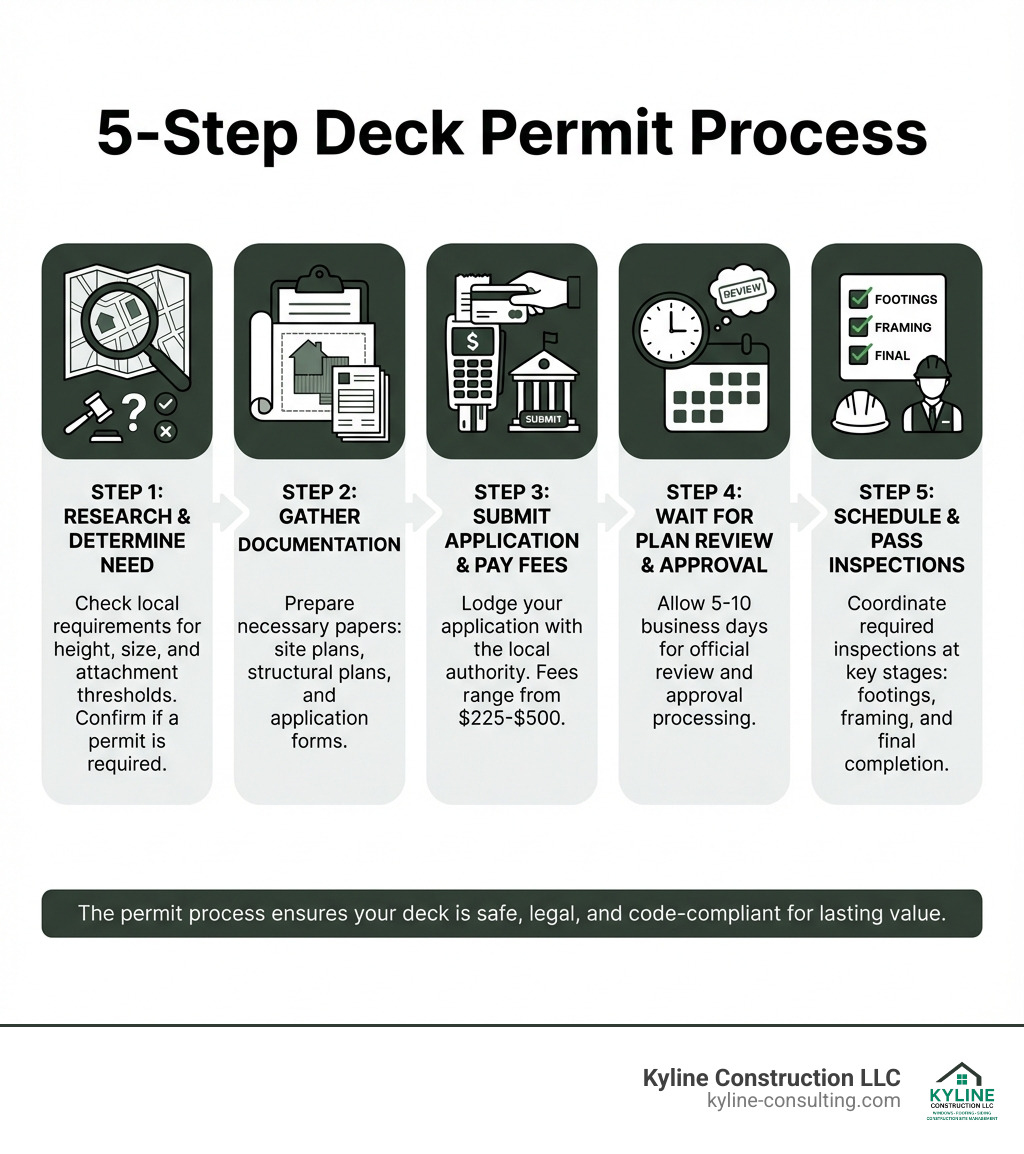
- Typical Permit Costs: We understand that every dollar counts in a home improvement project. Permit costs vary, but you can plan to spend between $225 and $500 to pull permits for a new deck. These fees cover the administrative costs of reviewing your application and performing inspections.
- Application Review Timeline: Once we submit a complete application, the review timeline can typically range from 5 to 10 business days. However, if plans are incomplete or require corrections, this timeline can extend. Promptly addressing any “checksheets” or requests for additional information from the building department is key to keeping the process moving.
- How a Contractor Simplifies the Process: This is where partnering with experienced professionals like us at Kyline Construction LLC really pays off. We handle the entire deck building permit process for you, from preparing detailed plans to submitting the application and scheduling inspections. Our 40+ years of experience mean we’re familiar with the specific requirements of Columbus, Circleville, and Pickaway County. We ensure all documentation is accurate and complete, minimizing delays and ensuring compliance. This allows you to focus on the exciting parts of your project, while we manage the complexities.
To learn more about how we manage all aspects of your home improvement project, including the permit process, please visit our page on Project Management.
From Permit to Completion: The Inspection Process
Obtaining the deck building permits is just the first step. The permit also outlines a series of mandatory inspections that must occur at various stages of construction. These inspections are critical checkpoints to verify that the work is progressing according to the approved plans and meets all local building codes.
The inspector’s role is to ensure your deck is safe and structurally sound. We ensure the inspector has access to the construction site and that the approved plans are always available on-site for their review.
Key Inspection Stages
While the exact number and type of inspections can vary, most deck projects in Ohio will involve these key stages:
- Footing and Post-Hole Inspection: This is typically the first inspection and must occur before any concrete is poured into the post holes. The inspector will verify that the holes are dug to the correct depth (below the frost line), are the specified diameter, and are free of organic matter or loose debris. This ensures your deck’s foundation is solid and won’t shift over time.
- Framing Inspection: This inspection happens after the entire deck frame is built but before any decking boards are installed. The inspector will check the size, spacing, and connections of your joists, beams, posts, and ledger board attachment. They’ll also verify any required blocking, bracing, and the overall structural integrity of the frame. Any stairs and railings (guards) that are part of the structural frame will also be inspected at this stage.
- Final Inspection: Once the deck is completely finished—decking, railings, stairs, and any other approved features are installed—the final inspection takes place. The inspector will ensure everything is built according to the approved plans, guards and handrails meet height and spacing requirements, and all safety features are in place. Only after passing this final inspection will your permit be officially closed out.
Passing Your Inspections
To ensure a smooth inspection process, we always adhere to a few best practices:
- Approved Plans On-Site: Always have a copy of the approved deck building permits and plans readily available at the construction site. Inspectors will refer to these documents.
- Addressing Corrections: If an inspector identifies any issues or “corrections” that need to be made, we address them promptly. We’ll then schedule a re-inspection to confirm the corrections have been properly implemented.
- Scheduling Inspections: It’s important to schedule inspections with sufficient notice—typically 24 to 48 hours in advance, depending on your local building department’s requirements. We handle all scheduling to ensure timely inspections and keep your project on track.
Once all inspections are passed, your permit will receive final sign-off, confirming your new deck is fully compliant and ready for years of enjoyment!
Frequently Asked Questions about Deck Permits
We often hear similar questions from homeowners in Columbus, Circleville, and Pickaway County regarding deck building permits. Here are some of the most common ones:
Do I need a permit to repair or resurface my existing deck?
Generally, simple repairs like replacing a few rotten deck boards or swapping out individual railing pickets with identical ones usually do not require a permit. However, if your repair project involves:
- Structural Changes: Replacing significant structural elements like joists, beams, or posts.
- Expanding the Deck Footprint: Making the deck larger in any dimension.
- Changing the Deck’s Height: Raising or lowering the deck.
- Replacing Railings with a Different Style: Especially if it affects safety or code compliance (e.g., changing from solid panels to pickets, which might alter spacing requirements).
… then you will likely need a deck building permit. When in doubt, it’s always safest to check with your local building department.
What happens if I bought a house with an unpermitted deck?
Finding an unpermitted deck after purchasing a home can be a sticky situation. During the home-buying process, sellers are typically required to disclose any unpermitted work. If it wasn’t disclosed, you might have legal recourse against the previous owner.
However, as the current homeowner, the responsibility for compliance ultimately falls to you. You might need to:
- Obtain Retroactive Permits: This often involves submitting “as-built” plans (drawings of the deck as it exists) and undergoing inspections. If the deck doesn’t meet current code, you might be required to modify or even partially rebuild it.
- Face Potential Removal: In rare cases, if the deck poses a significant safety hazard or cannot be brought up to code, you might be ordered to remove it.
This is why we emphasize the importance of permits upfront – it avoids these headaches for future homeowners (and for you, should you ever sell!).
How do I find my local deck permit requirements?
Finding the specific deck building permits requirements for your Ohio home is crucial. Here’s how we recommend you proceed:
- City or County Building Department Website: Most cities and counties have dedicated sections on their official websites for building permits.
- For those in Pickaway County, you’ll want to check the Building Department – Pickaway County, Ohio.
- If you’re in Circleville, the Planning & Zoning – City of Circleville page is a good starting point.
- For Columbus residents, the Commercial and Mixed Use Building Permits – City of Columbus, Ohio page can provide general permit information, and specific deck requirements are often detailed in separate documents, such as the [PDF] Department of Building & Zoning Services DECK REQUIREMENTS .
- Contact a Local Permit Technician: If you can’t find clear answers online, don’t hesitate to call your local building department directly. They have staff dedicated to answering permit-related questions. Having your property address and a general idea of your project (e.g., “I want to build a 12×16 foot liftd deck attached to my house”) will help them guide you.
Local regulations are designed to keep you and your property safe. A quick call or visit to the website can save you a lot of trouble down the line.
Conclusion
Understanding and obtaining deck building permits might seem like an extra step in your home improvement journey, but as we’ve explored, it’s a non-negotiable part of building a safe, compliant, and valuable deck. From ensuring structural integrity and protecting your investment to avoiding costly fines and legal troubles, permits are truly your project’s foundation.
At Kyline Construction LLC, we bring over 40 years of experience to every project, changing Ohio homes with precision craftsmanship in siding, windows, and decks. We believe in transparent processes and meticulous attention to detail, especially when it comes to navigating local regulations in Circleville, Columbus, and Pickaway County. Our commitment to quality and safety means we handle all aspects of the permit process, ensuring your new deck not only looks fantastic but also stands the test of time, fully compliant with every code.
For a seamless and compliant home improvement project, explore our expert Services. We’re here to turn your outdoor living dreams into a safe and stunning reality.