Why Federal Window Assistance Matters for Ohio Homeowners
If you’re searching for a federal window replacement program application, here’s what you need to know right away:
Quick Answer: How to Apply for Federal Window Assistance
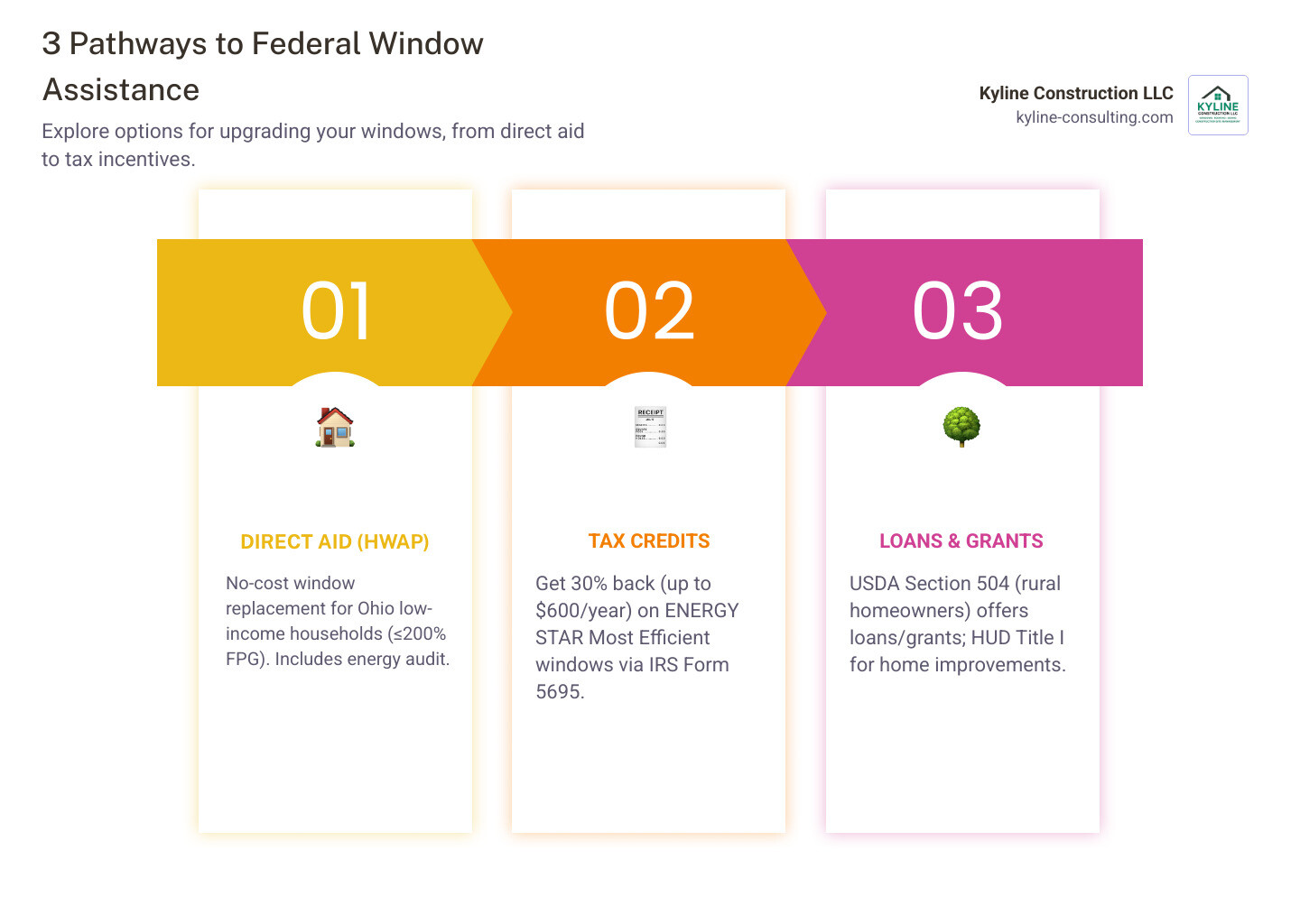
- For Direct Assistance (No-Cost): Apply through Ohio’s Home Weatherization Assistance Program (HWAP) if your household income is at or below 200% of federal poverty guidelines
- For Tax Credits (DIY): Purchase ENERGY STAR Most Efficient certified windows and claim 30% back (up to $600/year) using IRS Form 5695 when you file taxes
- For Rural Homeowners: Check eligibility for USDA Section 504 loans/grants at USDA’s eligibility site
Let’s be honest: replacing old, drafty windows in your Central Ohio home isn’t cheap. A full window replacement project can easily run $400 to $900 per window, which adds up fast when you’re looking at your whole house. That’s why so many homeowners are looking for help through federal programs.
The good news? There are legitimate federal programs that can help you upgrade your windows. The challenge is that there isn’t one single “federal window replacement program.” Instead, there are several different paths you can take, depending on your income, where you live, and whether you’re looking for direct assistance or tax incentives.
The reality is this: some programs will cover the full cost of your window replacement if you qualify (like Ohio’s HWAP). Others give you money back after you’ve already paid for the work (like the federal tax credit). And some are actually loans that need to be repaid. Understanding which program fits your situation is the most important first step.
I’m Shawn, and I’ve spent my entire career in construction here in Central Ohio. Over the years, I’ve helped countless homeowners steer the confusing world of the federal window replacement program application process, from understanding eligibility requirements to ensuring their new windows meet the strict energy efficiency standards these programs require.
Understanding the Main Federal Programs for Window Upgrades
When we talk about a “federal window replacement program,” it’s crucial to understand that it’s more of a collection of opportunities than a single, unified program. Each option has its own set of rules, benefits, and application processes. We’ll break down the three main types of federal assistance that can make your window upgrade project more manageable.
The Weatherization Assistance Program (WAP): Direct Help for Ohio Households
For many low-income families in Central Ohio, the Weatherization Assistance Program (WAP) is a game-changer. Ohio’s version of this program is aptly named the Home Weatherization Assistance Program, or HWAP. This isn’t just a window program; it’s a “whole-home” approach to make your house more energy-efficient, safer, and more comfortable. Think of it as a comprehensive health check-up for your home’s energy performance.
How does it work? An expert will perform a thorough energy audit to see what your home needs most. This isn’t a quick glance; it’s a computerized assessment that includes things like a blower-door test to measure air infiltration. Based on this audit, a scope of work is determined, which could include crucial upgrades like insulation, air sealing, or, yes, new windows. For those who qualify, these services are provided at no cost. The goal is to reduce your energy bills by 25-40%, with potential average annual savings of around $960 on energy costs. It’s truly the largest residential energy conservation program in the country, and it can make a real difference in your monthly budget and home comfort.
To learn more about this vital program and how it can help you, we encourage you to visit the official Ohio Development Services Agency page: Learn more about Ohio’s HWAP.
The Energy Efficient Home Improvement Tax Credit: A DIY Incentive
This is perhaps the most common way for homeowners to get some federal assistance for their window upgrades. Thanks to the Inflation Reduction Act of 2022, you can get a federal income tax credit for installing new, energy-efficient windows. It’s important to understand the distinction here: this isn’t a grant that gives you money upfront; it’s a credit that reduces the amount of tax you owe when you file your annual federal income tax return.
The credit covers 30% of the product costs for qualifying windows and skylights, up to a maximum of $600 annually. This means if your new windows cost $2,000, you could get a $600 credit. If they cost $1,000, you’d get $300. This incentive is effective for products purchased and installed between January 1, 2023, and December 31, 2032. The total annual limit for all efficiency tax credits in one year is $3,200, with a specific total limit of $1,200 for home envelope improvements like windows, doors, skylights, insulation, and electrical components. It’s a fantastic way to make a smart home investment more affordable over time.
For detailed information and to see if your potential window upgrades qualify, you can check the FAQs about Energy Star tax credits: See FAQs about Energy Star tax credits. And if you’re considering making the jump to energy-efficient windows, our team at Kyline Construction is ready to help you explore your options: Our energy-efficient window services.
Other Financial Assistance: USDA and HUD Loans
For some Central Ohio homeowners, particularly those in rural areas, other federal loan programs can provide crucial financial assistance for home repairs and improvements, including window replacement.
One significant program is the USDA Section 504 Home Repair program. This initiative offers loans to very-low-income homeowners to repair, improve, or modernize their homes. Loans are typically for 20 years at a fixed 1% interest rate, with a maximum of $40,000. What’s even better is that elderly, very-low-income homeowners (age 62 or older) can also qualify for grants up to $10,000 specifically to remove health and safety hazards. These grants don’t need to be repaid, unless the property is sold within three years. This program is specifically for eligible rural areas, so it’s worth checking if your property qualifies.
Additionally, the Department of Housing and Urban Development (HUD) offers programs like Title I property improvement loans. These loans can help you finance property repairs or improvements. Another option is the FHA 203(k) mortgage insurance, which allows home buyers or homeowners to borrow an extra $35,000 through their mortgage for home repairs and improvements. While these aren’t direct “free money” programs, they provide pathways to finance necessary upgrades.
To find out if your Central Ohio address is in an eligible rural area for USDA programs, you can use their convenient online tool: Check if your address is in an eligible rural area.
Step-by-Step: The Federal Window Replacement Program Application Process

Now for the “how-to.” The application process is completely different depending on which path you take. Applying for HWAP is a formal process that involves income verification and home assessments, while claiming a tax credit is something you do when you file your taxes, much like any other deduction or credit.
Your federal window replacement program application for Ohio’s HWAP
The process for HWAP in Ohio involves a few key steps. It’s not always a quick process, but it’s thorough and designed to provide the most benefit to your home.
- Find Your Local Provider: The first step is to locate your local HWAP provider in Central Ohio. These are typically community action agencies or non-profit organizations that administer the program on behalf of the state. You can find their contact information and apply through the Ohio Development Services Agency website: Find your local Ohio HWAP provider to apply.
- Submit Your Application: You’ll need to fill out an application form, which can often be done online or submitted via mail.
- Gather Required Documents: This is where attention to detail pays off. You’ll need to provide several documents to prove your eligibility. While specific requirements can vary slightly by local agency, generally, you’ll need:
- Proof of income for the last 30 days for all adult household members.
- A copy of recent utility bills (heating and electric).
- Proof of home ownership (such as a property tax bill, deed, or mortgage statement).
- Photo IDs for all adults in the household.
- Social Security cards for all household members.
- Bank statements (most recent).
- Proof of homeowner’s or renter’s insurance.
- The Energy Audit: Once your application is reviewed and you’re deemed eligible, your local HWAP provider will schedule an energy auditor to visit your home. This professional will conduct a comprehensive assessment, often including a blower-door test to identify air leaks. They’ll analyze your home’s energy usage and determine the most cost-effective energy conservation measures. If new windows are deemed a priority for improving your home’s energy efficiency, they will be included in the recommended scope of work.
- Work Completion and Inspection: After the audit, a work crew or contractor will be assigned to perform the approved weatherization services, which could include window replacement. Once the work is completed, a local HWAP inspector will review everything to ensure it meets program standards and that all equipment is operating safely. Your health and safety are paramount throughout this process.
How to Claim the Energy Efficient Window Tax Credit
Unlike the HWAP, there’s no traditional “application” for the federal tax credit. The process is simpler and largely depends on you making the right purchases and keeping excellent records.
- Purchase Qualifying Windows: This is the most crucial step. Your new exterior residential windows or skylights must meet the ENERGY STAR Most Efficient criteria for your climate zone in Central Ohio. For installations on or after January 1, 2025, there are additional requirements: manufacturers must be registered with the IRS as a Qualified Manufacturer, and you’ll need to include a Product Identification Number (PIN) from the manufacturer on your tax return. Our team at Kyline Construction can help you select windows that meet these stringent requirements.
- Keep All Receipts: Save your purchase receipts and records of installation costs. The credit is only for the product cost, not labor.
- Save Manufacturer Certification Labels: It’s wise to keep the ENERGY STAR labels and any National Fenestration Rating Council (NFRC) labels that come with your new windows. These documents serve as proof that your windows meet the necessary energy efficiency standards.
- File IRS Form 5695 with Your Taxes: When you file your federal income taxes for the year your windows were installed, you’ll use IRS Form 5695, Residential Energy Credits, to claim the credit. You don’t need to submit your receipts or labels with your tax return, but keep them in your records in case the IRS has questions later.
Are You Eligible? Qualifying for Window Replacement Assistance
Eligibility is the most important factor in accessing any of these programs. The requirements for direct assistance programs like Ohio’s HWAP are quite strict, focusing on income and household needs, while the tax credits are generally open to almost any homeowner who installs qualifying products.
Who is eligible for the federal window replacement program?
For Ohio’s HWAP, eligibility primarily revolves around household income. Your household income must be at or below 200% of the federal poverty guidelines, or sometimes 60% of the State Median Income (SMI), whichever is higher. We know these numbers can be a bit confusing, but your local HWAP provider can help you determine if you meet the specific thresholds for Central Ohio. You may also be automatically income-eligible if someone in your home receives assistance from other programs, such as the Low Income Home Energy Assistance Program (LIHEAP) or Supplemental Security Income (SSI). Priority for services is often given to households with older adults (over 60), individuals with disabilities, or families with young children.
For the Energy Efficient Home Improvement Tax Credit, the eligibility criteria are much broader. You simply need to own an existing home in the U.S. that you use as your primary residence. Renters can even claim credits for eligible improvements they make to a home they occupy as their principal residence. However, landlords cannot claim these credits for properties they rent out but do not reside in themselves. The key is that the improvements are made to your main home.
If you’re curious about other ways we can help improve your home beyond just windows, please explore our full range of services: More about our services.
What types of windows are eligible for replacement under the program?
This is a critical detail, as not all windows qualify for every program.
For Ohio’s HWAP, the eligibility of windows for replacement is determined by the energy auditor. They will assess your existing windows and consider if new, energy-efficient windows are a cost-effective measure to improve your home’s overall energy performance. The program’s goal is to maximize energy savings, so if sealing leaks and adding insulation provide more bang for the buck, those might be prioritized. If your windows are truly inefficient and a major source of energy loss, they would likely be included.
For the federal Energy Efficient Home Improvement Tax Credit, the rules are very specific: your new exterior residential windows or skylights must meet the ENERGY STAR Most Efficient certification criteria. This is a higher standard than basic ENERGY STAR certification. The eligibility also depends on the climate zone where your home is located in Central Ohio. You can use the ENERGY STAR website to find your climate zone and check for eligible products. Look for windows with a good National Fenestration Rating Council (NFRC) label, which provides performance ratings like U-factor and Solar Heat Gain Coefficient (SHGC). These numbers are what determine if a window meets the “Most Efficient” criteria for our specific region.
The Nitty-Gritty: Costs, Benefits, and Timelines

Let’s talk about the real-world impact. What are the true benefits of these programs, what will they cost you, and how long does it all take? As Shawn, I’ve seen the difference new windows can make for families in Circleville, Columbus, and across Ohio.
What are the benefits of participating in a federal window replacement program?
The number one benefit, and often the driving force for homeowners, is lower energy bills. With new, energy-efficient windows, you could see savings of 25-40% on your heating and cooling costs. That’s a potential average annual saving of $960 on your energy bills! Imagine what you could do with that extra money.
But it’s not just about savings; it’s also about comfort. Old, drafty windows can make your home feel unevenly heated or cooled, forcing your HVAC system to work overtime. New windows eliminate those annoying drafts and help keep your home’s temperature stable year-round, making every room more enjoyable. This improved comfort can also extend the life of your heating and cooling systems, as they won’t have to cycle as frequently.
Beyond comfort, there are significant health and safety benefits. By reducing moisture and preventing condensation, new windows can help deter mold growth, contributing to a healthier indoor environment. They also often provide better sound insulation, creating a quieter, more peaceful home. And let’s not forget curb appeal! Modern, energy-efficient windows can dramatically boost your home’s aesthetic appeal and increase its market value. It’s a win-win situation.
To see some of the changes we’ve helped create for our clients, check out our articles and FAQs: See our past projects.
Are there any costs associated with these programs?
This is a crucial question, and the answer varies depending on the program.
To be clear: Ohio’s HWAP services are provided at no cost to eligible homeowners. If you qualify for this program, the energy audit, materials, and installation of approved measures (including windows if deemed necessary) are covered. This is truly direct assistance designed to help low-income households.
For the federal Energy Efficient Home Improvement Tax Credit, you pay the full cost of your new windows upfront. So, if you’re looking at a project that costs, say, $4,500 for five new windows ($900 each), you’ll pay that initially. Then, when you file your taxes, you can claim a credit for 30% of the product cost, up to $600. It’s an incentive to encourage energy-efficient upgrades, not a free ride. It helps offset the cost, but it requires that initial investment.
As for the USDA and HUD loan programs, these are financial products that require repayment. While they offer favorable terms (like the 1% fixed interest rate for USDA Section 504 loans), they are not free money and come with obligations. Grants from the USDA Section 504 program are the exception, but they are specifically for elderly, very-low-income homeowners to address health and safety hazards.
What is the timeline for the window replacement process?
Patience is definitely a virtue when dealing with government assistance programs like Ohio’s HWAP. From the moment you submit your federal window replacement program application to the completion of the work, the process can take several months or even longer due to high demand and the various steps involved (application review, scheduling an audit, waiting for materials, contractor availability, and final inspection). While this might seem like a long wait, the benefit of no-cost services often makes it worthwhile for those who qualify.
The tax credit path, on the other hand, moves at your speed. Once you decide to purchase qualifying windows and hire a contractor like us, the project can be done in a matter of days or weeks, depending on the scope of work and window availability. The timeline for receiving your financial benefit is tied to when you file your taxes.
Sometimes, waiting just isn’t an option, especially if you have a broken or severely damaged window. For immediate needs, we also offer Emergency Repair Services to help homeowners in a pinch.
Frequently Asked Questions about Federal Window Programs
Navigating federal assistance can bring up a lot of questions. Here are some of the most common ones we hear from homeowners in Central Ohio.
Is there really a program for free windows for seniors?
While there isn’t a specific federal program titled “Free Windows for Seniors,” programs like Ohio’s HWAP often give priority to households with members who are over 60 years old. This means that while eligibility is still income-based, seniors may move up the waiting list for services. Additionally, the USDA Section 504 program, which we discussed earlier, offers grants (that don’t need to be repaid) specifically to elderly, very-low-income homeowners to remove health and safety hazards. If a hazardous window issue (like a broken pane that can’t be safely repaired) falls under that category, it could potentially be covered.
Can I get a tax credit for windows I install this year?
Absolutely! The Energy Efficient Home Improvement Credit, established by the Inflation Reduction Act, is available for windows purchased and installed between January 1, 2023, and December 31, 2032. So, if you install qualifying windows this year, you can claim the credit on your taxes for this year (filed next year). Just remember the annual limit for windows and skylights is $600. If you have a large project and are replacing many windows, you might consider splitting the installation across two different tax years. For example, if your product costs exceed $2,000, you could install some this year and some next year, potentially claiming the $600 credit twice. This is a smart strategy to maximize your federal tax savings over time.
Where can I find more information or assistance?
The best places for official and up-to-date information are always government websites. For direct assistance through Ohio’s Home Weatherization Assistance Program, start with the Ohio Development Services Agency. They can connect you to your local HWAP provider.
For details on the federal tax credit, you can visit the ENERGY STAR website, which also has a fantastic ENERGY STAR’s Rebate Finder tool. This can help you find not only federal tax credits but also potential state and local rebates or utility incentives available in Central Ohio, which can further reduce your project costs. We always recommend checking all available avenues for savings!
Upgrade Your Home with Confidence
Navigating these federal programs and understanding the nuances of the federal window replacement program application process can feel overwhelming, but the potential savings on your energy bills and the improvement in your home’s comfort are well worth the effort.
The most important step, no matter which path you choose, is to ensure you’re installing high-quality, energy-efficient windows that are installed correctly by experienced professionals. We’ve seen it all, and a poorly installed window, no matter how energy-efficient it claims to be, will never perform as it should.
The team at Kyline Construction has been helping Central Ohio homeowners for over 40 years. We pride ourselves on precision craftsmanship and ensuring quality and safety in every project. We know what it takes to do the job right and to help you select products that meet the strict standards required by these federal programs. If you’re ready to upgrade your home with new, energy-efficient windows, we’re here to help you choose the right products and transform your home. We even offer free, no-obligation estimates.
Ready to take the next step towards a more comfortable and energy-efficient home? Contact Us today to discuss your window replacement needs and Explore our energy-efficient windows. We look forward to helping you seal the deal on your home’s energy future!