
How Much Can Energy-Efficient Storm Windows Actually Save You?
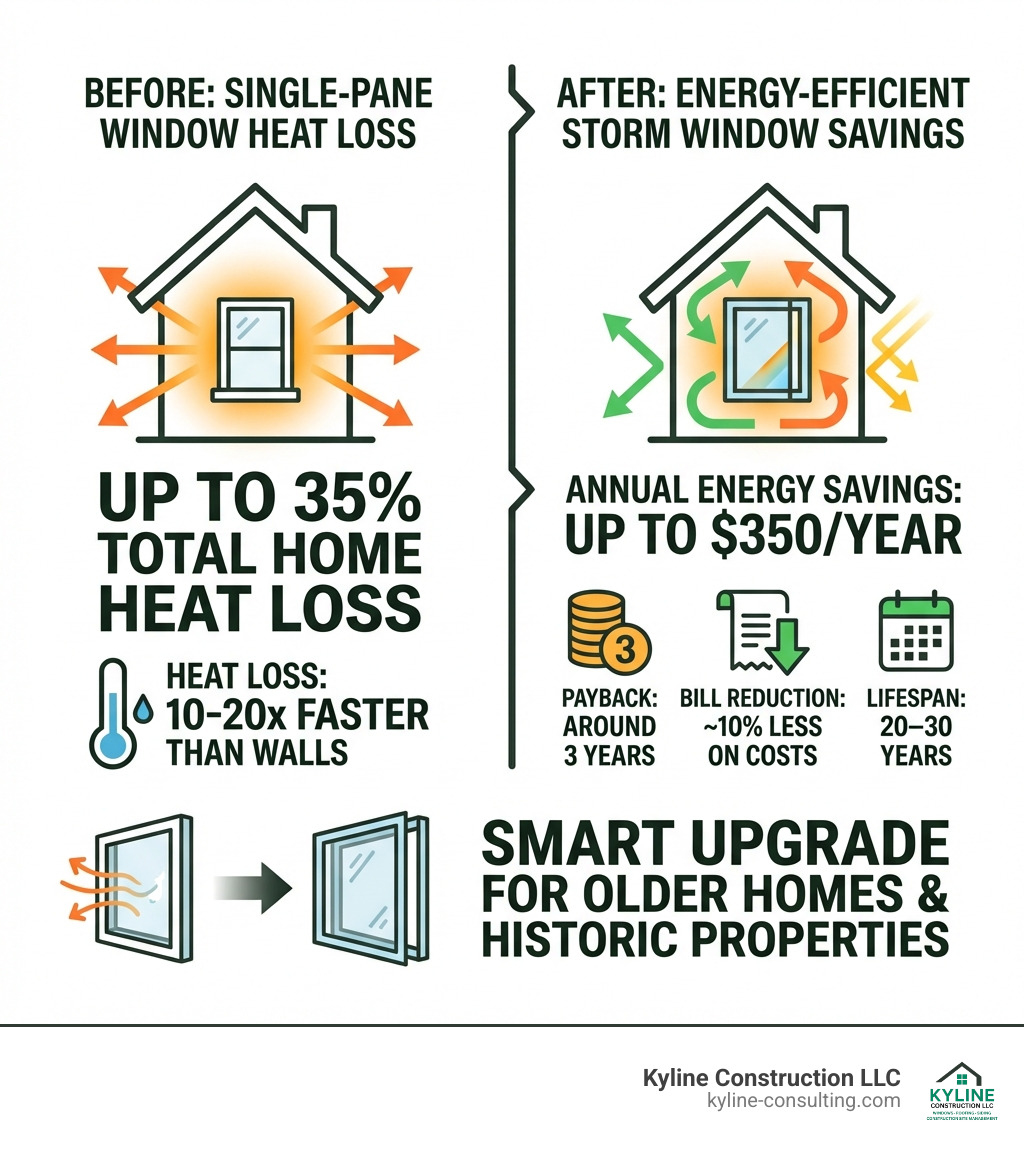
Energy efficient storm windows are one of the most cost-effective upgrades an Ohio homeowner can make — especially if you have older, single-pane windows.
Here’s a quick snapshot of what they offer:
| Factor | What to Expect |
|---|---|
| Annual energy savings | Up to $350/year (national average) on heating and cooling |
| Payback period | Around 3 years on your investment |
| Energy bill reduction | Roughly 10% less on annual heating and cooling costs |
| Cost vs. full replacement | 20–50% less than replacing windows entirely |
| Lifespan with proper care | 20–30 years |
| Best for | Single-pane windows, historic homes, tight budgets |
Windows, doors, and skylights can account for up to 35% of your home’s total heat loss. And single-pane windows? They lose heat at 10 to 20 times the rate of a properly insulated wall. That’s a serious drain on your comfort and your wallet — especially during a Central Ohio winter.
Storm windows work by adding a second layer of protection over your existing windows, trapping an insulating air gap in between. When that second layer includes a low-E (low emissivity) coating, you get even more performance — blocking heat from escaping in winter and reducing solar heat gain in summer.
They’re not a patch job. They’re a legitimate, proven upgrade.
I’m Shawn Zeisler, of Kyline Consulting LLC, a general contracting and exterior remodeling firm based in Circleville, Ohio — and I’ve spent my entire career helping homeowners make smart, lasting improvements to their properties, including selecting and installing energy efficient storm windows that actually perform. In the sections ahead, we’ll walk through everything you need to know to choose the right option for your home.
Easy energy efficient storm windows glossary:
What Are energy efficient storm windows and How Do They Work?
When we talk about energy efficient storm windows, we aren’t talking about those heavy, clunky glass panes your grandmother had to swap out every spring and fall. Modern storm windows are sophisticated “secondary glazing” systems designed to stay in place year-round.
They work by creating a buffer zone. When we mount a storm window over your primary window, we create an air gap. This gap acts as a thermal break, significantly slowing down the transfer of heat. In the winter, it keeps the warm air you paid for inside; in the summer, it prevents the humid Ohio heat from baking your living room.
According to the Department of Energy, these units are attachments rather than full replacements. While a full replacement involves tearing out the entire frame and sash, a storm window mounts directly onto your existing trim. For many homes in Columbus or Circleville, this is the “sweet spot” for efficiency because it addresses the glass’s thermal weakness without the $400–$900 per window price tag of a full high-end replacement.
Understanding Low-E Coatings
The real “magic” in modern energy efficient storm windows comes from Low-E (low emissivity) glass. This is a microscopically thin, virtually invisible metallic layer applied to the glass.
Think of it like a thermos for your house. In the winter, Low-E glass reflects radiant heat back into your room. In the summer, it rejects the sun’s infrared energy, keeping the house cooler. Low-E storm windows can be 30% to 50% more energy efficient than standard clear glass storm windows. If you want to see which models lead the pack, you can Find and Compare ENERGY STAR products to see the latest performance data.
Performance Metrics That Matter
When you’re shopping, don’t just look at the price tag. You need to understand the NFRC (National Fenestration Rating Council) label. Here are the big three metrics:
- U-Factor: This measures how well the window prevents non-solar heat flow. In Central Ohio, we want a lower number (typically 0.2 to 0.6) because it means better insulation during our freezing winters.
- SHGC (Solar Heat Gain Coefficient): This measures how much solar radiation comes through. A lower number means less heat from the sun enters your home.
- Air Leakage: This is crucial. Even the best glass won’t help if the wind is whistling through the frame. Look for a rating of 0.3 or lower.
For a deeper dive into these numbers, check out our Smart Shopper’s Guide to Window Performance Ratings.
Comparing Interior, Exterior, and Temporary Options
Not all storm windows are built the same. Depending on your home’s architecture and your personal goals, one type will usually stand out as the winner.
| Type | Best Use Case | Pros | Cons |
|---|---|---|---|
| Exterior | Standard homes | Permanent, protects primary window | Changes exterior look |
| Interior | Historic/Victorian | Preserves exterior charm, easy to clean | Takes up interior sill space |
| Temporary | Renters/Tight budgets | Very cheap, DIY friendly | Must be replaced annually |
Exterior Storm Windows
These are the workhorses of the industry. Usually made with aluminum frames, they come in two-track or three-track configurations. A three-track system is great because it allows you to slide the glass and the screen independently, giving you maximum flexibility for ventilation.
One thing I always tell my clients: make sure your exterior storms have weep holes. These small openings at the bottom allow moisture to drain out. Without them, you’ll end up with wood rot on your primary sills, which is a headache nobody needs.
Interior Storm Windows
If you live in a historic neighborhood in Circleville or a classic Columbus Foursquare, you might not want to cover up your beautiful original wood trim. Interior storm windows are often the answer. They use magnetic seals or compression fits to “pop” into the interior frame. They are incredibly airtight—often more so than exterior versions—and they make cleaning a breeze because you never have to climb a ladder.
Energy Savings and Financial Payback
Let’s talk brass tacks: the money. One of the most common questions I get is, “Shawn, are these actually worth the investment?”
The EPA estimates that ENERGY STAR certified (low-e) storm windows can save the average homeowner $350 a year on heating and cooling bills. That is a roughly 10% reduction. If you already have old, clear-glass storm windows and upgrade to Low-E versions, you can still expect to save an additional $50 per year.
Maximizing ROI with energy efficient storm windows
The “payback period”—the time it takes for the energy savings to cover the cost of the windows—is typically just three years. Compare that to full window replacements, which can take decades to pay for themselves through energy savings alone.
Storm windows are particularly effective when installed over single-pane windows. They essentially turn a single-pane window into a double-pane unit for a fraction of the cost. Plus, they protect your primary windows from the elements, potentially extending their lifespan by another 20 years.
Additional Benefits Beyond the Bill
While the savings are great, there are “invisible” benefits that make a huge difference in how your home feels:
- Noise Reduction: If you live near a busy road in Columbus, storm windows act as a massive sound dampener.
- UV Protection: Low-E coatings block UV rays that fade your carpets, furniture, and expensive drapes.
- Storm Shielding: They provide an extra layer of defense against flying debris during Ohio’s spring thunderstorms.
- Condensation Control: By keeping the inner glass warmer, they significantly reduce that annoying winter fogging on your windows.
Historic Preservation in Central Ohio
In places like Circleville’s historic districts, the windows are part of the home’s soul. Original old-growth wood sashes are often higher quality than anything you can buy at a big-box store today.
Many homeowners think they have to rip out those beautiful 100-year-old windows to get efficiency. That’s often a mistake. As we discuss in our guide, Beyond the Pane: Everything You Need to Know About Energy Efficient Windows, preserving original windows is often the smarter financial and architectural move.
Why Replacement Isn’t Always the Answer
New replacement windows often have thinner frames and less glass area. More importantly, the “ROI” (Return on Investment) for replacing a historic window is often 40 to 100 years. By adding a high-quality energy efficient storm window, you get nearly the same thermal performance as a new double-pane window while keeping your home’s architectural integrity intact.
You also avoid the mess of dealing with sash weights and pulleys hidden in the walls—parts that “paper contractors” often just cover up rather than addressing correctly.
Professional Installation: Real Contractors vs. Paper Contractors
This is where I get a bit fired up. In the home improvement world, there’s a massive difference between a “paper contractor” and a real contractor.
A paper contractor is essentially a salesperson with a clipboard. They sub everything out and might not even know how to hold a level. The biggest risk to you is that if their subcontractor quits or fails to show up, your project stops dead. A paper contractor can’t step in to help because they don’t actually know how to do the work. You’re left with an unfinished home and a contractor who can only make phone calls.
At Kyline Construction LLC, we believe in being real contractors. A real contractor has the technical skills to step in and finish the job personally if a crew member gets sick or a subcontractor walks off the site. When we install energy efficient storm windows, we ensure they are perfectly “square”—meaning they aren’t tilted or warped. If a storm window isn’t square, it won’t seal, and if it doesn’t seal, you’re just throwing money out the window. Our ability to pick up the tools and complete the work ourselves is your insurance policy against labor delays.
Maintaining Your energy efficient storm windows for Longevity
With minimal maintenance, these windows can last 20 to 30 years. Here is a checklist:
- Clear the Weeps: Once a year, make sure the drainage holes aren’t clogged with dirt or paint.
- Lubricate the Tracks: A little bit of silicone spray on the tracks once a year keeps them sliding like butter.
- Check the Seals: Ensure the caulking around the exterior frame hasn’t cracked.
The Kyline Construction LLC Difference
With over 40 years of experience in Central Ohio, we’ve seen every type of window problem there is. We don’t believe in high-pressure sales. We provide free, no-obligation estimates because we want you to have the facts. Whether you’re in Circleville or Columbus, we treat your home like it’s our own.
Frequently Asked Questions about Energy Saving Upgrades
Can I install energy efficient storm windows over double-pane windows?
You can, but it’s usually not necessary unless your double-pane windows are very old or the seals have failed. If you live in a particularly windy area or want extreme soundproofing, adding a storm window over a double-pane unit can provide a massive insulation boost.
Is DIY installation recommended for exterior storms?
If you’re handy and working on the first floor, it’s a manageable weekend project. However, for second-story windows or historic homes with settled, out-of-square frames, professional installation is safer and ensures the airtight fit you need for those energy savings.
How do storm windows compare to window films or weatherstripping?
Weatherstripping is a great first step (and very cheap!), but it only stops drafts; it doesn’t stop heat from moving through the glass. Window films can help with heat gain but are often temporary and can peel. Energy efficient storm windows are a permanent, structural solution that addresses both drafts and heat transfer.
Conclusion
Upgrading your home doesn’t always require a total overhaul. Sometimes, the smartest move is to enhance what you already have. Energy efficient storm windows offer a rare combination of high performance, low cost, and historic preservation.
If you’re tired of feeling a draft every time you sit near a window, or if your energy bills are making you do a double-take, it might be time to look at storm windows. At Kyline Construction LLC, we’re here to help you navigate those choices with 40 years of local expertise. Unlike paper contractors who are helpless if their subs quit, we have the hands-on capability to ensure your project is completed to the highest standard, no matter what.
Ready to see how much you could save? We’d love to chat. More info about our window services can be found here, or you can reach out for a free, no-obligation estimate today. Let’s make your Ohio home as comfortable and efficient as it can be.


