Why Installing an Awning on Vinyl Siding Requires Special Care
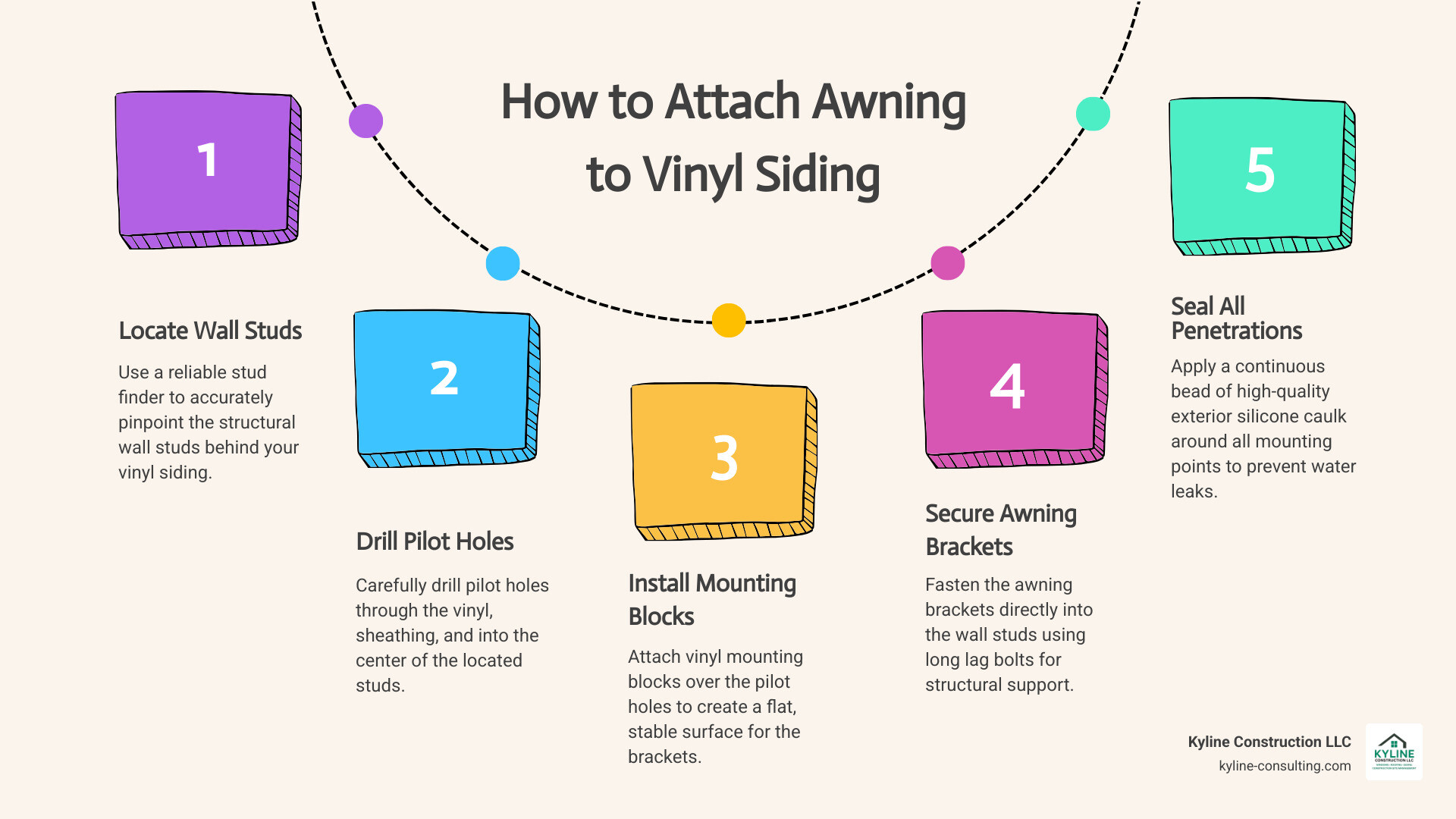
Attach awning to vinyl siding by following these essential steps:
- Locate wall studs behind the siding using a stud finder
- Drill pilot holes through the vinyl and sheathing into the studs
- Install vinyl mounting blocks to create a flat, stable surface
- Secure awning brackets to the studs with long lag bolts (not just to the siding)
- Seal all penetrations with high-quality exterior silicone caulk
The core challenge many homeowners face is this: vinyl siding is primarily aesthetic cladding, not a structural element. It cannot support the weight of an awning on its own. As the research clearly states, “Vinyl siding itself cannot bear the weight of retractable awnings. The mounting process involves drilling through the exterior to anchor into the wall studs behind it.”
This is why the solution requires mounting through the vinyl siding and into your home’s structural frame. Without this approach, you risk damaging your siding, creating water infiltration points, or worse—having an awning tear away from your home during a storm.
Proper installation is not just about making something look good. It’s about protecting your home’s structural integrity, preventing water damage, and ensuring the safety of everyone who uses the space beneath your new awning.
I’m Shawn Zeisler, owner-operator of Kyline Consulting LLC, and I’ve spent my entire working career in construction and exterior remodeling. Throughout my years helping Ohio homeowners attach awning to vinyl siding and complete other exterior projects, I’ve seen both the right way and the costly mistakes that come from shortcuts.
Before You Begin: Planning and Preparation
Installing an awning on vinyl siding is possible with careful planning. The primary challenge is that vinyl siding is not structural. As research indicates, “Vinyl cladding is mostly for aesthetic purposes only. It is not expected to support any weight.” Screwing an awning directly into vinyl will damage it, and its uneven, non-flat surface also makes direct mounting difficult.
The solution, therefore, is to bypass the vinyl siding and anchor the awning’s support brackets directly into the structural elements of your home, specifically the wall studs. This ensures that the awning’s weight is borne by your home’s framing, not its decorative exterior.
When choosing an awning, consider its size, shape, material, and durability. Retractable awnings offer flexibility, allowing you to extend them for shade and retract them during harsh weather. Fixed awnings provide constant coverage. The material should be weather-resistant and durable, capable of withstanding Ohio’s changing seasons. Style and design are also important to ensure the awning complements your home’s architecture.
Safety is paramount. Always wear safety glasses, use a sturdy ladder, and ideally, have a helper on hand, especially when lifting and positioning the awning frame.
Essential Tools and Materials
To successfully attach awning to vinyl siding, you’ll need a specific set of tools and materials to ensure a secure and watertight installation. Gathering everything beforehand will make the process smoother and more efficient.
Here’s what we recommend:
- Stud finder (with electrical and plumbing detection): This is non-negotiable. You need to locate the wall studs behind your vinyl siding to ensure the awning is anchored to something structural. A stud finder with electrical and plumbing detection features is particularly useful to avoid drilling into hidden wires or pipes, a crucial safety consideration.
- Power drill and bits: You’ll need a powerful drill capable of driving lag bolts and appropriate drill bits for pilot holes through vinyl, sheathing, and wood studs.
- Level (48-inch recommended): A long level is essential for ensuring your awning brackets are perfectly aligned and installed straight. This is critical for both appearance and proper awning function.
- Tape measure: For accurate measurements of placement and bracket spacing.
- Caulk gun: To apply sealant effectively.
- Ladder: A sturdy, stable ladder is a must for working at height.
- Socket wrench set: For tightening lag bolts securely.
- Pencil or marker: For marking stud locations and pilot holes.
- Safety glasses: Always protect your eyes when drilling or working with tools.
And for materials:
- Awning kit with brackets: Ensure the brackets are heavy-duty and rated for the weight of your awning. Specialized mounting brackets are crucial for distributing weight evenly and preventing damage to your exterior material.
- Lag bolts (long enough for studs): These fasteners must be long enough to penetrate the vinyl siding, any sheathing (like OSB or plywood), and securely anchor into the center of the wall studs.
- Vinyl siding mounting blocks: These specialized blocks provide a flat, stable surface for mounting brackets over the uneven profile of vinyl siding. They also create a channel for sealing. Some homeowners opt for custom-cut plywood spacers as an alternative, but mounting blocks are often more convenient and designed for this purpose.
- Spacers (if needed): In some cases, if mounting blocks aren’t available or for custom solutions, spacers (like those cut from plywood) can be used to create a gap between the bracket and the siding, preventing pressure on the vinyl.
- High-quality exterior silicone caulk: Essential for sealing all penetration points against water infiltration. As our research highlights, “Water infiltration poses a significant risk if you don’t seal the penetration points correctly.”
Inspecting and Preparing Your Siding
Before we even think about drilling, a thorough inspection of your vinyl siding is crucial. This step ensures that you’re installing your awning on a sound surface and preventing future issues.
- Check for damaged or loose siding panels: Walk around the area where you plan to install the awning. Look for any cracks, dents, chips, or warped sections in the vinyl. Also, gently press on the siding panels to see if any are loose or detached from the wall. Our research emphasizes that “repairing or replacing damaged vinyl siding panels before awning installation is necessary for a secure mount.” If you find damaged or loose panels, they must be repaired or replaced before proceeding with the awning installation. This prevents water from getting behind the siding and ensures the integrity of your home’s envelope.
- Clean the installation area: Dirt, grime, mold, or mildew can prevent proper adhesion of caulk and make accurate marking difficult. Clean the section of vinyl siding where the awning will be installed. A mild, soapy water solution and a soft-bristle brush are usually sufficient. For tougher grime, you can use a solution of three parts water to one part vinegar or bleach. Always clean from the bottom up to prevent streaking. Ensure the siding is completely dry before marking or drilling.
- Why pre-installation repairs are crucial: Beyond the obvious aesthetic reasons, damaged siding can compromise your home’s protection against moisture and pests. Installing an awning over compromised siding could exacerbate these problems, leading to costly repairs down the line. We want to ensure your home is well-protected, which is why a solid foundation for your awning is key.
For more information on maintaining and repairing your home’s exterior, including expert advice on vinyl siding, we invite you to explore our general siding services offered right here in Ohio.
How to Attach Awning to Vinyl Siding: A Step-by-Step Guide
This section details the complete process, ensuring a secure and stable attachment that protects your home. We’ll guide you through each critical step to successfully attach awning to vinyl siding.
Step 1: Measure and Mark the Location
Accuracy in this initial step will save you headaches later. The goal is to determine the ideal placement for your awning, ensuring it provides optimal shade and doesn’t interfere with doors or windows.
- Determining awning height and placement: Consider the primary purpose of your awning. Is it for sun protection over a window, or shade for a patio door? Factor in the sun’s movement throughout the day and the prevailing wind direction. For door awnings, a common recommendation is to extend the awning 6 inches from each side of the door and project it about 12 inches outwards.
- Accounting for door and window clearance: Ensure the awning, when extended or retracted, will clear any doors, windows, or other architectural features. Pay attention to the swing of your doors or the opening mechanism of your windows.
- Marking bracket locations accurately:
- Once you’ve decided on the overall height and width, use your tape measure and pencil to mark the top line where the awning will sit.
- Next, measure and mark the exact positions for your awning brackets according to the manufacturer’s instructions. These marks should correspond to the locations where your brackets will eventually be mounted.
- Use your 48-inch level to ensure these marks are perfectly horizontal. A level awning not only looks better but also functions correctly, especially for water drainage. A slight downward slope for water runoff is often built into the awning design or adjustable during installation.

Step 2: Locate Wall Studs and Prepare Mounting Points
This is arguably the most critical step when you attach awning to vinyl siding. Vinyl siding offers no structural support. All the weight of your awning must be transferred to the solid framing of your home.
- Using a stud finder to locate framing members: With your marked bracket locations, use a reliable stud finder to locate the vertical wall studs behind the vinyl siding. Run the stud finder horizontally along the wall, directly above and below your marked bracket positions. Mark the edges of the studs, then find the center point. It’s often helpful to mark the entire length of the stud to ensure you stay on target. As the research points out, a stud finder with electrical and plumbing detection is highly recommended to avoid any nasty surprises.
- Marking the center of each stud: Once located, mark the precise center of each stud where your awning brackets will align. Aim to have at least two, preferably more, anchor points per bracket securely fastened into studs.
- The critical role of studs in supporting the awning’s weight and cantilevered forces: The studs are the backbone of your wall. They are designed to bear weight. When an awning extends, especially a retractable one, it exerts significant cantilevered force—meaning it acts like a lever, trying to pull away from the wall. Without anchoring directly into these studs, your awning will eventually pull away from your house, damaging your siding and potentially causing injury. Our research confirms this, stating, “Due to the cantilevered force of a fully extended awning, you should verify the mounting…”. This is why ensuring your fasteners hit solid wood studs is paramount for a secure and stable installation.
Step 3: The Correct Procedure to Attach Awning Brackets to Vinyl Siding
Now that we know where our studs are and our locations are marked, it’s time for the actual attachment. This step is where we carefully work through the vinyl siding to reach the structural support.
Drilling pilot holes through the siding and sheathing into the studs:
- Using your marks, carefully drill pilot holes. It’s crucial to pre-drill to prevent cracking the vinyl siding. Start with a drill bit slightly smaller than your lag bolts.
- Drill straight through the vinyl, the underlying house wrap, the sheathing (OSB or plywood), and finally, into the center of the wall stud. Ensure your drill bit is long enough to penetrate all these layers and create a sufficient hole in the stud for the lag bolt to grip firmly.
- Take your time here. If you encounter unexpected resistance, stop and re-evaluate with your stud finder to ensure you haven’t hit anything unintended.
Installing vinyl mounting blocks for a flat, stable surface:
- Vinyl siding mounting blocks are designed to bridge the gap created by the uneven profile of vinyl siding. They provide a flat, solid surface for your awning brackets to rest against, distributing pressure evenly and preventing the brackets from crushing or deforming the siding.
- Align the mounting blocks over your pilot holes. If your mounting blocks require their own fasteners, install them now, ensuring they are snug but not overtightened, which could warp the siding.
- Some DIYers opt for creating custom spacers from plywood. If going this route, cut pieces of plywood slightly larger than your bracket’s footprint and as thick as the deepest part of your vinyl siding profile. Drill pilot holes through these spacers, then install them between the siding and the bracket, aligning with your stud holes. The goal is to create a flush, stable surface.
Securing the awning brackets to the studs with lag bolts:
- Position your awning brackets over the installed mounting blocks (or spacers), aligning the bracket’s holes with the pilot holes in the studs.
- Insert your long lag bolts through the bracket, mounting block/spacer, vinyl siding, sheathing, and into the stud.
- Using your socket wrench, slowly and steadily tighten the lag bolts. Ensure they are extremely secure, pulling the bracket firmly against the mounting block and the mounting block against the siding. Do not overtighten to the point of deforming the vinyl, but make sure there is no wobble or play in the bracket. This secure attachment into the studs is precisely how we ensure a stable and safe awning installation.
Finalizing Your Awning Installation
With your brackets firmly in place, the end is in sight! This final stage brings your awning to life, ensuring it’s not only securely attached but also functions perfectly and protects your home from the elements.
Step 4: Mount the Awning Frame and Fabric
This step often requires an extra set of hands, as awning frames can be bulky and heavy.
- Lifting the awning assembly onto the brackets (requires a helper): Carefully lift the assembled awning frame (or the main housing if it’s a retractable model) and position it onto the installed wall brackets. Many awning brackets have a lip or hook system that allows the awning to temporarily rest in place before being fully secured. Having a friend or family member assist you with this ensures safety and prevents damage to both the awning and your home.
- Securing the awning frame to the brackets: Once the awning frame is resting on the brackets, align the pre-drilled holes in the frame with the corresponding holes in the brackets. Insert the manufacturer-provided bolts, pins, or screws, and tighten them securely. Double-check that all connections are snug and that the awning feels stable on the brackets. Use your level one last time to confirm the awning is perfectly horizontal, or at the slight downward angle recommended by the manufacturer for water drainage. This ensures a tight and level fit.
- Attaching the awning fabric or material according to the kit’s instructions: Most awning kits come with specific instructions for attaching the fabric to the frame. This usually involves sliding the fabric into channels, securing it with clips, or tying it to designated points. Follow your awning’s manual closely to ensure the fabric is taut, evenly distributed, and properly secured. A well-attached fabric will look better, last longer, and perform optimally.
Step 5: How to attach awning to vinyl siding and ensure it is weatherproof
This is where we safeguard your home against the elements, ensuring that your efforts to attach awning to vinyl siding don’t inadvertently create new problems. Weather resistance and proper sealing are crucial.
- Applying a continuous bead of silicone caulk around the top and sides of the mounting blocks: Water infiltration is a significant risk with any exterior penetration. To prevent moisture from seeping behind your vinyl siding and into your home’s structure, you must create a watertight seal. Apply a generous, continuous bead of high-quality exterior silicone caulk along the top edge of each mounting block where it meets the vinyl siding. Also, caulk the sides of the mounting blocks. Do not caulk the bottom edge. Leaving the bottom unsealed allows any incidental moisture that might get behind the block to escape, preventing it from being trapped and causing rot. This practice is essential for preventing water damage and maintaining the integrity of your wall studs.
- Why sealing is non-negotiable to prevent water infiltration and rot: Our research clearly states, “Water infiltration poses a significant risk if you don’t seal the penetration points correctly. Professional installers use silicone caulk and specialized flashing to prevent moisture problems around awning attachment points.” Proper sealing protects your home from rot, mold, and structural damage that can result from water intrusion.
- Checking for a slight downward slope for proper water runoff: For fixed awnings, ensure there’s a slight downward angle (typically 10-15 degrees) to allow rainwater to run off efficiently. Retractable awnings often have this angle built into their design or allow for adjustment. This prevents water from pooling on the fabric, which can cause stretching, damage, and excessive weight, especially during heavy Ohio rainfalls.
After completing these steps, test your awning’s functionality. For retractable models, extend and retract it a few times to ensure smooth operation. Check for any obstructions and make minor adjustments as needed for optimal coverage and stability.
Frequently Asked Questions about Awning Installation
We understand that installing an awning, particularly on vinyl siding, can bring up several questions. Here, we address some of the most common concerns we hear from homeowners in Ohio.
What are the most common problems during installation?
When you attach awning to vinyl siding, several common pitfalls can turn a straightforward project into a headache. The most frequent issues we encounter include:
- Mounting only to the vinyl siding: This is the cardinal sin of awning installation on vinyl. As we’ve stressed, vinyl is not structural. Screwing directly into it will lead to the awning pulling away, damaging the siding, and potentially falling. Our research confirms this: “If you do try to hang something heavy onto it, the vinyl material will be pulled down and damaged and it will lose its aesthetic value.”
- Failing to hit wall studs: Even if you drill through the vinyl, if your fasteners don’t hit solid wood studs, your awning will lack the necessary structural support. It might hold for a while, but strong winds or the sheer weight of the awning over time will cause it to fail.
- Using fasteners that are too short: Lag bolts must be long enough to pass through all layers (siding, sheathing, and into the stud) and embed deeply enough into the stud for a secure grip. Short fasteners won’t provide adequate holding power.
- Improper sealing: Neglecting to properly caulk around the mounting points leaves your home vulnerable to water infiltration. This can lead to wood rot in the wall studs, mold growth, and expensive structural damage. “Water infiltration poses a significant risk if you don’t seal the penetration points correctly.”
- Uneven installation: If brackets aren’t perfectly level, the awning will look crooked, operate poorly, and may not shed water effectively.
These problems can be avoided by carefully following the steps outlined in this guide, especially focusing on stud location, appropriate fasteners, the use of mounting blocks, and thorough sealing.
How do I know if my wall can support a heavy retractable awning?
The ability of your wall to support a heavy retractable awning is a critical consideration. These awnings, especially when fully extended, exert significant cantilevered forces on the mounting points.
- Structural assessment: The wall’s capacity depends entirely on its internal structure. We’re looking at the size and spacing of your wall studs (e.g., 2x4s or 2x6s), their condition (no rot or damage), and the quality of the underlying sheathing. Older homes, or those with non-standard framing, might present unique challenges.
- Weight of the awning: Awnings vary greatly in weight. A small, lightweight fixed awning will put less strain on the wall than a large, motorized retractable unit. Retractable awnings can offer projections of over 10 feet, increasing the leverage and stress on the mounting points.
- Professional assessment for heavy awnings: For large or particularly heavy retractable awnings, or if you have any doubts about your wall’s integrity, we highly recommend a professional assessment. As our research suggests, “Professional teams can assess your home’s structural capacity and recommend appropriate retractable awning options for your specific situation.” They can evaluate the framing, identify potential weaknesses, and advise on any necessary reinforcements before installation. This ensures safety and prevents potential structural damage to your home.
When should I consider professional installation?
While many homeowners with good DIY skills can successfully attach awning to vinyl siding using this guide, some situations make professional installation the wiser choice.
Consider hiring a professional if:
- You’re not confident in your DIY skills: Awning installation involves precise measurements, drilling into structural components, and ensuring watertight seals. If you’re uncomfortable with any of these steps, a professional will provide peace of mind.
- You cannot reliably locate studs: If your stud finder isn’t giving clear readings, or you suspect irregular framing, a professional has advanced tools and experience to find the correct anchoring points. Trying to guess can lead to a failed installation and damage.
- You are installing a large or motorized awning: Larger or motorized awnings are heavier, more complex to handle, and exert greater forces on the wall. They often require electrical wiring, which should always be handled by a qualified electrician.
- You want the peace of mind that comes with a warranty and insurance: Professional installers typically offer warranties on their work, and they carry insurance to protect you from potential awning-related damage during installation. This can be invaluable.
- You prefer to save time and effort: Installing an awning can be a time-consuming project. A professional team can complete the job efficiently and correctly, allowing you to enjoy your new awning sooner.
For those interested in seeing how other homeowners have approached similar projects or discussed various home improvement challenges, you might find discussions on forums like Chevy Nova Forum67K members interesting, although the context may differ.
Conclusion: Enjoy Your New Shade with Confidence
Successfully installing an awning on your vinyl-sided home is a rewarding project that improves both the aesthetics and functionality of your outdoor living spaces. We’ve walked through the critical steps to attach awning to vinyl siding securely and safely. The key takeaways are clear: always anchor directly into your home’s structural wall studs, use vinyl siding mounting blocks to create a stable mounting surface, and carefully seal all penetrations to protect against moisture.
The benefits of adding an awning are numerous. You’ll gain welcome shade on sunny days, making your patio or deck more comfortable for relaxation and entertaining. Awnings can also protect your indoor furnishings from sun fading and reduce cooling costs by blocking direct sunlight through windows. They add an attractive architectural element, boosting your home’s curb appeal.
For over 40 years, Kyline Construction LLC has provided expert home exterior solutions to homeowners across Ohio, including Circleville and Columbus. We pride ourselves on precision craftsmanship in siding, windows, and decks, backed by experienced professionals who prioritize quality and safety. If you’re considering enhancing your home’s exterior but prefer expert assistance, don’t hesitate to reach out. For professional help with your next project, explore our siding services and other home improvement services. We offer free, no-obligation estimates and are always ready to help you transform your home with confidence. Contact Us today!