Why Window Energy Savings Matter More Than You Think
Window energy savings are one of the fastest ways Ohio homeowners can cut monthly utility bills — here’s what you need to know right away:
- 25-30% of your home’s heating and cooling energy escapes through windows
- Replacing single-pane windows with ENERGY STAR certified models saves $126 to $465 per year on average
- That adds up to as much as a 13% reduction in total household energy bills
- Even without full replacement, upgrades like caulking, weatherstripping, and cellular shades deliver real savings
- The biggest gains come from matching the right window to your climate zone and ensuring proper installation
If you live in Central Ohio, you already know what extreme weather looks like. Bitter winters in January. Humid, scorching summers in July. Your windows are working hard — or not working at all — through every degree of that swing.
Here’s the uncomfortable truth: most homes are quietly bleeding energy through their windows every single day. According to the U.S. Department of Energy, heat gain and heat loss through windows account for 25 to 30 percent of what you spend on heating and cooling. That’s not a small number. For many Ohio homeowners, that’s hundreds of dollars walking right out the glass every year.
The good news? You have more options than you might think — from simple weekend fixes to full window replacements — and not all of them require a massive budget.
I’m Shawn, owner of Kyline Construction LLC, and I’ve spent my entire working career in construction helping Central Ohio homeowners make smart, lasting improvements to their homes, including delivering real window energy savings through quality installs and honest advice. In the sections ahead, I’ll walk you through everything you need to know to make the right call for your home and your budget.
Window energy savings vocabulary:
The Real Impact of Window energy savings on Your Bills
When we talk about window energy savings, we aren’t just talking about being “eco-friendly.” We’re talking about your bank account. In our 40+ years of experience serving areas like Circleville and Columbus, we’ve seen how much a drafty window can punish a homeowner during an Ohio winter.
Nationwide, replacing old, single-pane windows with ENERGY STAR Residential Windows, Doors and Skylights lowers household energy bills by an average of up to 13 percent. For a typical home, that translates to a savings range of $126 to $465 per year. If you’re currently rocking single-pane windows, you might even see savings closer to the $583 mark depending on how hard your HVAC system is currently struggling to keep up.
Think of your HVAC system like a marathon runner. If your windows are inefficient, it’s like asking that runner to go uphill, in the mud, while carrying a backpack full of bricks. The system never gets a break. It cycles on and off constantly, which leads to premature wear and tear. By focusing on Beyond the Pane: Everything You Need to Know About Energy Efficient Windows, you aren’t just saving on the monthly bill; you’re extending the life of your furnace and air conditioner.
In the summer, a standard double-pane window without special coatings allows about 75 percent of the sun’s heat into your home. That’s why that one room in the back of the house feels like a sauna in August. Upgrading to energy-efficient models can cut that solar heat gain significantly, keeping your home cooler without you having to wage war with the thermostat.
Decoding Performance Ratings for Ohio Homeowners
If you’ve ever looked at the sticker on a new window, it looks like a math quiz you didn’t study for. But understanding these numbers is the key to Smart Shopper’s Guide to Window Performance Ratings. Here in Central Ohio, we live in a “mixed” climate zone, which means we need windows that can handle both freezing snow and humid heat.
There are three main numbers you need to watch on the Energy Performance Label for Windows, Doors, and Skylights:
- U-Factor: This measures the window’s ability to keep heat inside your home. It’s all about insulation. The lower the number, the better the window is at keeping you warm during a Columbus blizzard. Look for a U-factor of 0.30 or lower.
- Solar Heat Gain Coefficient (SHGC): This measures how much heat from the sun the window lets in. In the South, you want this very low. In the North, you might want it a bit higher to help warm the house in winter. For Ohio, we usually recommend a mid-range SHGC to balance the seasons.
- Visible Transmittance (VT): This tells you how much natural light comes through. A higher VT means more light, which is great for those gloomy Ohio spring days, but you want to make sure it’s balanced with a good SHGC so you aren’t baking your living room.
[TABLE] Energy Performance Requirements for Ohio (North-Central Zone)
| Rating Type | Recommended Value | Why It Matters locally |
|---|---|---|
| U-Factor | ≤ 0.28 – 0.30 | Keeps the furnace heat from escaping in January. |
| SHGC | ≤ 0.40 | Blocks the “sauna effect” during humid July afternoons. |
| Air Leakage | ≤ 0.3 | Prevents that “whistling” draft during windy autumn days. |
When you’re shopping, always look for the National Fenestration Rating Council (NFRC) label. It’s the only way to compare apples to apples. If a salesperson tells you their window is “the best” but can’t show you the NFRC ratings for the whole unit (not just the center of the glass), keep your wallet closed.
Strategic Upgrades: When to Replace vs. Update
One question we get all the time at Kyline Construction is: “Shawn, do I really need to spend $400 to $900 per window, or can I just fix what I’ve got?”
It’s a fair question. Here is my “Rule of Thumb”: If your windows are over 20 years old and you’re seeing condensation between the panes of glass, the seal has failed. At that point, the insulating gas (like argon) has leaked out, and you’re basically looking through two pieces of glass with dirty air in the middle. You can’t “fix” that efficiently.
Another sign it’s time to replace is if the frames are rotting or if they are so drafty that you can see the curtains move when the wind blows. A 1/16-inch gap around a window might not look like much, but added up, it’s the equivalent of having a hole the size of a large fist in the side of your house!
If you are already planning on a full siding repair—which typically runs between $11k and $17k for a standard Ohio home—that is the absolute best time to do windows. Why? Because we can integrate the window flashing perfectly with the new vinyl siding. This ensures a water-tight seal that protects your home’s structure for decades.
Cost-Effective Ways to Boost Window energy savings
If a full replacement isn’t in the cards this year, don’t worry. You can still make a dent in those bills. We’ve seen homeowners save quite a bit by taking a “triage” approach to their existing windows.
- Caulking and Weatherstripping: This is the cheapest way to see an immediate result. Seal the gaps where the window frame meets the siding and where the moving parts of the window close.
- Cellular Shades: These are often called “honeycomb” shades. They trap a layer of air between the room and the window. According to the Department of Energy, tight-fitting Energy Efficient Window Coverings can reduce heat loss through windows by as much as 40%.
- Low-E Storm Windows: If you have old single-pane windows in a historic home and don’t want to replace them, adding a modern storm window with a Low-E coating can save you 12%–33% on heating and cooling costs.
- Window Films: Applying a solar control film can help reflect heat in the summer, though you have to be careful with these on newer double-pane windows as they can sometimes void your warranty.
For more on why the right material matters, check out Go Green Save Green: Why Energy Efficient Vinyl Windows Are a Smart Choice.
The Professional Difference in Central Ohio
Now, I need to get serious for a second. There is a massive difference between what I call “paper contractors” and “real contractors,” and understanding this distinction is the single most important factor in your project’s success.
A paper contractor is essentially a middleman—a salesperson with a fancy website and a smooth pitch. They sell you the job, take your deposit, and then scramble to hire whatever crew is available on Craigslist that morning. They don’t own the tools, they don’t know the techniques, and they certainly aren’t on-site to ensure quality. If that crew walks off the job or makes a critical error in your vinyl siding integration, the paper contractor is helpless because they lack the technical expertise to fix it themselves. You’re left paying for their overhead while receiving amateur results.
At Kyline Construction, we are real contractors. We’ve been in the trenches for over 40 years. We own the equipment, we employ the experts, and we possess the deep technical knowledge required for high-stakes exterior work. If a sub decides to disappear or a complex issue arises, I can pick up the tools and finish the job myself to the highest professional standard. That level of accountability is non-negotiable when you’re cutting into your home’s exterior. We ensure that every Complete Window and Frame Replacement is done with the precision only a true tradesman can provide.
Why Professional Installation is the Key to Window energy savings
You could buy the most expensive, high-tech window in the world, but if it’s installed poorly by a paper contractor’s revolving-door crew, it’s useless. I’ve seen $1,000 windows performing worse than a $200 window because the installer didn’t understand air sealing or flashing.
When we install a window, we focus on:
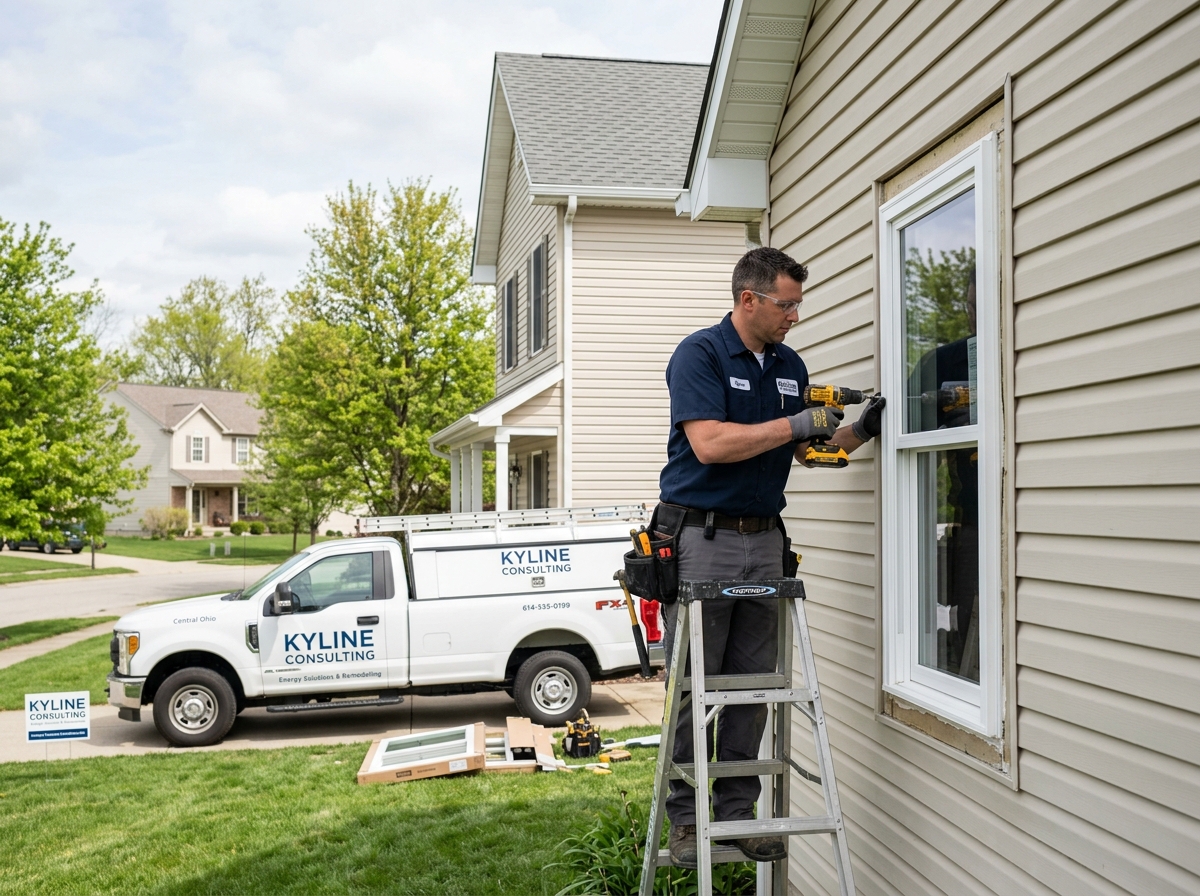
- The Rough Opening: We make sure the space between the window frame and your home’s framing is properly insulated with low-expansion foam. No gaps allowed.
- Flashing: This is what keeps the water out. In Central Ohio, we get plenty of driving rain. Proper flashing ensures that water is shed away from the house, not into your walls.
- J-Channel Integration: Since we specialize exclusively in vinyl siding, we make sure the J-channel (the trim that holds the siding around the window) is fitted perfectly. This isn’t just for looks; it’s a critical part of your home’s drainage system that paper contractors often overlook.
If you’re worried about the cost, there are ways to get help. Check out Seal the Deal: How to Apply for Federal Window Assistance to see what programs might apply to you.
Frequently Asked Questions about Window Efficiency
How long does it take to recoup the investment in new windows?
Generally, it takes about 10 to 15 years to pay for the windows purely through energy savings. However, that’s only half the story. Unlike a vacation or a new car, windows add immediate value to your home. On average, homeowners recoup about 78% of the cost of replacement windows in added home value when they sell. When you combine the energy savings, the increased comfort, and the resale value, it’s one of the smartest investments you can make.
What are the best window coverings for energy efficiency?
Insulated cellular shades are the champions here. Because of their honeycomb design, they create a very effective thermal barrier. If you install them in a track so they are tight against the window, they can reduce heat loss by 40% or more. Look for the Attachments Energy Rating Council (AERC) label to see exactly how much a specific shade will help.
Are there tax credits for energy-efficient windows in Ohio?
Yes! Under the current federal guidelines, homeowners can claim a tax credit of 30% of the cost of ENERGY STAR Most Efficient windows, up to a cap of $600 per year. This is a great way to shave some money off the total project cost. I always recommend using the ENERGY STAR Rebate Finder to see if there are additional local utility rebates available in Columbus or Circleville.
Conclusion
Maximizing window energy savings isn’t just about picking a product out of a catalog; it’s about understanding how your home works as a system. From the way the sunlight hits your south-facing windows to the way your vinyl siding protects the window frame, every detail counts.
My final advice? Don’t wait until your furnace is screaming in the middle of a February freeze to think about your windows. Take a look at them now. Check for drafts, look for fogging between the glass, and feel the temperature of the panes on a hot day.
At Kyline Construction LLC, we’ve spent 40+ years ensuring that Ohio homes are built to last. Whether we’re using a circular saw to perfectly cut a new composite deck (which, by the way, has a 25-50 year lifespan!) or we’re precision-fitting a new set of vinyl windows, we treat your home like our own.
We’re proud to serve our neighbors in Circleville and Columbus with quality, safety, and honesty. If you’re ready to stop bleeding money through your glass, give us a call. We offer free, no-obligation estimates so you can plan your budget without any pressure.
Ready to see the difference? Don’t Pay a Dime: Schedule Your Complimentary Window Estimate today and let’s get your home back to being the comfortable sanctuary it’s supposed to be. For more information on our specific window styles and options, visit our Windows page.
Stay warm (or cool), Ohio!