Chimney Flashing Repair in Central Ohio: Catching a Leak Before It Rots the Deck
Chimney flashing repair is a fix almost nobody plans for, but it is one of the most common leak points on a Central Ohio roof. Your shingles can have another decade left while the metal at the chimney has already given up. The chimney and the roof are two structures that wear and shift at different rates, and the only thing bridging them is bent sheet metal and mortar. If you see a stain on a ceiling near a chimney chase, or a rusty streak on brick, check the flashing first.
Why the chimney is where roofs leak
Chimney leaks usually start at the metal rather than at the brick. Every place the roof surface gets interrupted needs metal to carry water back onto the shingles. Ohio’s residential code says so plainly. Flashing goes in at wall and roof intersections, at any change in slope or direction, and around every roof opening (Rule 4101:8-9-01, Section 903.2.1). A chimney has all three problems at once, so it gets the most complicated flashing on the house.
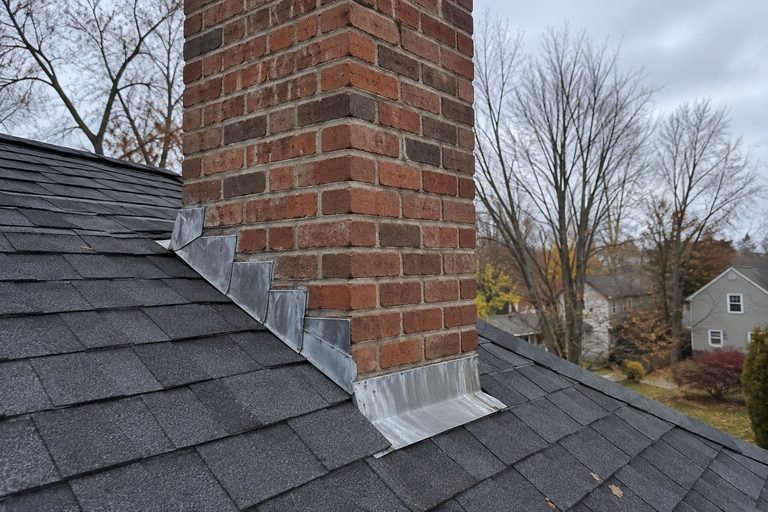
Good flashing installation keeps the joint dry. The assembly has to prevent water from reaching the deck at four angles, so a proper chimney has four parts working together. Step flashing weaves up each side, course by course. Base flashing crosses the low side. A back pan or cricket handles the uphill side. Counterflashing, also called cap flashing, sets into a mortar joint and laps down over the rest so water can’t get behind the metal.
The Brick Industry Association spells out the overlap that makes this work. Counterflashing gets set 3/4 to 1 inch into a mortar joint and mortared solidly. It then laps the base flashing by at least 3 inches, and sections higher up the roof lap the ones below by at least 2 inches (BIA Technical Notes 19B). Lose one of those laps and water has a path to your deck.
The freeze-thaw cycle is what breaks the assembly here. In Columbus, every day in January has a normal low between 21°F and 24°F and a normal high of 37°F or 38°F, so the whole month sits in the freeze-and-thaw range (NWS Wilmington January normals). December runs the same pattern. Each cycle works the mortar joint holding your counterflashing and flexes the metal a little more.
Signs of a leaking chimney flashing you can see from the ground
You don’t need to get on the roof to build a case. Walk the yard with binoculars and look for these, then check inside.
- Rust or dark streaks running down the brick below the flashing line, which means the metal is corroding or water is tracking behind it
- Counterflashing lifted away from the brick, or a mortar joint that’s crumbled out around it
- Caulk or roof cement smeared along the metal, the signature of a previous patch that someone hoped would hold
- White chalky staining on the brick, a sign the masonry is staying wet longer than it should
- A ceiling stain, damp drywall, or a musty smell in the room nearest the chimney, or on an upper floor after wind-driven rain
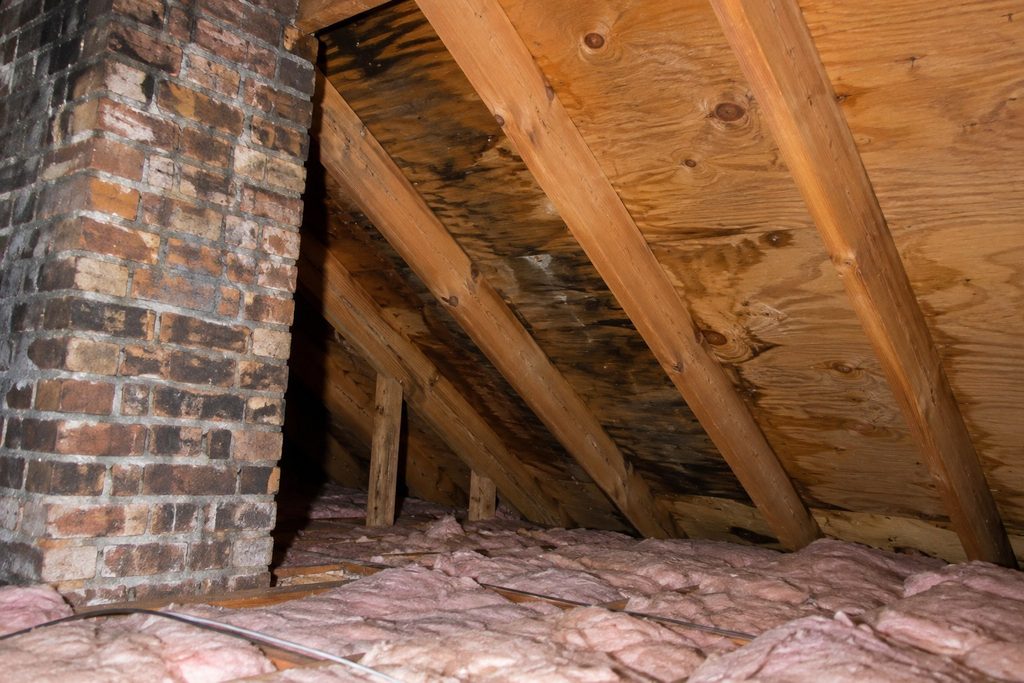
Attic evidence is the most reliable. Head up with a flashlight during daylight. Check the sheathing around the chimney chase for dark rings, rusty nail shanks, or matted insulation. Wood decays when it stays wet, and the practical threshold is a moisture content around 20 percent, with decay fungi working fastest above that (USDA Forest Service, Carll and Highley). Sheathing that dries between storms usually survives. Sheathing that stays damp all winter turns a small flashing problem into water damage in the framing.
What chimney flashing repair actually involves
A real repair is more than just caulking. The shingles need to come off around the chimney and the old metal has to come out. New step flashing goes back in woven with the courses, and new counterflashing gets cut into the mortar joints and sealed. Ohio’s code sets the material floor. Base flashing and cap flashing both have to be corrosion-resistant metal of at least 0.019 inch nominal thickness, which is No. 26 galvanized sheet or better (Rule 4101:8-9-01, Section 905.2.8.1).
The step flashing detail has one rule people get wrong constantly. The Asphalt Roofing Manufacturers Association calls for pieces at least 10 inches long and at least 2 inches wider than the shingle exposure. Bend each one 90 degrees so 5 inches sits on the deck and 5 inches runs up the wall. Nail the horizontal flange and leave the vertical flange unnailed, because the wall and the roof move at different rates and a nailed flange buckles shingles and tears sealant (ARMA Residential Asphalt Roofing Manual). If your last roofer nailed the flashing tight to the brick, that’s likely why the joint failed early.
Wide chimneys need one more piece. Ohio code requires a cricket, sometimes called a saddle, on any chimney or penetration wider than 30 inches across the slope. That cricket has to be flashed and counterflashed like the rest of the chimney (Sections 903.2.2 and 1003.20). The height of that cricket depends on your roof pitch.

Ohio code requirements at the chimney
| Requirement | What the code says | Section |
|---|---|---|
| Where flashing is required | Wall and roof intersections, changes in slope or direction, around roof openings | 903.2.1 |
| Minimum metal thickness (flashing) | Corrosion resistant, not less than 0.019 in. (No. 26 galvanized) | 903.2.1 |
| Base and cap flashing material | Corrosion-resistant metal at 0.019 in. nominal, or 77 lb/100 sq ft mineral-surfaced roll roofing for base | 905.2.8.1 |
| Cricket or saddle | Required on any chimney or penetration wider than 30 in. across the slope | 903.2.2 / 1003.20 |
| Cricket height (H) by roof slope | 3:12 = 1/8 of W · 4:12 = 1/6 of W · 6:12 = 1/4 of W · 8:12 = 1/3 of W · 12:12 = 1/2 of W | Table 1003.20 |
W is the chimney dimension parallel to the ridge. On a 6:12 roof with a 48-inch chimney, that puts the cricket at 12 inches tall, so a proper one needs framing, not a bent sheet of metal.
Patch, reflash, or reroof
The answer depends on what else is going on up there. One lifted section of counterflashing on a sound roof is a targeted fix. Flashing that’s rusted through, or a chimney patched twice with roof cement, needs the full assembly replaced. If your shingles are near the end of their life, do the chimney during the reroof, since those shingles come off either way.
Two things push a repair into urgent territory. Active water in the attic during rain means the deck is taking on moisture now, and a crumbling crown above the flashing line means that masonry needs to be done first, because new metal set into bad mortar won’t hold. At Kyline, we handle both the roofing side and emergency repair work when water is already coming in, and a chimney leak found in September is a much smaller job than if the same leak were found in February.

Getting it done before the weather turns
September and October are the right window for this type of repair, because the mortar work involved in cutting and sealing counterflashing does best in temperatures above freezing. January alone carries a normal snowfall of 9.5 inches in Columbus (NWS Wilmington), which is weeks of melt water finding any gap you left open.
Attic condition matters too, because trapped attic moisture makes it harder to tell a flashing leak from a condensation problem (Pennsylvania Housing Research Center). Have both looked at in the same visit so you’re not chasing the wrong cause.
Ask chimney flashing repair contractors which of the four pieces they’re replacing and whether your chimney needs a cricket under Ohio code. That answer separates a repair that lasts from one you’ll pay for again in two years. Get it inspected now and you protect the deck, the framing, and the ceiling below, so call and schedule a look while the weather is still cooperating.
FAQ
How much does chimney flashing repair cost?
Cost depends on chimney size, roof pitch, whether a cricket is required, and the condition of the mortar joints. One section of counterflashing is a small job, while a full reflash with masonry repair is a much larger one. Ask for the scope in writing before you compare quotes.
Can I use a chimney flashing repair kit or sealant myself?
ealant buys you time and nothing more. The waterproofing comes from the laps between step flashing, base flashing, and counterflashing, and caulk over failed metal can’t recreate those. Treat a kit as temporary.
How do I know the leak is the flashing and not the chimney itself?
Staining that appears only during wind-driven rain often points to the crown or the brick absorbing water rather than the flashing. A roofer should check the crown, the mortar joints, and the flashing laps before quoting, since fixing one and ignoring the other leaves you wet.
Does my chimney need a cricket?
Measure the chimney width across the slope. If it’s more than 30 inches wide and it doesn’t sit on the ridge, Ohio code calls for a cricket or saddle (Section 903.2.2). Plenty of older Central Ohio homes have wide chimneys with only a flat back pan, and those are frequent leak sources.
Can flashing be replaced in winter?
Metal work can happen in cold weather, but mortar and sealant perform better above freezing, and snow makes the work slower and less safe. Emergency stabilization is possible, with the permanent repair scheduled for a dry stretch.