Signs You Need a New Roof: A Central Ohio Homeowner’s Repair-or-Replace Checklist
Most roofs don’t fail all at once. They give you a season or two of small warnings first- a few granules in the gutter, a shingle corner that lifts, a stain in the attic- and the homeowners who catch those warnings early are the ones who get a repair instead of a replacement. Here’s how to read those signals on an asphalt shingle roof in Central Ohio, and how to tell which ones are genuinely urgent.
Start With Age and What the Shingle Was Rated For
Before you climb a ladder, figure out what’s actually on your roof. Manufacturer warranty terms are the clearest public benchmark for how long a shingle line is expected to perform. Malarkey Roofing Products, the shingle line we install, publishes a good/better/best chart showing limited lifetime shingle warranties against manufacturing defects, with non-prorated periods of 10, 15, or 20 years depending on the line, and standard wind warranties of 110 mph (130 mph enhanced) in its roof system warranty trifold.
Those numbers tell you two things. First, the “non-prorated period” is the window in which a manufacturer stands fully behind the product- a rough proxy for the shingle’s premium service window. Second, wind ratings are a design limit, not a promise: a 110 mph rating assumes correct nailing, sealed tabs, and intact starter courses.
The Malarkey Highlander AR product page shows how much the tier matters- impact ratings step from Class 3 to Class 4, and tear strength and algae coverage rise with them. A roof at year 18 with a builder-grade shingle is in a very different position than one at year 18 with a Class 4 product.
The Seven Symptoms Worth Checking
You can spot most of these from the ground with binoculars, from a gutter, or from inside the attic. Do not walk a roof you’re unsure of- wet or brittle shingles are a fall hazard, and walking a hail-bruised roof can cause more damage.
1. Granule loss
Granules are the shingle’s sunscreen. A handful of loose granules from a brand-new roof is normal- GAF’s technical bulletin on granule loss on new shingles describes excess “rider” granules shedding after installation as a self-correcting, non-defect condition. What is not normal is steady granule accumulation from a mature roof, or shiny black patches where the asphalt mat is showing through. That’s the shingle running out of protection.
2. Curling and clawing
Edges that turn up (curling) or centers that lift while edges stay down (clawing) mean the mat has lost dimensional stability. Isolated on one slope, it may be a ventilation or heat problem. Across the whole roof, it’s age.
3. Cracked or brittle tabs
Central Ohio shingles cycle from summer heat to hard winter freeze every year. Once tabs snap rather than flex, they no longer seal, and wind gets underneath.
4. Nail pops
Small bumps in straight lines across a slope are fasteners backing out, usually from deck movement or moisture in the sheathing. Each pop is a puncture waiting to leak. A few can be sealed; a slope full of them means the deck and the fastening pattern are both suspect.
5. Flashing failures
Chimneys, sidewalls, valleys, and pipe boots are where most leaks actually start. Flashing is often repairable independently of the field shingles — which is why a leak near a chimney is not automatically a replacement conversation.
6. Decking sag
A roof plane that dips, waves, or feels soft underfoot is a structural signal, not a cosmetic one. Sagging means the sheathing (or worse, framing) has taken on moisture. This one always gets inspected in person.
7. Attic moisture
Check the underside of the deck for dark staining, rusted nail shanks, frost in winter, or damp insulation. Moisture inside the attic can come from a roof leak or from trapped household humidity with inadequate ventilation, and the fix is completely different depending on which it is.
Symptom → Likely Cause → Repair or Replace
| Symptom | Likely cause | Repair or replace? |
|---|---|---|
| Heavy granules in gutters, bald black patches | Shingle at end of service life; or storm impact | Replace if widespread; spot repair only if impact is localized |
| Granules shedding from a roof installed months ago | Excess “rider” granules from manufacturing (GAF) | Neither — monitor; it typically self-corrects |
| Curling or clawing across multiple slopes | Age, heat, poor attic ventilation | Replace; address ventilation at the same time |
| Cracked, brittle tabs | Freeze–thaw and UV aging | Replace if widespread; repair if confined to one area |
| Nail pops in rows | Deck movement, moisture, or fastening issue | Repair if isolated; replace if slope-wide |
| Leak at chimney, valley, sidewall, or pipe boot | Failed or improperly installed flashing | Repair — flashing is often replaceable on its own |
| Sagging or spongy roof plane | Saturated or deteriorated decking | Replace, with deck repair; inspect immediately |
| Missing shingles after a storm | Wind uplift past the shingle’s rated limit | Repair if few and shingles are matchable; replace if extensive |
| Attic stains, rusted nails, damp insulation | Active leak or trapped humidity from poor ventilation | Diagnose first — the repair depends on the cause |
Why Central Ohio Roofs Age the Way They Do
Our roofs take hail, straight-line wind, ice, and big temperature swings — sometimes in the same month. The National Weather Service office in Wilmington has documented severe storms across the Columbus metro producing hail over an inch in diameter and downburst wind damage in northern Franklin and southern Delaware counties. Hail that size bruises asphalt shingles even when the roof still looks fine from the street.
That’s why storm inspection matters here more than in milder climates: impact damage frequently shows up as accelerated granule loss and cracked mats months later, not as an obvious hole on day one.
Repair vs. Replace: The Practical Test
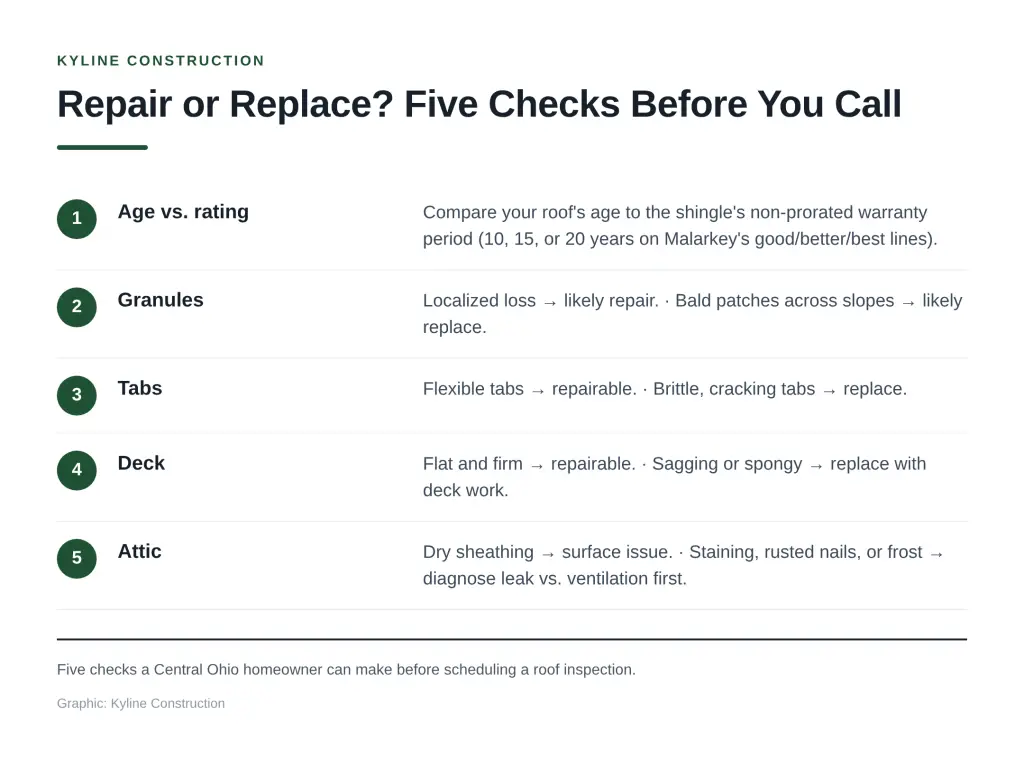
A repair makes sense when the damage is localized, the surrounding shingles still have flexible tabs and full granule coverage, and the deck is sound. A replacement makes sense when the same symptom appears on multiple slopes, when the deck is compromised, or when the roof is deep into its expected service window and you’d be repairing it again next season.
Cost is driven by roof size and pitch, number of layers to tear off, deck condition once shingles come off, the number of penetrations and valleys, and the shingle tier you choose. We publish detailed estimates that spell out costs, materials, and timelines up front, and estimates are free.
What an Inspection Should Cover
A useful roof inspection is not a five-minute look from the driveway. It should include the field shingles on every slope, all flashing points, the condition of the deck where accessible, the attic side of the sheathing, and the ventilation path from soffit to ridge. It should end with photos and a written scope, so you can see what we saw. The National Roofing Contractors Association publishes a homeowner-facing guide, Asphalt Shingle Roof Systems — A Homeowners Guide for Inspection, Maintenance and Repair, covering industry guidelines for inspections and proactive maintenance if you want to read the standard yourself.
We provide roof inspections, roof repairs, storm damage restoration, roof replacement, and new installation for homes and commercial buildings across Circleville, Columbus, and Central Ohio, and a new roof is installed as a system- ice and water barrier, underlayment, starter shingles, field shingles, and hip and ridge- not just a layer of shingles.
Get a Straight Answer on Your Roof
If you’ve spotted two or more of the symptoms above, get eyes on it before the next storm. Call Kyline Construction at (740) 777-4374 or request an inspection at kyline-consulting.com for a free, no-obligation estimate, and an honest answer about whether you need a repair or a replacement.