Best Time of Year to Replace a Roof in Central Ohio
Most people will tell you the best time of year to replace a roof is fall, and they’re mostly right. The trouble is that homeowners hear “fall” and start waiting, even when the roof over their head is already leaking in February.
Three things actually decide your timing: temperature, sunlight, and how booked local crews are. Once you know how a shingle seals itself down, picking a month gets a lot easier.
How asphalt shingles seal, and why temperature matters so much
Every modern asphalt shingle comes with a factory-applied strip of sealant that needs heat to activate. Sun and warm air soften that strip, and it bonds each shingle to the one below it. Before that bond forms, the shingles are nailed down but not sealed, and wind can lift them.
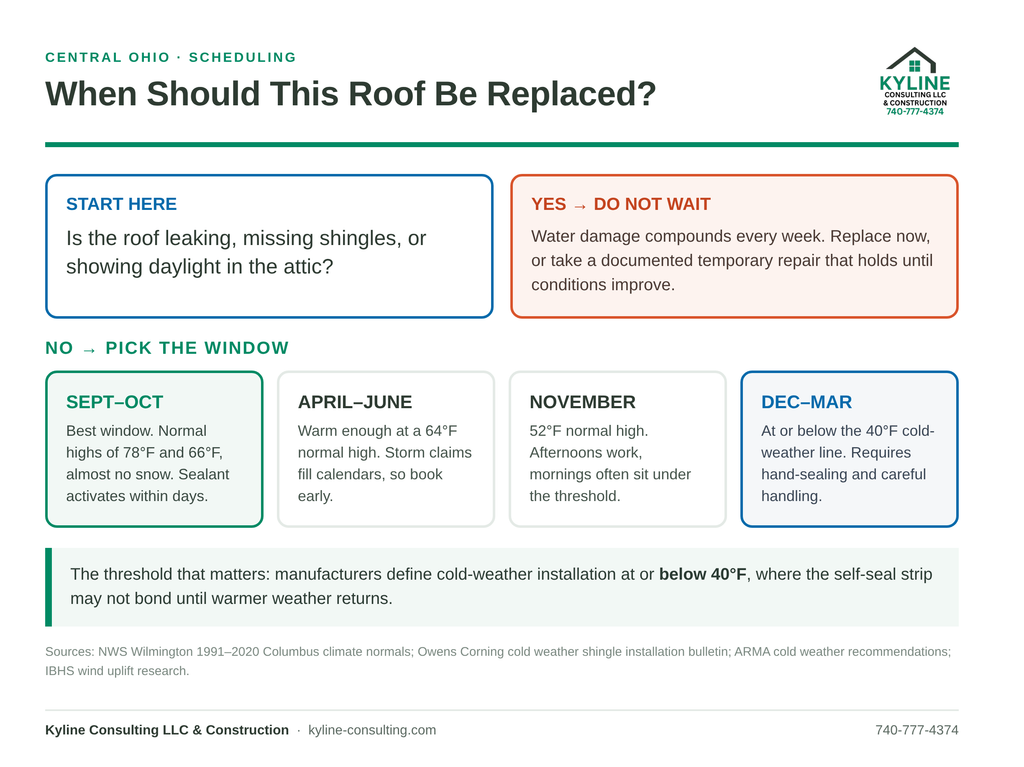
Manufacturers put the practical line near 40°F. One published cold-weather bulletin defines cold-weather installation as air and surface temperatures at or below 40°F (4°C), and it notes that shingles installed in those conditions may not seal until warmer weather returns. They can also take longer to lie flat. See the Owens Corning technical bulletin.
Cold weather doesn’t rule out a roof replacement. It does mean the crew has to work differently. The Asphalt Roofing Manufacturers Association spells out what that looks like: follow the manufacturer’s cold-weather instructions, handle bundles carefully because cold shingles crack, and hand-tab with dabs of adhesive in wind-prone areas until the sealing strips set. See the ARMA cold weather recommendations.
Testing backs up the caution. The Insurance Institute for Business & Home Safety reports that manufacturers typically call for hand-sealing on steep slopes or during extended cold, which some define as below 40°F. It also found that hand-sealing isn’t common practice on winter jobs. See the IBHS wind uplift study.
If you’re getting a roof put on in January, it is worth asking is whether your crew will actually do those extra steps.

What Columbus weather says, month by month
Columbus climate normals for 1991 to 2020 show the pattern clearly. These are the monthly averages published by the National Weather Service office in Wilmington (Columbus climate normals).
| Month | Normal high (°F) | Normal low (°F) | Normal snow (in) | What it means for shingle sealing |
|---|---|---|---|---|
| April | 64.2 | 42.2 | 0.5 | Reliably above the 40°F threshold most days. |
| September | 77.9 | 56.5 | 0.0 | Warm, dry, and long daylight. Sealing is fast. |
| October | 65.6 | 44.9 | 0.2 | Still comfortably warm on the roof surface. |
| November | 52.4 | 35.0 | 1.2 | Daytime highs work. Mornings often don’t. |
| December | 41.6 | 27.5 | 5.1 | Near or below the threshold. Hand-sealing territory. |
| January | 37.2 | 22.0 | 9.5 | Coldest and snowiest month of the year. |
| March | 51.2 | 32.1 | 4.1 | Warming, but snow and wet days still interrupt. |
The last column describes sealing conditions rather than a hard rule. A dark roof slope in full November sun runs warmer than the air around it, and a south-facing slope will seal sooner than a north-facing one.
The best time of year to replace a roof, season by season
Late summer and early fall is the sweet spot. September and October give you warm surfaces, little rain, and enough daylight to tear off and dry in a roof in a single day. Shingles seal within days instead of months, so this is the window most homeowners should aim for.
Spring works well, with one catch. April normals sit comfortably above the sealing threshold. Scheduling is the catch, because spring follows storm season and claims pile up fast.
Summer is fine, just hot. High heat softens shingles and makes them easy to scuff underfoot, so crews start early and stage material with more care. Summer heat doesn’t hurt the finished roof.
Winter is possible, and sometimes it’s the right call. A roof leaking in December will cost you more if you wait until April, because water damage keeps spreading. Your options are a cold-weather install done properly, with hand-sealing and careful material handling, or a documented temporary repair that gets you to spring.
The scheduling factor nobody mentions
Weather isn’t the only thing working against your timeline. Every other homeowner in your county is looking at the same calendar you are.
Fall is the season everyone wants, which is exactly why it fills up. Crews book tear-offs weeks out through September and October, and any storm that rolls through Central Ohio pushes emergency repairs to the front of the line ahead of planned replacements. Winter shortens the workday too. Columbus gets under ten hours of daylight from late November through mid-January, so a job that takes one day in September can easily stretch into two in December.
Book your assessment in the shoulder season, before weather makes the decision for you. A roof scheduled in August gets a much better spot on the calendar than the same roof scheduled after the first ice storm.
Signs you shouldn’t wait for a better season
A few things outrank the calendar. Active leaks or water stains on your ceilings, missing shingles after a wind event (especially along ridges and rakes), granules collecting in your gutters and at the downspouts, daylight showing through the roof deck in your attic, and decking that feels soft or spongy underfoot.
Once you’re seeing any of those, timing stops being about optimization. Our post on signs you need a new roof walks through what each symptom usually means.

What to ask before you sign for a cold-weather install
If your project lands between late November and March, ask these four questions:
- Will the crew hand-seal perimeter shingles and rakes, and with what adhesive?
- How will the bundles be stored and warmed before they go up on the roof?
- What’s the plan for ice-and-water barrier at the eaves and valleys?
- If temperatures drop mid-project, what happens to the schedule?
Clear answers to all four usually mean the contractor has real winter experience.
Kyline handles roofing repairs and installation year-round across Lancaster, Circleville, Chillicothe, Logan and the surrounding communities.. Inspections are free, and a fall inspection is how most homeowners avoid an emergency in February.
Frequently asked questions
What is the best time of year to replace a roof in Ohio?
Early fall, roughly September into October. Columbus normal highs run 65 to 78°F in those months with very little precipitation, so shingle sealant activates quickly.
Can a roof be replaced in winter in Central Ohio?
Yes, with cold-weather technique. Manufacturers define cold-weather installation at or below 40°F and call for careful handling plus hand-sealing, because the self-seal strip may not bond until warmer weather returns.
Does a roof installed in cold weather leak more?
Not if it’s installed correctly. The real risk is wind uplift before the shingles seal, which is why hand-sealing along perimeters and rakes matters on winter jobs.
Is spring a bad time to replace a roof?
No. April normals average a 64°F high, which is fine for sealing. The tradeoff is scheduling, because spring storm damage fills local roofing calendars quickly.
How long does a roof replacement take?
Most residential replacements take one to two days once material is on site, weather permitting. Steeper roofs, multiple layers of tear-off, and decking repairs add time.