Why Your Fence Deserves More Attention Than It’s Getting
Fence repair services are the fastest way to restore your yard’s security, privacy, and curb appeal — without the cost of a full replacement.
Here’s a quick look at what you need to know:
| Question | Quick Answer |
|---|---|
| When should I repair instead of replace? | When less than 20-50% of the fence is damaged |
| What’s the most common repair? | Rotted or unstable fence posts |
| Can a leaning fence be fixed? | Yes — by resetting the post in fresh concrete |
| How long does a repair take? | Most jobs are done in a single day |
| What materials can be repaired? | Wood, vinyl, chain link, aluminum, wrought iron |
| Do I need a permit? | Usually not for like-for-like repairs |
A damaged fence is easy to ignore — until it isn’t. A single loose post puts stress on the posts next to it. A small gap in a wood panel grows after one hard Ohio winter. What starts as a minor fix quietly becomes a much bigger problem.
Central Ohio weather — freeze-thaw cycles, heavy spring storms, and hot dry summers — is especially hard on fencing. It warps wood, heaves posts out of the ground, and corrodes metal hardware faster than most homeowners expect.
The good news? Most fence damage is repairable if you catch it early enough.
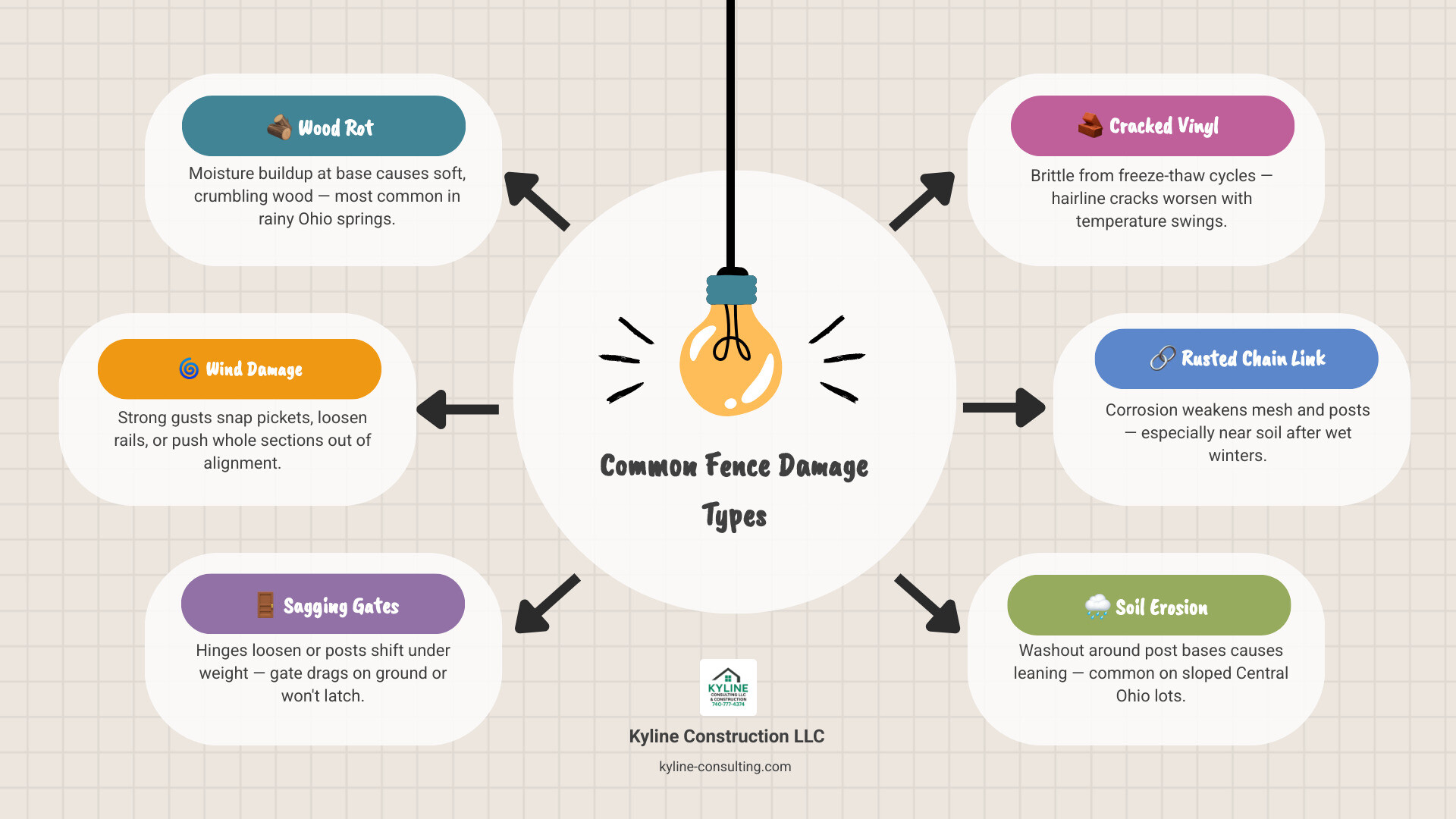
Common Types of Fence Damage and How to Spot Them
Fences take a beating year-round. In Central Ohio, our properties experience everything from humid July heatwaves to freezing January blizzards. Over time, these environmental shifts cause materials to expand, contract, and break down.
Understanding what causes fence failure is the first step in saving it. The most common issues requiring professional fence repair services include:
- Wood Rot: Wood is beautiful, but it is highly susceptible to moisture and fungi. When soil stays damp against the base of your panels or posts, rot sets in.
- Wind and Storm Damage: High winds can easily snap old posts or rip entire panels away, especially if a falling tree limb gets involved.
- Sagging Gates: Heavy gates put constant tension on latch posts. Over time, hinges bend, or the post itself shifts, causing the gate to drag on the grass.
- Cracked or Displaced Vinyl: While vinyl doesn’t rot, extreme cold makes it brittle. A stray rock from a lawnmower or a backyard football game can easily crack a cold vinyl panel. High winds can also pop vinyl panels completely out of their tracks.
- Rusted and Loose Chain Link: Moisture leads to corrosion. Once the protective coating on a chain link fence wears off, rust takes over, weakening the tension of the mesh.
- Soil Erosion and Shifting: Heavy rains wash away the soil anchoring your posts, leaving them loose and unstable.
If you want to understand the deeper biological and environmental mechanics behind how moisture and fungi degrade wood structures over time, you can read this Scientific assessment of wood rot and moisture.
Identifying Post Rot and Instability
The most critical part of your fence is the post. It bears the structural load for the entire run. If a post fails, the neighboring sections will soon follow due to lateral stress.
To check if your posts are structurally sound, perform a simple physical inspection along the ground line. Take a flathead screwdriver or a specialized probing tool and press it firmly into the wood right where the post meets the soil or concrete. If the wood feels spongy, soft, or crumbles away easily, you have rot.
Shifting soil and heavy clay — which we have plenty of around Columbus and Delaware — can also cause posts to wobble even if the wood isn’t rotted yet. If you notice your fence line shaking when the wind blows, it is time to look into professional stabilization. For homeowners planning a new project or looking to understand standard post depths in our local soils, check out our guide on fence installation in delaware ohio.
Can a Leaning Fence Be Fixed?
I get asked this question all the time: “Shawn, my fence is leaning like it’s playing limbo. Do I have to tear the whole thing down?”
The short answer is no. A leaning fence can absolutely be fixed, provided the panels themselves are still in decent shape.
The root cause of a leaning fence is almost always a compromised post. In Central Ohio, our winter freeze-thaw cycles cause the ground to expand and contract. If the original installer didn’t set the concrete footings deep enough (below the frost line), the ground will literally heave the concrete and post upward, causing it to tilt.
To fix this, we don’t just push the fence back and call it a day. That is a temporary band-aid that will fail during the next storm. Real fence repair services involve:
- Bracing the healthy adjacent panels.
- Disconnecting the leaning post.
- Digging out the old concrete footing entirely.
- Setting a brand-new post deep into the ground.
- Pouring fresh concrete and allowing it to cure completely before reattaching the panels.
If your fence was built on tricky terrain, you might also face unique water runoff and gravity issues. To understand how slope affects structural stability, read our expert advice on how to build a fence on a slope or hill.
Why Professional Fence Repair Services Are Essential for Central Ohio Homes
It is tempting to look at a broken picket or a leaning post and think, “I can knock that out on Sunday afternoon.” But fencing is heavier and more structurally complex than it looks.
Hiring professional fence repair services ensures the job is done safely, quickly, and to local building standards. Our team at Kyline Construction LLC brings decades of hands-on experience to every project. We know exactly how Central Ohio’s climate affects different materials, and we use commercial-grade fasteners, galvanized hardware, and proper concrete mixtures designed to withstand local weather extremes.
Furthermore, professional repair ensures safety compliance. For example, if you have a backyard pool, local municipal codes have strict legal requirements regarding pool fence height, gate latch placement, and self-closing mechanisms to prevent accidents. A DIY patch job that fails to self-latch could expose you to major liability.
If you want to see how professionals approach complex structural restorations, check out these Expert insights on structural fence restoration.
Choosing the Right Fence Repair Services for Your Material
Every fencing material has its own personality, structural rules, and repair requirements:
- Wood Fences: Repairing wood requires matching the exact species (like Western Red Cedar or pressure-treated pine), board width, and rail layout. New wood will always look lighter than weathered wood initially, but staining the entire fence after a thorough cleaning helps everything blend seamlessly.
- Vinyl Panels: Vinyl is modular. If a single panel cracks, we can usually slide it out and replace it without disturbing the rest of the run. The trick is sourcing the exact profile and color from the original manufacturer so the repair doesn’t stick out like a sore thumb.
- Chain Link Mesh: If a section of chain link is crushed by a fallen branch, we don’t have to replace the whole fence. We can cut out the damaged section of mesh, splice in a new piece of matching gauge wire, and re-tension the top rail.
- Aluminum and Wrought Iron Gates: Metal gates require specialized welding or hardware replacement to fix sagging.
If you are considering upgrading your yard’s perimeter or want to see how different materials look in our local neighborhoods, take a look at our page on fence installation in powell ohio.
Emergency Fence Repair for Storm and Accident Damage
When a severe thunderstorm rolls through Central Ohio, or a tree limb crashes down, your secure yard can disappear in an instant. Suddenly, your dogs can escape, your kids aren’t safe playing outside, and your home’s privacy is gone.
In these situations, you need a rapid response. We provide emergency securing and temporary fencing to keep your household safe while we plan the permanent repair.
If you are filing an insurance claim for storm damage, do not clear away the debris immediately. Take clear, high-resolution photos of the fallen tree, the broken panels, and the warped posts from multiple angles first. We can provide a detailed, written structural assessment and cost estimate that you can hand directly to your insurance adjuster to expedite your claim. For our neighbors eastward, we also offer complete services including fence installation in pataskala ohio.
Repair vs. Replacement: The 20/50 Rule
How do you decide whether to patch up your old fence or tear it down and start fresh? In the contracting world, we use a simple guideline called the 20/50 Rule.
Here is how the rule works:
- The 20% Threshold: If the damage is localized and affects less than 20% of your total fence (e.g., a couple of broken pickets, one leaning post, or a sagging gate), a targeted repair is highly cost-effective. It will easily extend the life of your fence by several years.
- The 50% Threshold: If more than 50% of the fence is showing structural failure, widespread rot, or severe storm damage, a full replacement is the smarter financial choice. Trying to patch a fence in this condition is just throwing good money after bad. You will end up paying for constant repairs that ultimately cost more than a brand-new fence.
For fences sitting between 20% and 50% damage, the decision comes down to the overall age of the structure. Most wood fences have a natural lifespan of 10 to 15 years. If your wood fence is 14 years old and the posts are starting to rot at the base, repairing a few sections is a temporary fix; a full replacement is inevitable. However, if your fence is only 5 years old and was damaged by a localized impact, repairing it is a no-brainer.
Additionally, biological issues like active termite infestations make repairs useless. Termites eat wood from the inside out, meaning the structural integrity of the entire run is likely compromised.
| Factor | Choose Repair | Choose Replacement |
|---|---|---|
| Extent of Damage | Under 20% of the structure | Over 50% of the structure |
| Post Condition | Solid, minimal shifting | Widespread rot at the ground line |
| Fence Age | Under 10 years old | Over 15 years old |
| Biological Issues | Localized moisture/surface mold | Active termite or pest infestation |
| Aesthetic Goal | Minor cosmetic touch-ups | Complete style upgrade or layout change |
To read a deeper analysis of this decision-making process, explore this guide on Deciding between repair and replacement.
What to Expect: Costs, Timelines, and Contractor Quality
When you hire professional fence repair services, you deserve clear timelines and honest pricing.
Most residential fence repairs are surprisingly fast. Replacing a few broken pickets, swapping out gate hinges, or stabilizing a single post can usually be completed in just a few hours. Even more extensive repairs — like replacing three or four structural posts — are typically completed in a single day. The only part of the process that takes time is letting the new concrete footings cure, which usually requires 24 to 48 hours before we can fully tension or attach heavy gates.
While we are discussing home improvement investments, it is helpful to keep realistic local pricing in mind. For context, while a small fence repair might cost a few hundred dollars, larger exterior projects run higher. For instance, we focus exclusively on high-quality vinyl siding for exterior cladding because of its durability and low maintenance; a full residential vinyl siding repair typically ranges from $11,000 to $17,000 (with quality vinyl siding averaging around $4.50 to $8.00 per square foot depending on the profile), and professional window replacements generally run between $400 and $900 per window.
The Critical Difference: ‘Paper Contractors’ vs. ‘Real Contractors’
Let me give you some straight talk from my decades in this industry: there is a massive, night-and-day difference between “paper contractors” and “real contractors,” and choosing the wrong one can ruin your project.
A paper contractor is nothing more than a glorified sales office. They don’t own tools, they don’t know how to build, and they often don’t even know the basic physics of a fence post. They bid on your job, collect your deposit, and then immediately shop the labor out to the cheapest, random subcontractors they can find online. If those subcontractors walk off the job, do shoddy work, or damage your property, the paper contractor is completely helpless. They can’t fix the mistakes themselves because they don’t actually know how to build anything.
A real contractor is a completely different breed. We are hands-on builders who live and breathe construction. At Kyline Construction LLC, we employ skilled, experienced professionals and oversee every single detail. If a subcontractor ever got sick or walked off one of our jobs, I have the personal skills, tools, and decades of hands-on experience to step in, grab a shovel, run the saw, and finish the job myself to perfection. When you hire a real contractor, you are paying for actual craftsmanship, accountability, and expertise—not just a middleman with a clipboard.
When hiring a contractor for your home, always look for:
- A Physical Local Presence: Ensure they are based in Central Ohio (like Columbus or Circleville) and know our local soil and weather patterns.
- Proper Licensing and Insurance: Never work with an uninsured handyman or a paper contractor who hides behind unvetted subs. If someone gets hurt on your property, you could be held liable.
- Written Estimates: Avoid verbal quotes. Insist on a detailed, written estimate that breaks down material and labor costs clearly.
Frequently Asked Questions About Fence Repair
How long does a typical fence repair job take?
Most standard residential repairs — like replacing a few rotted boards, aligning a gate, or resetting a couple of posts — are completed in a single day. If we are setting new posts in concrete, we will secure the panels temporarily and return after 24 to 48 hours once the concrete has fully cured to finish the final assembly. For a detailed breakdown of standard project durations, read about Timeframes for professional repairs.
Do I need a permit to repair my fence in Central Ohio?
In most Central Ohio municipalities (including Columbus, Circleville, and surrounding suburbs), you do not need a building permit for simple, “like-for-like” repairs on an existing fence, provided you aren’t changing the height, material, or location of the fence line. However, if you are replacing more than 50% of the fence, changing its height, or moving it closer to a property boundary, you will likely need to submit a quick zoning application. It is always smart to check your local city or HOA guidelines first.
How can I maintain my fence to prevent future damage?
Preventative maintenance is the best way to avoid expensive repairs down the road:
- Stain or Paint Regularly: Wood fences should be cleaned and stained every 2 to 3 years to seal out moisture and protect against UV damage.
- Keep the Ground Clear: Ensure dirt, mulch, and wet leaves don’t pile up against the bottom of your wood panels.
- Trim Trees and Bushes: Cut back overhanging tree limbs that could break and fall during a summer storm. Also, clear away heavy vines like ivy, which trap moisture against wood and can warp vinyl or pull down chain link.
- Improve Yard Drainage: Ensure your yard drains away from your fence posts so water doesn’t pool around the concrete footings.
Conclusion
Your fence is your home’s first line of defense. It keeps your kids and pets safely contained, outlines your property boundaries, and gives your family the privacy you deserve.
If your fence is starting to lean, sag, or show its age, don’t wait for the next major storm to turn a simple repair into a total collapse. Catching damage early is the smartest way to save money and extend the lifespan of your existing structure.
At Kyline Construction LLC, we bring over 40 years of combined home improvement experience to every project across Central Ohio. Whether you need a quick post stabilization, a gate alignment, or a complete exterior upgrade, our team of real, hands-on builders is here to help. We offer precision craftsmanship, honest communication, and free, no-obligation estimates.
If you are ready to restore the safety and beauty of your yard, take a look at our complete range of services for fences and give us a call today!