The Roof Insurance Claim Process in Ohio: What Happens After You File
The roof insurance claim process may start the day you call it in, but then most homeowners sit and wait to hear back. You’ve got more say in how it goes than that. Ohio gives your insurer deadlines it has to meet, your policy decides how the money reaches you, and the adjuster’s numbers can be corrected when they’re wrong.
The roof insurance claim process starts a clock
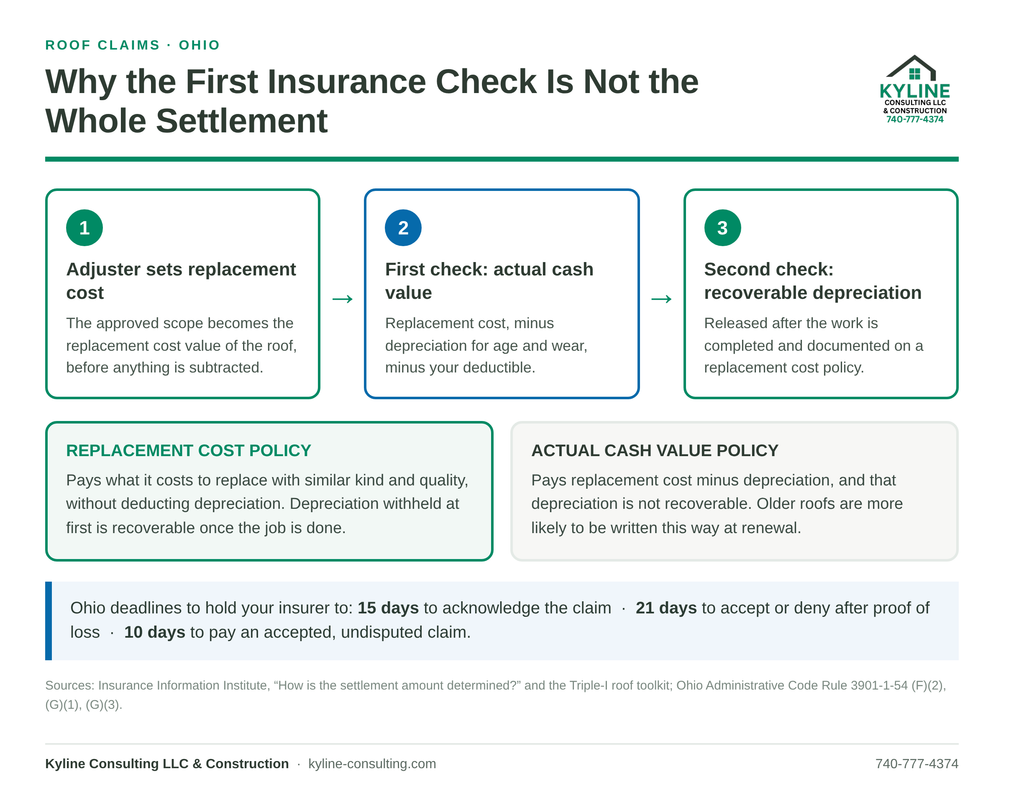
Ohio’s rule on claim handling sets the pace. Your insurer has 15 days from notice to acknowledge the claim. They then have 21 days to accept or deny once it has a properly executed proof of loss, and 10 days to pay an accepted claim nobody is disputing (Ohio Administrative Code 3901-1-54).
Write down the date you first reported it. Every one of those clocks runs from that date, not from the storm.
The claim timeline, door-knockers, contracts and public adjusters get the full treatment in our post on storm damage insurance claim questions Ohio homeowners ask most. This one covers what happens to the money after your claim is accepted.

The adjuster visit sets the number
Your insurer sends an adjuster out to scope the roof damage. Whatever that adjuster writes down becomes the dollar figure your claim gets paid on, so it’s worth being home for the visit.
Ask your roofer to be on site for it. Someone who has already walked your roof can point out lifted shingles, bruised mats, cracked vents and bent flashing. Those details get missed on a quick walkthrough. Watch the measurements too. An adjuster who sizes up the roof from the ground can undercount your squares, which lowers the payout.
Bring your own file too. Your roofing contractor can hand you the photos and measurements to go with it. Our guide on what to document before you file a hail damage claim walks through the photos and storm-date records worth pulling together first.
The money usually comes in two payments
Insurance claims for roof damage usually pay out in two pieces. Homeowners open the first check, see a number well below the estimate, and figure they got shorted. Most of the time the claim is fine and the payment is just the first half.
The Insurance Information Institute lays out the difference between the two ways a policy pays. A replacement cost policy pays what it costs to replace the damaged property with something of similar kind and quality. Nothing gets taken off for depreciation. An actual cash value policy pays that same replacement cost minus depreciation, which is the value your roof lost to age and wear. The III explains it in how a settlement amount is determined.
| Stage | What it represents | What triggers it | Source |
|---|---|---|---|
| Approved scope | Replacement cost value of the roof, before any subtractions | Adjuster inspection and agreed scope | III, settlement amounts |
| First payment | Replacement cost minus depreciation minus your deductible, the actual cash value | Acceptance of the claim. Ohio expects payment within 10 days on an undisputed claim | OAC 3901-1-54(G)(3) |
| Supplement | Documented items the first scope missed, such as decking or code work | Photos and measurements submitted after tear-off | III, settlement amounts |
| Second payment | The withheld recoverable depreciation | Completed work, invoiced and documented | III, settlement amounts |
| No second payment | Nothing further is released because the depreciation was not recoverable | The policy was written at actual cash value | Triple-I roof toolkit |
Cash the first check, finish the work, then send in the invoice and photos to release the depreciation. Homeowners who stop after the first payment leave that second piece sitting with the insurer.
Check your declarations page while you’re at it. The III says some insurers move older roofs to actual cash value coverage at renewal, and many ask for an inspection once a roof passes 20 years (roof and insurance toolkit). If your policy switched at some point, there’s no recoverable depreciation waiting for you, and that’s worth knowing before the next hail storm.
Supplements cover what nobody could see
An adjuster can only price what they can see from the surface. Once the old shingles come off, the crew often finds rotted decking, an undersized drip edge, or a missing ice-and-water barrier at the eaves, and sometimes the ventilation doesn’t meet code. Nobody can spot any of that from a ladder.
A supplement asks the insurer to add those documented items to the approved scope. It needs photos, measurements and a line-item explanation of each one. Done that way, it’s routine paperwork that gets approved.
Code items belong in the same conversation. Ohio’s residential code requires shingles to go on per the manufacturer’s instructions, and those instructions carry fastening and underlayment details that a first scope sometimes leaves out.
A denial can be reopened
Read the denial letter and find the exact reason it gives. Wear and tear, pre-existing damage and maintenance exclusions come up the most. All three are judgment calls about your roof’s condition, and a fresh inspection report can change the answer.
- Ask for the full estimate and any engineer or inspection report. You’re entitled to see what the decision was based on.
- Get an independent inspection. A written contractor report with dated photos carries weight that a phone call doesn’t.
- Request a reinspection. Insurers reopen files when fresh documentation lands.
- File a complaint with the Ohio Department of Insurance. The department asks your insurer to respond. Under OAC 3901-1-54(F)(4), the company has 21 days to answer a department inquiry about a claim.
- Watch the suit-limitation clause in your policy. Most homeowner policies cap how long you have to bring an action. Your insurer has to warn you at least 60 days out. Track the date yourself anyway.
Get on a schedule before the weather turns
Storm season and roofing season overlap in Ohio. Franklin County has logged 404 damaging thunderstorm wind events since 1996 and Fairfield County 226, according to county counts compiled from the NOAA Storm Events Database. Insurance claims pile up after those storms, and so do roofing contractor calendars.
If your claim gets approved in late fall, ask whether the install can still go on well in the cold. Usually it can, with the right handling. If it can’t, ask what temporary repair keeps water out until spring.

Kyline handles roofing repairs and replacement across Lancaster, Circleville, Chillicothe and the rest of central Ohio, and we’ll meet your adjuster on the roof. If water is coming in right now, start with emergency repair services and sort the paperwork after.
Frequently asked questions
How long does the roof insurance claim process take in Ohio?
It depends on your insurer and on how many claims that storm produced. The state milestones don’t move. Acknowledgment is due within 15 days, an accept-or-deny decision within 21 days of a properly executed proof of loss, and payment within 10 days of acceptance on an undisputed claim (OAC 3901-1-54).
Why was my first insurance check so much smaller than the estimate?
It’s usually the actual cash value payment, which is replacement cost minus depreciation minus your deductible. On a replacement cost policy, the withheld depreciation gets released after the work is done and documented.
Does the insurance company decide which roofer I use?
No. Your insurer can hand you a preferred vendor list, and you can still hire the licensed contractor you want. That contractor can work with the adjuster on scope.
Can my claim be denied because my roof is old?
Age by itself is not damage. It does affect coverage, because older roofs are more likely to be written at actual cash value, and insurers often require an inspection once a roof passes 20 years.
What is a supplement, and who files it?
A supplement adds documented items to an approved scope, usually after tear-off exposes decking or code work. Your contractor puts it together with photos and measurements and sends it to the adjuster.
What should I do if my claim is denied?
Get the written reason first. Then line up an independent inspection, request a reinspection with that new documentation, and file a complaint with the Ohio Department of Insurance if the file stops moving.