The Fastest Way to Find Budget-Friendly Deck Repair Services in Central Ohio
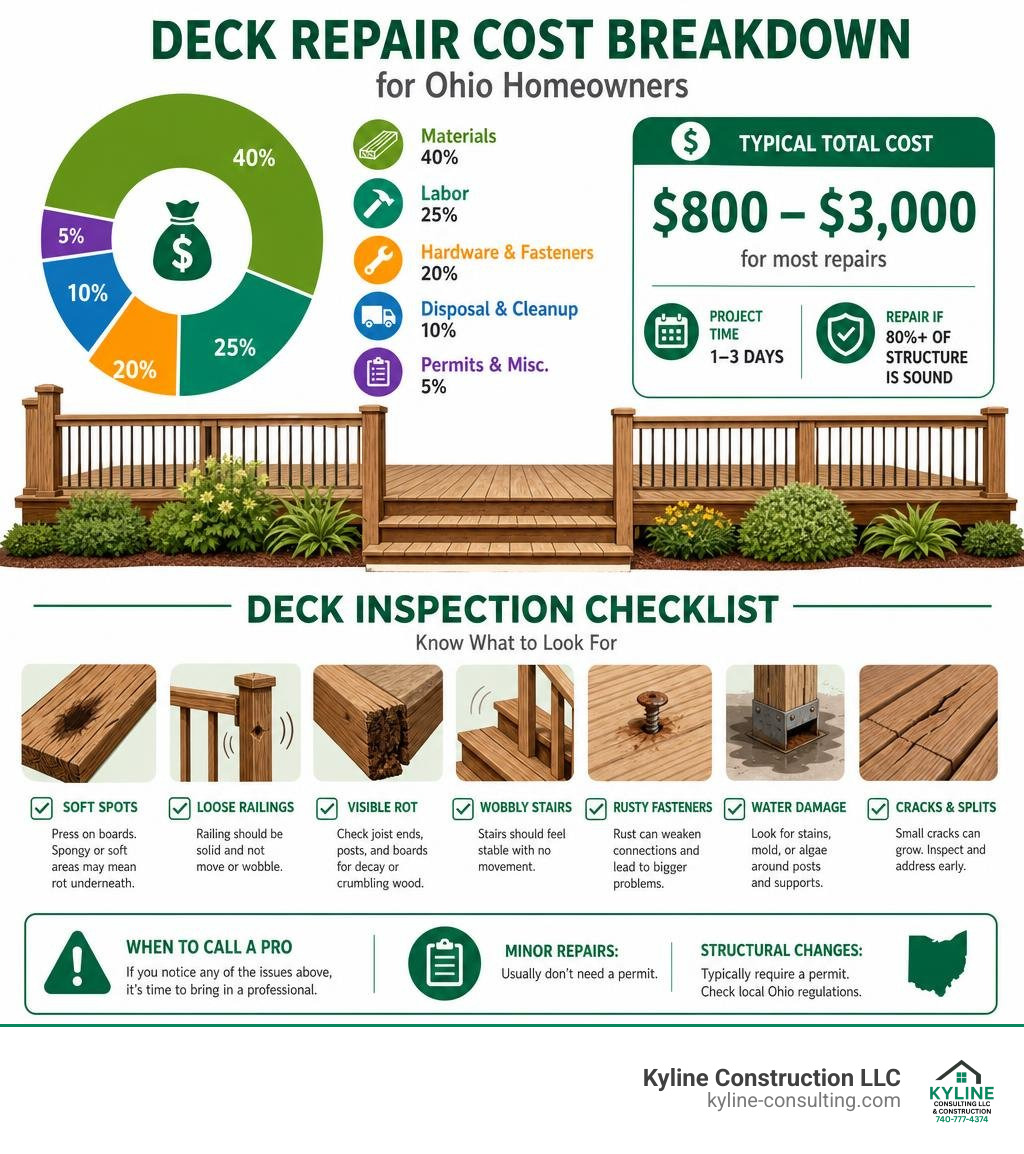
Looking for a quick answer? Here’s what most Ohio homeowners need to know upfront:
| Question | Quick Answer |
|---|---|
| Average repair cost | $800 – $3,000 for most repairs |
| Typical project time | 1–3 days |
| Repair vs. replace threshold | Repair if 80%+ of structure is sound |
| When to call a pro | Soft spots, loose railings, visible rot, wobbly stairs |
| Permit needed? | Usually not for minor repairs; yes for structural changes |
Finding reliable deck repair services that don’t blow your budget is harder than it should be — especially in Central Ohio, where freeze-thaw cycles and humid summers put real stress on outdoor structures every single year.
Most decks here show their age fast. A few loose boards turn into soft joists. A wobbly railing becomes a safety hazard. Before long, what looked like a small fix is creeping toward a full rebuild — and a much bigger bill.
The good news? Most decks don’t need to be replaced. With the right repairs done at the right time, you can extend your deck’s life significantly without spending a fortune. This guide covers the best budget-friendly options available to Central Ohio homeowners right now.
Easy deck repair services glossary:
Spotting the Damage: When Do You Need Professional Deck Repair Services?
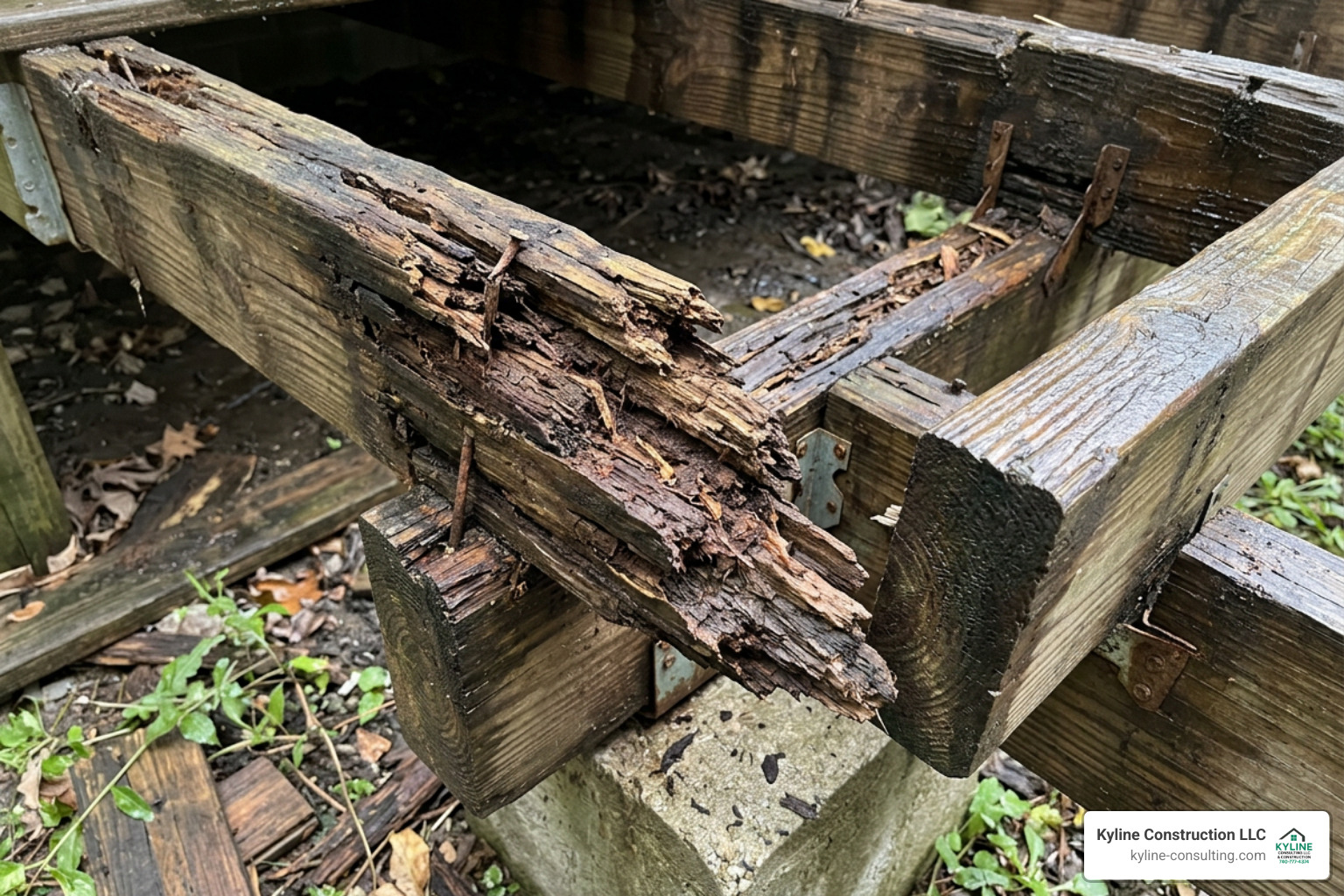
Before we talk about budgets, we have to look at what actually goes wrong with Ohio decks. Wood is a natural material, and even the best pressure-treated lumber eventually gives way to the elements. In our corner of Central Ohio, the combination of heavy winter snows and high summer humidity creates a perfect breeding ground for structural decay.
When you are trying to keep costs down, the trick is catching the damage before it spreads to the structural skeleton of your deck. If you let a small patch of moisture damage sit, it will eat its way through your joists and ledger boards. At that point, you are no longer looking at a quick budget-friendly fix—you are looking at a major structural overhaul.
If you want to keep your backyard safe without draining your savings, you need to know exactly what to look for during your spring and fall walk-throughs. For a deeper dive into local deck issues, check out our guide on how to Patch Up Your Patio: Ohio’s Best Deck Repair Pros.
Common Signs of Wood Rot and Structural Decay
Wood rot is the ultimate budget-killer. It occurs when the moisture content in your deck boards or framing remains above 20% for an extended period, allowing wood-decaying fungi to take root.
Here is what we look for when we inspect a deck in Columbus or Circleville:
- Spongy or Soft Wood: Take a flathead screwdriver and gently poke any areas that look dark or damp. If the wood fibers yield easily or feel spongy, rot has already begun.
- Discolored Patches and Mold: Dark white, gray, or black spots on your timber are clear indicators of standing moisture.
- Crumbling Timber: If you can break off pieces of your deck boards or joists with your bare fingers, the structural integrity of that piece is completely gone.
- Fungal Growth: If you see actual mushrooms growing out of your deck framing, the rot is advanced and needs immediate professional attention.
Catching these signs early is the difference between a $500 board replacement and a massive structural rebuild. To understand how these issues impact your wallet, take a look at our breakdown of the Deck Rot Dilemma: What’s the Real Cost to Repair?.
Safety Hazards: Loose Railings and Wobbly Stairs
While a soft deck board is annoying, a loose railing or a wobbly stair tread is an accident waiting to happen. These are critical safety issues that should never be put off, regardless of your budget.
Wobbly handrails are usually caused by loose fasteners or rusted hardware where the posts connect to the deck frame. Over time, the constant physical strain of people leaning on the rails, combined with wood expansion from Central Ohio’s humid summers, loosens the bolts.
Stair treads take the brunt of foot traffic and are highly susceptible to moisture trap. If the stair stringers (the sloped boards supporting the steps) begin to rot, the entire staircase can collapse under load.
The absolute most dangerous safety hazard we see is ledger board failure. The ledger board is what fastens your deck directly to your house. If this connection was installed without proper flashing, water will seep behind it, rotting both the ledger and your home’s rim joist. When a ledger board fails, the entire deck can pull away from the house and collapse. If you notice a gap opening up between your deck and your home, do not step onto the deck—call a professional immediately.
Repair, Resurface, or Rebuild: Making the Budget-Friendly Choice
When we sit down with homeowners in Circleville and Columbus, the most common question we get is: “Do I really need a brand-new deck, or can we save what’s already here?”
As a general rule, we always try to save the existing frame if the structural skeleton of the deck is still sound. It is a massive waste of money to tear down solid, pressure-treated structural framing support just because the surface boards look weathered and splintered.
To help you visualize the best path forward for your budget, we use a simple decision framework:

If your posts, beams, and joists are structurally sound, resurfacing (also called re-decking) is an incredibly smart, budget-friendly choice. It allows you to replace only the surface boards and railings, saving you 40% to 60% compared to the cost of a full rebuild. If you are considering tackling some of these surface fixes yourself, read our helpful Composite Deck Repair Made Easy: A DIYer’s Handbook.
The 30 Percent Rule for Deck Board Replacement
How do you draw the line between targeted board replacement and full resurfacing? We use the 30 Percent Rule.
If less than 30% of your deck surface boards are damaged, warped, or rotted, it makes the most sense to perform targeted board replacements. We simply back out the old fasteners, cut out the damaged sections, and install matching pressure-treated or composite boards.
If you have composite decking, we use specialized circular saws to make clean, precise cuts without melting or fraying the synthetic fibers. Modern composite decks have an incredible lifespan of 25-50 years, but if a single board gets gouged or damaged by a heavy grill or dropped tool, a targeted replacement is a quick and cheap fix.
However, if more than 30% of your deck boards are showing severe splitting, warping, or rot, paying a contractor to replace them individually becomes highly inefficient. At that point, the labor costs of piecemeal repairs will catch up to the cost of a full resurfacing.
Resurfacing vs. Full Rebuild Cost Breakdown
To keep your expectations realistic, let’s look at how the numbers actually shake out for Central Ohio homeowners in July 2026.
| Project Type | Scope of Work | Average Cost Range | Structural Lifespan |
|---|---|---|---|
| Targeted Repair | Replacing 2-10 surface boards, tightening railings, reinforcing a few joists. | $800 – $3,000 | Adds 3–7 years to current deck |
| Resurfacing | Tearing off old surface boards and railings; keeping the existing frame; installing new wood or composite. | $3,500 – $8,500 | 15–20 years (depending on frame age) |
| Full Rebuild | Complete demolition of old deck; pouring new footings; building a brand-new frame and surface. | $9,000 – $22,000+ | 20–30 years |
As you can see, keeping your existing frame and opting for targeted repairs or resurfacing keeps your project firmly in that manageable $800 to $3,000 range. The average structural lifespan of a well-maintained wood deck frame is about 20 years. If your frame is only 8 or 10 years old and the wood is still solid, there is absolutely no reason to pay for a full rebuild.
Finding Reliable Contractors in Central Ohio
Now, let’s talk about the actual process of getting this work done. If you are living in Columbus, Circleville, or any of the surrounding suburbs, you have likely noticed that finding a contractor who actually answers the phone and gives you an honest bid is surprisingly tough.
When you are looking for budget-friendly deck repair services, you have to be careful. There are plenty of fly-by-night operations that will offer you an unbelievably low price, only to vanish halfway through the job or hit you with massive “unexpected” upcharges once your deck is half-demolished.
If you want to avoid getting burned, check out our guide on Don’t Get Decked: Finding Top-Rated Deck Building & Repair Near You.
Why Real Contractors Outperform Paper Contractors
Let me share some critical industry perspective. In the home improvement world, there is a massive, non-negotiable difference between what we call “paper contractors” and “real contractors.” Understanding this distinction is the single most important factor in protecting your home and your wallet.
A paper contractor is essentially a broker. They don’t actually know how to build or repair anything themselves. They sit in a clean truck, manage a spreadsheet, and sub out 100% of the physical labor to whoever is willing to work for the lowest daily rate that week. If their subcontractor doesn’t show up, or if a crew walks off the job because of a dispute, your project grinds to a halt. The paper contractor can’t help you because they don’t even own a circular saw. They are middlemen who inflate costs while adding zero craftsmanship.
A real contractor is entirely different. We are hands-on builders who grew up on job sites, tool belts on, getting our hands dirty. We manage our crews and subcontractors closely, but more importantly, we have the actual skills to step in and finish the job personally if a subcontractor quits or gets sick.
When you hire a real contractor, you are paying for actual craftsmanship, deep structural knowledge, and absolute accountability—not just a middleman who passes paper back and forth. If a problem comes up on-site, a real contractor knows exactly how to fix it on the spot without waiting for a callback from a third party. This distinction is what separates a stressful, delayed project from a seamless, high-quality build.
How to Vet Local Deck Repair Services
When you are ready to start gathering quotes, don’t just hire the first name that pops up on your phone. Take 15 minutes to vet them properly:
- Check Local Standing: Look for companies with a physical presence near you. For example, you can search for a verified Deck Builder near Circleville, OH | Better Business Bureau to ensure they are registered and have a clean track record.
- Read Real Reviews: Don’t just trust the testimonials on a contractor’s website. Look at independent platforms. You can browse the Top 10 Best Deck and porch pros in Circleville, OH | Angi to see what your neighbors are saying about their actual experiences.
- Ask the “What If” Question: Ask the estimator point-blank: “If your crew doesn’t show up on Tuesday, who is coming to finish my deck?” If the answer is vague, you are likely dealing with a paper contractor.
Choosing Budget-Friendly Deck Repair Services Near Columbus
If you are located in the metro area, you have access to various local maintenance and handyman operations.
For quick, reliable surface fixes and minor patio tune-ups, a general handyman service can often handle small, straightforward repair tasks. However, make sure they are fully insured and experienced with outdoor structures.
If your deck needs more extensive framing work, structural reinforcement, or a complete face-lift to bring it back up to Ohio building codes, you should talk to a dedicated local specialist who understands structural load requirements and local building regulations. Working with a specialized deck professional ensures your repairs are safe, durable, and fully compliant with local codes.
Frequently Asked Questions About Deck Maintenance
Taking care of your deck after the repairs are finished is the absolute best way to protect your investment and prevent future damage. To help you keep your deck in top shape, we have answered the most common questions we get from Central Ohio homeowners. For more tips on keeping your outdoor wood looking beautiful, read our guide on how to Color Your Outdoor World: Deck Staining & Restoration in Ohio.
How long does a typical deck repair project take?
Most standard deck repair services—such as replacing a dozen surface boards, reinforcing a sagging joist, or stabilizing a shaky handrail—take 1 to 3 days to complete.
The exact timeline depends on the overall project scope and how easy it is to access your deck frame. If we find hidden structural rot once the old boards are pulled up, we will need to pause and reinforce the framing before putting down new wood. However, a professional crew should be able to get in, secure your deck, clean up the job site, and get out in under a week.
How does Ohio weather affect deck deterioration?
Central Ohio weather is incredibly tough on outdoor wood. Our climate features dramatic temperature swings, high humidity, heavy winter snow loads, and—most importantly—frequent freeze-thaw cycles.
During late autumn and early spring, we experience days where temperatures rise above freezing, allowing rain or melting snow to soak deep into the wood fibers. Overnight, the temperature drops below freezing. That trapped water turns to ice and expands, micro-splitting the wood fibers from the inside out. Over several seasons, these cycles cause boards to warp, cup, crack, and lose their fastener holding power.
Should pressure-treated wood weather before sealing?
This is one of the biggest myths in the home improvement industry! For years, people were told to let new pressure-treated lumber “weather” for six months to a year before applying any sealant.
If you leave brand-new, unsealed pressure-treated wood exposed to the hot Ohio sun and rain for a year, it will warp, crack, and turn gray before you ever get a brush on it.
Instead, you should seal your deck as soon as the wood is dry enough to absorb the sealant. We use the simple “water drop test.” Sprinkle a few drops of water onto the wood surface. If the water beads up, the wood is still too wet from the pressure-treating process. If the water drops soak rapidly into the wood fibers, it is ready for an immediate coat of high-quality water-repellent preservative or stain.
Conclusion
Your deck is the heart of your backyard living space. When it starts showing its age, you don’t have to choose between a massive financial headache and a dangerous, wobbly structure. By catching wood rot early, focusing on targeted board replacements, and choosing honest, hands-on professionals, you can keep your outdoor space safe and beautiful on a realistic budget.
At Kyline Construction LLC, we bring over 40 years of experienced professionalism to every single project we touch across Circleville, Columbus, and Central Ohio. Whether you need a quick deck tune-up, a complete resurfacing, or other home upgrades—like our professional vinyl siding installations (averaging $11,000 to $17,000 for a full siding repair, or roughly $6.50 per square foot) or window replacements ($400 to $900 per window)—we are here to help. We never use paper-contractor tricks, and we always stand behind our work.
Ready to get your deck ready for family cookouts and quiet summer evenings? Contact us today to schedule your free, no-obligation estimate, and let’s get your patio looking brand-new again: Patch Up Your Patio: Ohio’s Best Deck Repair Pros.