Why Your Windows Are Costing You More Than You Think
Energy conserving windows are one of the most impactful upgrades an Ohio homeowner can make — and one of the most misunderstood.
Here’s the quick answer most people are looking for:
| What You Want to Know | The Short Answer |
|---|---|
| What are energy conserving windows? | Windows engineered to reduce heat loss and gain through better glass, frames, and seals |
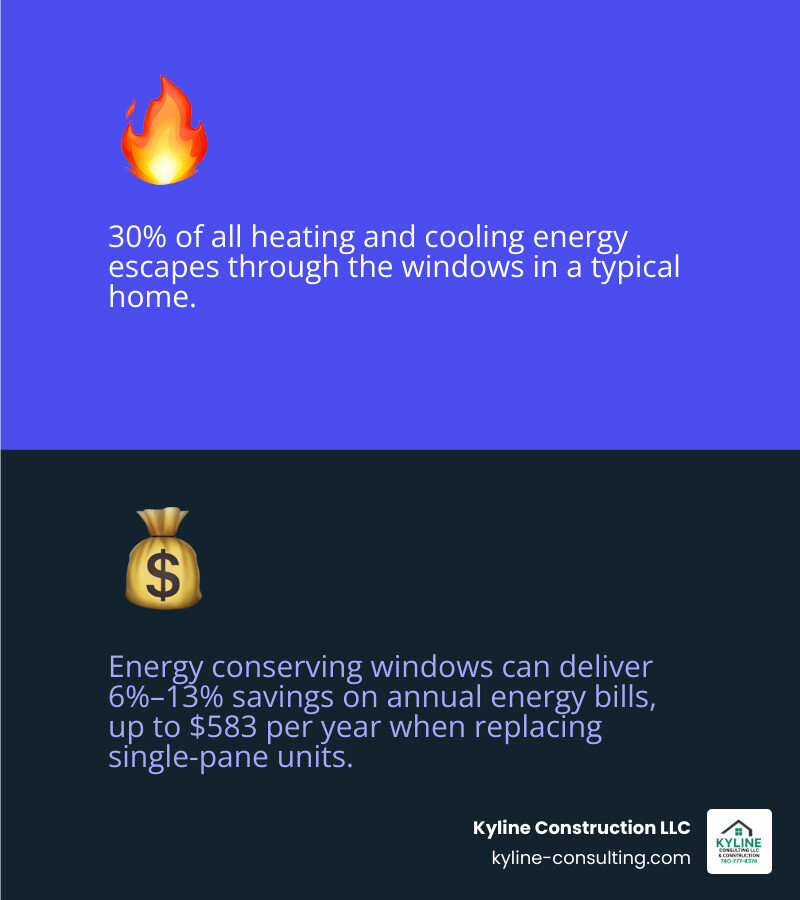
| How much can they save? | 6%–13% on annual energy bills; up to $583/year replacing single-pane |
| Key ratings to look for | U-factor ≤ 0.30, low SHGC for warm climates, high SHGC for cold climates |
| Best certification to look for | ENERGY STAR Version 7.0 + NFRC label |
| Federal tax credit available? | Yes — 30% of cost, up to $600, through 2032 |
| Worth it in Ohio? | Yes — Central Ohio winters make low U-factor windows especially valuable |
In a typical home, roughly 30% of all heating and cooling energy escapes right through the windows. That’s not a minor leak — that’s nearly a third of your utility bill quietly walking out the glass every single month.
For homeowners in Central Ohio, where winters bite hard and summers push the AC to its limits, that number hits close to home.
This guide breaks down everything you need to know — from reading performance labels to choosing the right glass package for your specific home — so you can make a smart, confident decision.
Learn more about energy conserving windows:
Decoding the Performance Labels: U-Factor and Beyond
When you start shopping for energy conserving windows, you’re going to see a lot of stickers. These aren’t just for show. The National Fenestration Rating Council (NFRC) label is the “nutrition facts” for your window. If a contractor can’t explain these numbers to you, they are likely a “paper contractor”—someone who sells jobs but doesn’t understand the physics of the products they install. A “real contractor” knows these ratings inside and out.
Here is the breakdown of what matters for your Columbus or Circleville home:
- U-Factor: This is the big one. It measures how well a window prevents heat from escaping. In Ohio, where we spend half the year running the furnace, you want this number as low as possible. A rating of 0.30 or below is considered very good, but for our Northern Climate zone, aiming for 0.25 or lower is even better.
- Solar Heat Gain Coefficient (SHGC): This measures how much solar radiation comes through the glass. In the summer, a low SHGC keeps your house cool. However, in Ohio, we sometimes want a bit of “passive solar” heat in the winter. Generally, an SHGC between 0.20 and 0.40 is the sweet spot for our region.
- Visible Transmittance (VT): This tells you how much natural light gets through. You want efficiency, but you don’t want to live in a cave.
- Air Leakage (AL): This measures how much air “leaks” through the window’s joints. Most industry standards require 0.30 cfm/ft² or less. If this number is high, you’ll feel drafts no matter how good the glass is.
For a deeper dive into how these apply specifically to our state, check out the [PDF] Energy Code Compliance Guide to Window Selection in Ohio.
Understanding ENERGY STAR Version 7.0
As of May 2026, we are operating under ENERGY STAR Version 7.0 standards, which took effect in late 2023. These are the strictest requirements yet. To earn the label in the Northern Zone (which includes Columbus and Circleville), windows must meet much more demanding U-factor requirements.
When you see that blue label, it means the window has been independently verified to save you money. For more on how to pick the right ones, read Window Wisdom: Maximizing Energy Savings in Your Home.
The Anatomy of High-Performance Energy Conserving Windows
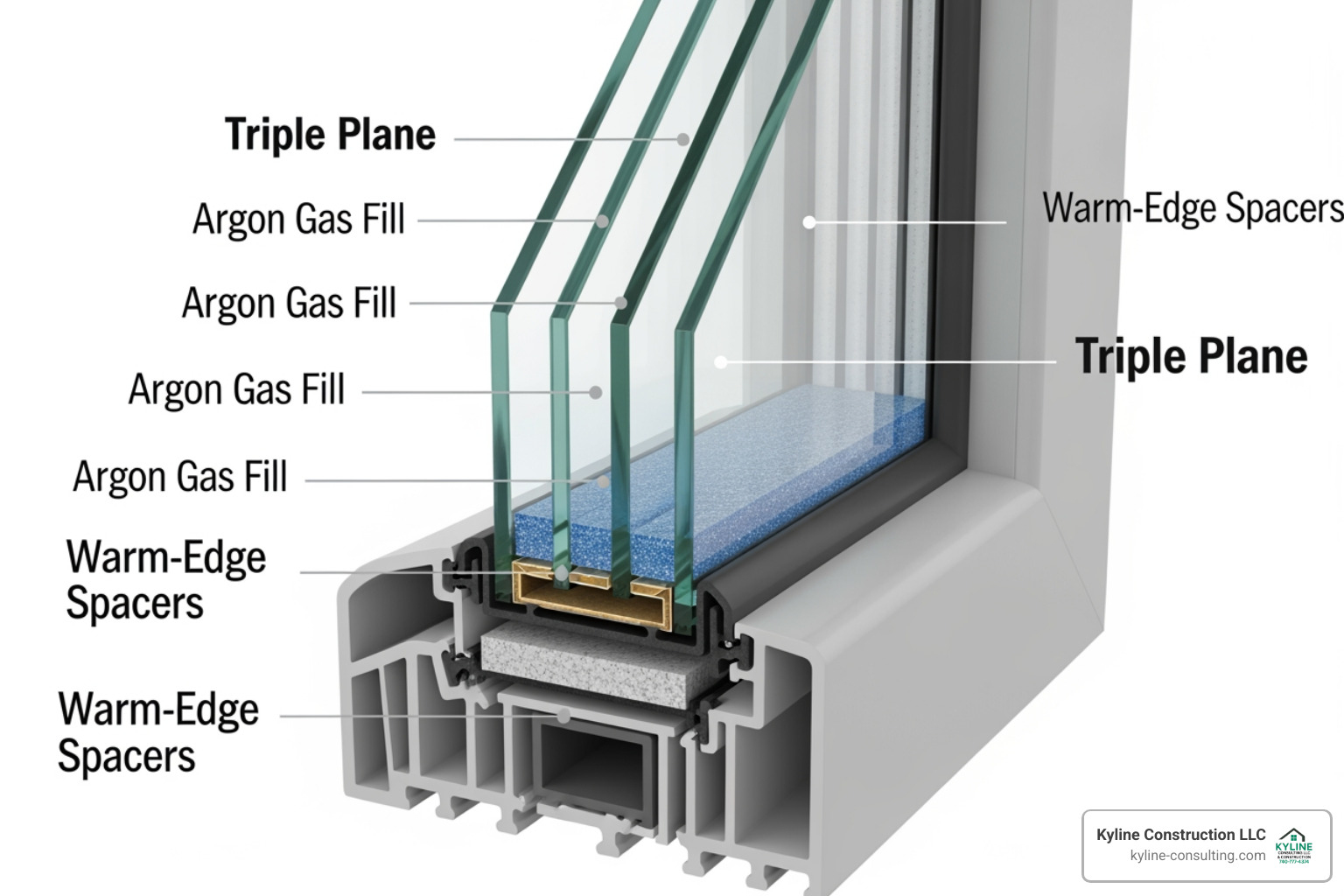
What actually makes a window “energy conserving”? It’s not just “thick glass.” It’s a combination of several high-tech components working together like a thermal shield for your home.
- Multiple Panes: Single-pane windows are basically holes in your wall. Double-pane windows are the standard now, creating an insulating air pocket. If you want the gold standard, triple-pane units can be up to 62% more efficient than single-pane options.
- Low-E Coatings: This is a microscopic layer of silver or other metallic oxide applied to the glass. It reflects infrared light (heat) while letting visible light through. In the winter, it reflects your home’s heat back inside. In the summer, it bounces the sun’s heat back out.
- Gas Fills: Instead of just air, high-performance windows fill the space between panes with Argon or Krypton gas. These gases are denser than air and move much slower, which significantly slows down heat transfer.
- Warm-Edge Spacers: Old windows used metal spacers to hold the glass apart. Metal conducts heat, which is why you’d see condensation and ice at the edges of old windows. Modern “warm-edge” spacers are made of composite materials or structural foam that block heat transfer.
You can learn more about the science of glass in our guide: Double the Panes, Double the Gains with Low-E Windows.
Why Energy Conserving Windows Outperform Storm Windows
I often get asked if a homeowner can just slap on some storm windows or films. While storm windows can save 12%–33% on heating costs, they are a “band-aid” fix.
Energy conserving windows provide a permanent, airtight seal that storm windows simply can’t match. Plus, they offer superior UV protection—reducing the fading of your furniture and flooring by up to 75%. If you’re deciding between the two, check out Choosing the Best Energy Efficient Storm Windows: What Every Homeowner Needs to Know.
Frame Materials for Central Ohio Homes
In Circleville and Columbus, we deal with humidity and extreme temperature swings. This makes your frame choice critical. We focus exclusively on Vinyl: This is our specialty at Kyline Construction. Modern, multi-chambered vinyl frames are fantastic insulators, especially when integrated with vinyl siding. They don’t rot, they don’t need paint, and they are very affordable (typically $400–$900 per window depending on the glass package). For our clients, Energy Efficient Vinyl Windows are a Smart Choice because they provide the best ROI and thermal performance for the price.
Strategic Selection for Ohio Climates and Home Design
Not every window in your house should be the same. A “real contractor”—unlike a “paper contractor” who uses a one-size-fits-all approach—will look at the orientation of your home to maximize your savings.
| Window Orientation | Recommended Strategy | Why? |
|---|---|---|
| North-Facing | Lowest U-Factor | These windows never see the sun; they are just cold spots in the winter. |
| South-Facing | Moderate SHGC | Allows some winter sun to help heat the home while maintaining insulation. |
| East/West-Facing | Low SHGC | Blocks the intense morning and afternoon sun that causes AC bills to spike. |
By tailoring your energy conserving windows to the side of the house they sit on, you can significantly improve your year-round comfort. For more technical details on this, see the High-Performance (ENERGY STAR) Windows | Building America Solution Center.
Maximizing ROI with Energy Conserving Windows
Let’s talk turkey. How much does this actually save? Nationwide, replacing single-pane windows with ENERGY STAR models saves an average of 13% on utility bills. In Ohio, specifically, the DOE estimates annual savings of up to $401 when replacing single-pane windows.
Beyond the monthly bills:
- Tax Credits: You can claim a federal tax credit of 30% of the cost, up to $600 per year, through 2032.
- Home Value: The national ROI for window replacement is roughly 69.5%. It’s one of the few upgrades that pays you back both monthly and when you sell.
For a full breakdown of the math, check out Crunching the Numbers: Your Guide to Energy Savings with New Windows.
Real Contractors vs. Paper Contractors: Why Installation is Everything
This is where I get a bit fired up. You can buy the most expensive, triple-pane, krypton-filled window in the world, but if it’s installed poorly, it’s worthless.
There is a massive, non-negotiable difference between a “paper contractor” and a “real contractor.” A paper contractor is essentially a middleman—a salesperson with a fancy phone and a slick pitch. They hire the cheapest, unvetted subcontractors they can find and hope for the best. If those subs walk off the job or botch the flashing, the paper contractor is helpless because they lack the actual trade skills to pick up a tool and fix it. They are paper-thin on expertise and heavy on excuses.
At Kyline Construction, we are “Real Contractors.” We specialize in vinyl siding homes, ensuring every window integration is perfectly flashed and sealed against the elements. I make sure our team has the hands-on expertise to finish the job personally if a sub ever fails. When we install energy conserving windows in vinyl-sided homes, we don’t just “pop them in.” We focus on:
- Air Sealing: We insulate the gap between the window frame and the rough opening. Without this, air leaks around the window, making the energy ratings irrelevant.
- Proper Flashing: Ensuring water sheds away from the home so you don’t end up with rot inside your walls.
- Precision Leveling: If a window isn’t perfectly square, the seals won’t meet correctly, leading to air infiltration and “seal failure” within a few years.
Proper installation is the secret sauce to Maximizing Home Comfort with Efficient Windows.
Frequently Asked Questions About Energy Conserving Windows
How much can I actually save on my Columbus utility bills?
While it depends on your current windows, homeowners replacing old single-pane windows in Central Ohio typically see savings between $101 and $583 per year. Even replacing old double-pane windows can save you nearly $200 annually because modern coatings and gas fills are so much more advanced than the technology from 20 years ago.
Do I really need triple-pane glass in Ohio?
“Need” is a strong word, but for Ohio winters, it’s a great investment. Triple-pane windows often reach a U-factor of 0.20 or lower. They are excellent for sound dampening (great if you live near High Street or a busy Circleville road) and virtually eliminate that “chill” you feel when sitting near a window in January. However, they do cost more, so we usually look at the “diminishing returns” based on how long you plan to stay in the home.
Can I just use window film instead of replacing the unit?
You can, but it’s a temporary fix. Films can peel, bubble, and eventually lose their effectiveness. More importantly, film doesn’t fix a leaky frame or a failed seal. If your windows are drafty or the frames are warped, a film is just putting a band-aid on a broken bone.
Conclusion
Upgrading to energy conserving windows isn’t just about being “green”—it’s about keeping your hard-earned money from floating out into the Ohio sky. By focusing on the right NFRC ratings, choosing quality vinyl frames, and—most importantly—hiring a “real contractor” who knows how to seal a home envelope correctly, you can transform your home’s comfort.
At Kyline Construction LLC, we’ve spent over 40 years perfecting the craft of home improvement in Circleville and Columbus. We are “Real Contractors,” not “paper contractors” who hide behind a desk and a phone. We do precision craftsmanship that lasts.
Ready to stop the 30% energy leak in your home? Schedule your free window estimate today and let’s make your home the most efficient one on the block.