Is It Time to Upgrade? What Every Ohio Homeowner Should Know About Double Pane Window Replacement
Double pane window replacement is one of the highest-impact upgrades you can make to a Central Ohio home — especially those with vinyl siding — and in May 2026, it’s more relevant than ever with rising energy costs and tighter building standards.
Quick answer for homeowners researching this topic:
| Question | Short Answer |
|---|---|
| What is it? | Swapping out old or failed insulated glass units (IGUs) for new double-pane windows |
| When do you need it? | Foggy glass, drafts, rising energy bills, or damaged frames |
| Glass-only or full frame? | Glass-only if the frame is solid; full replacement if the frame is rotted or warped |
| Average cost per window | $400–$900 installed |
| How long do they last? | 20–30 years with proper installation |
| Biggest benefit? | Up to 24% reduction in energy bills vs. single-pane windows |
Ohio winters are no joke. When a window seal fails, you’re not just losing a little heat — you’re paying for it every single month. That foggy, hazy look trapped between the panes isn’t a cleaning problem. It’s a sign the insulated glass unit has broken down and is no longer doing its job.
The good news? You don’t always need to replace the entire window. But you do need to know what you’re replacing, why it failed, and who is doing the work.
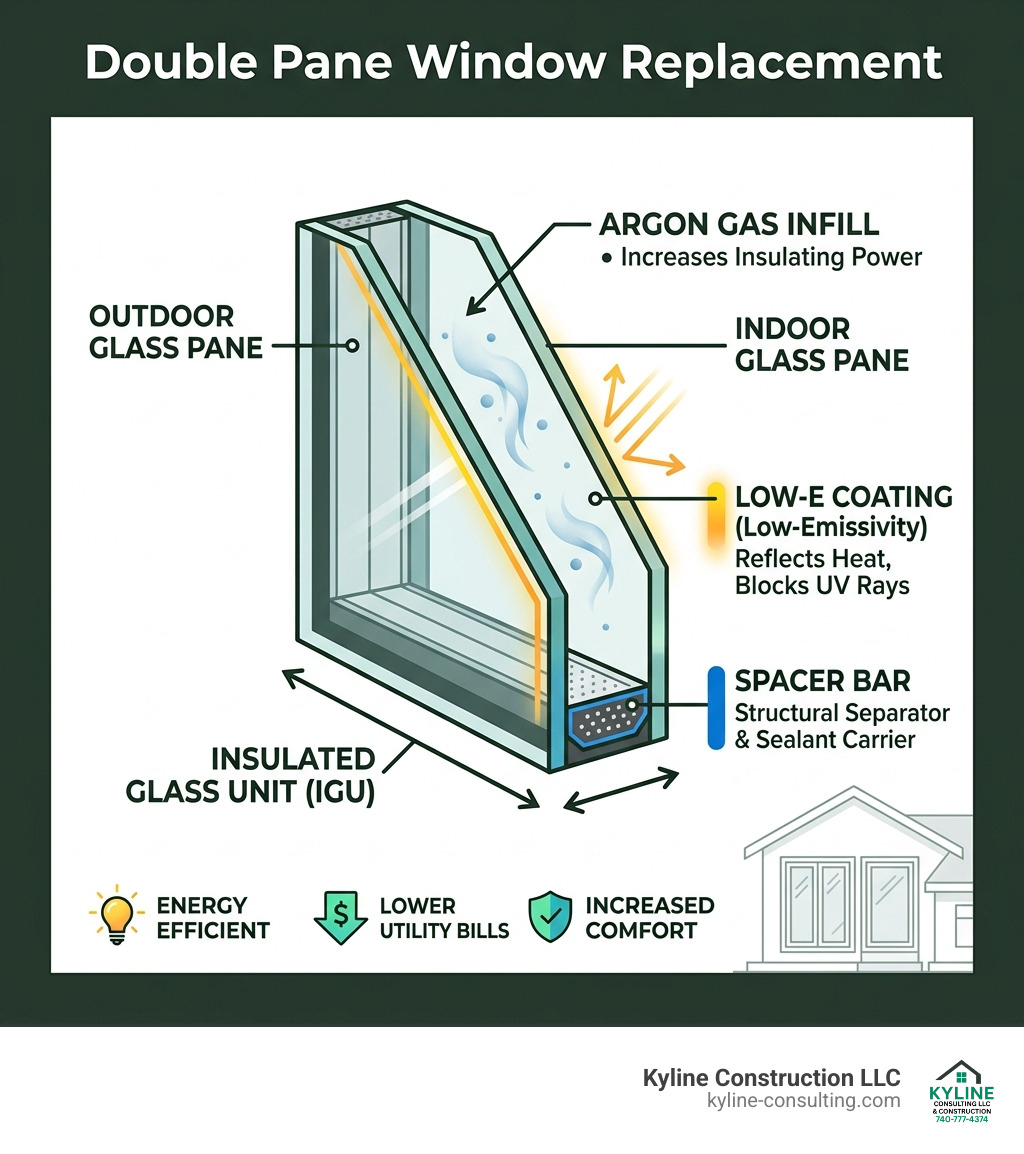
Double pane window replacement terms made easy:
Understanding Double Pane Window Replacement
To “master the art” of replacement, you first have to understand the science of what’s sitting in your wall. A double-pane window isn’t just two sheets of glass slapped together. It is a precision-engineered component called an Insulated Glass Unit (IGU).
An IGU consists of two panes of glass separated by a spacer bar, which creates a hermetically sealed gap. In a high-quality double pane window replacement, this gap is typically filled with Argon gas. Argon is an inert, non-toxic gas that is much denser than air. Because it’s denser, it moves slower, which significantly reduces the transfer of heat between the outside world and your living room.
Then there are Low-E (low-emissivity) coatings. This is a microscopic layer of silver or other low-emissive material applied to the glass. In the winter, it reflects your home’s heat back inside. In the summer, it rejects the sun’s UV rays and solar heat. If you’re looking for a deep dive into how these layers work together, check out our guide on Everything You Need to Know About Energy Efficient Windows.
When you browse options at retailers like The Home Depot, you’ll see hundreds of variations. The goal is to maximize thermal resistance (often measured by R-value or U-factor) so your HVAC system doesn’t have to work overtime during a Columbus cold snap.
The Benefits of Double Pane Window Replacement
Why bother with the investment? It usually comes down to three things: your wallet, your ears, and your comfort.
- Energy Bill Savings: Statistics show that upgrading to double-pane windows can reduce energy bills by up to 24% compared to old single-pane units. In a climate like ours in Circleville, that adds up to thousands of dollars over the lifespan of the windows.
- Noise Reduction: If you live near a busy road or a noisy neighborhood, you’ll notice the difference immediately. The dual layers and gas fill act as a sound dampener, turning a dull roar into a faint whisper.
- UV Protection: Ever notice your couch or hardwood floors fading where the sun hits them? Low-E glass blocks those damaging rays.
- Eliminating Drafts: A new, properly sealed unit stops that “ghostly” breeze that chills your ankles while you’re trying to watch TV.
For more on how these upgrades impact your daily life, see our tips on Maximizing Energy Savings in Your Home.
Measuring for Double Pane Window Replacement
If you’re going the DIY route for glass-only replacement, or even if you just want to verify what a contractor tells you, precision is everything. We aren’t talking “close enough” here; we are talking 1/16th inch precision.
To get an accurate measurement for an IGU:
- Width and Height: Measure the opening in at least three places (top, middle, bottom for width; left, center, right for height). Use the smallest measurement.
- Unit Thickness: This is the most common mistake. You need to know the total thickness of the entire “sandwich”—the two panes of glass plus the space in between. Common sizes are 1/2″, 5/8″, or 3/4”.
I always tell folks in Dayton and Columbus that if you’re unsure, it’s better to have a pro take the final look. You can read more about local measurement nuances in our guide to Home Window Repair in Dayton, Ohio.
Identifying Seal Failure and Structural Red Flags
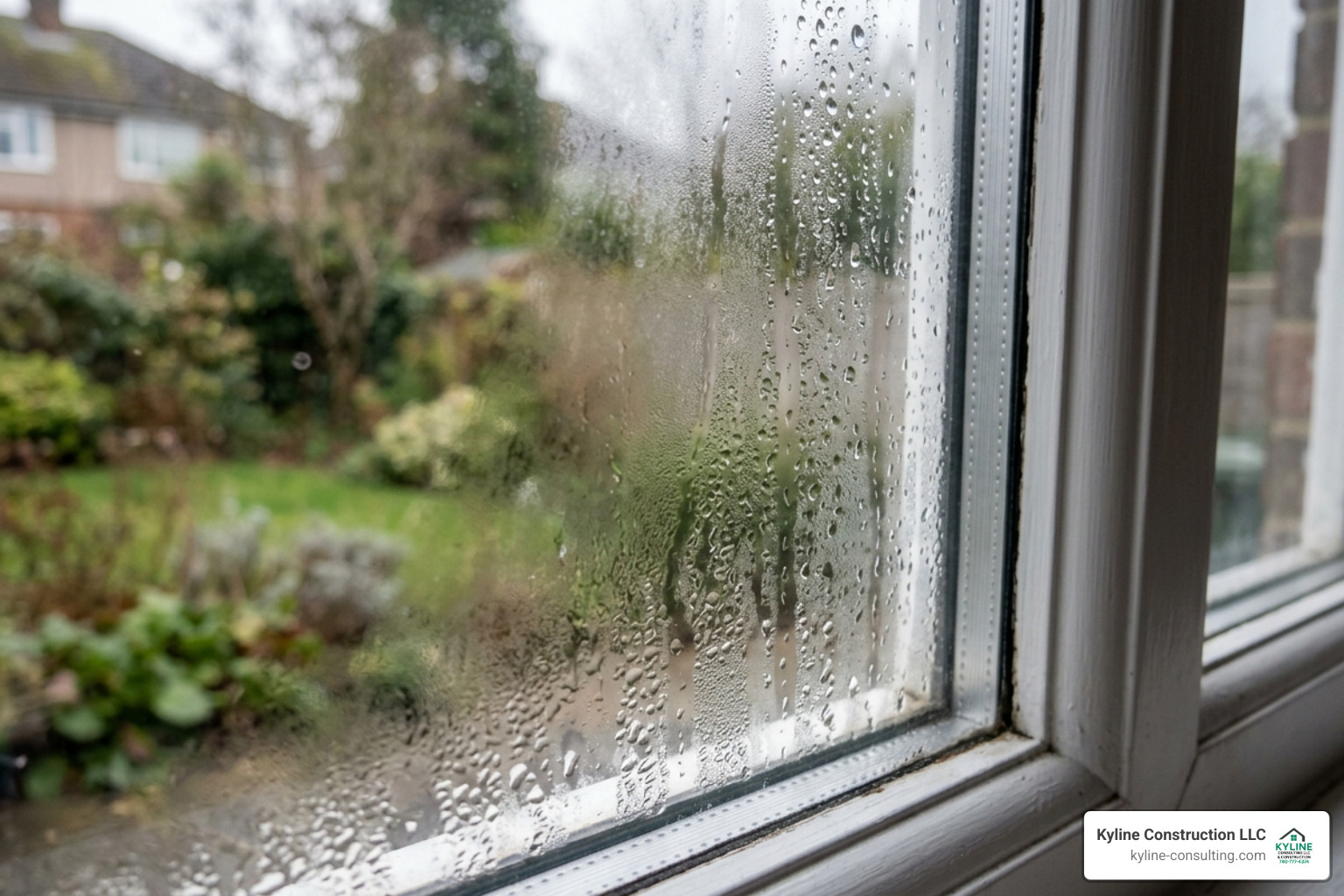
How do you know when it’s time to call us? The most obvious sign is fogging or condensation trapped between the panes. If you try to wipe it away and realize it’s inside the glass, the seal has failed. Once that seal is gone, the insulating gas has escaped, and moisture-laden air has moved in.
Other red flags include:
- Visual Rot: If you have wood frames and see soft spots or peeling paint, the structure is compromised.
- Drafts: If you can feel air movement when the window is locked.
- Difficulty Operating: If the window sticks, rattles, or won’t stay open, the internal balance or the frame itself might be warped.
- Chalky Appearance: A white, hazy film inside the glass is a sign of long-term calcium deposits from evaporated moisture.
In places like Columbus, we see a lot of “seal creep” where the spacer bar actually starts to slide into the field of vision. If you’re seeing these signs, check out Finding the Best Window Glass Replacement in Columbus or learn more about Double Pane Windows from Glass Doctor.
Selecting Styles and Materials for Central Ohio Homes
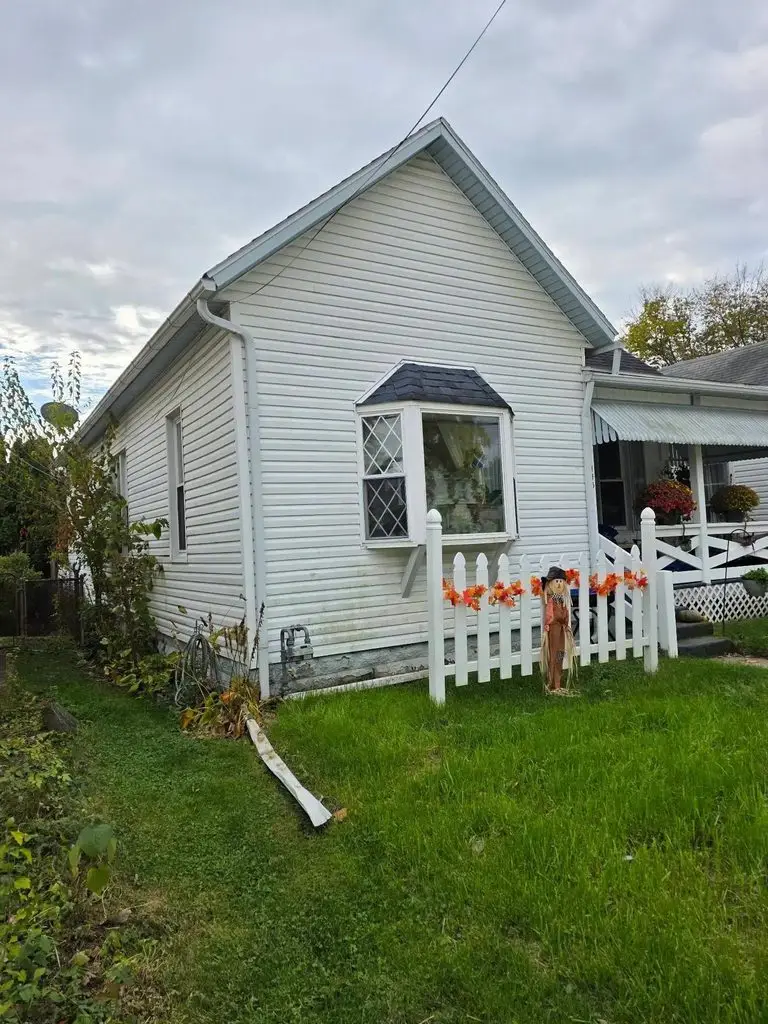
When we talk about double pane window replacement in Central Ohio, we almost exclusively recommend vinyl frames. They are the perfect companion for vinyl siding, creating a cohesive, low-maintenance exterior that stands up to Ohio weather. Why? Because vinyl doesn’t rot like wood, it doesn’t conduct cold like aluminum, and it’s incredibly low-maintenance.
Here are the styles we see most often:
- Double-Hung: The classic. Both the top and bottom sashes move. This is great for safety (open just the top sash to keep kids and pets safe) and cleaning (both sashes tilt in so you can wash the outside from inside your house).
- Sliding: These move horizontally. They’re simple, durable, and offer a great view.
- Awning: Hinged at the top, these open outward. You can even leave them open during a light rain without getting the floor wet.
- Hopper: Common in basements, these are hinged at the bottom and open inward. For a specific look at these, see our Guide to Hopper Window Replacement in Ohio.
The Installation: Real Contractors vs. Paper Contractors
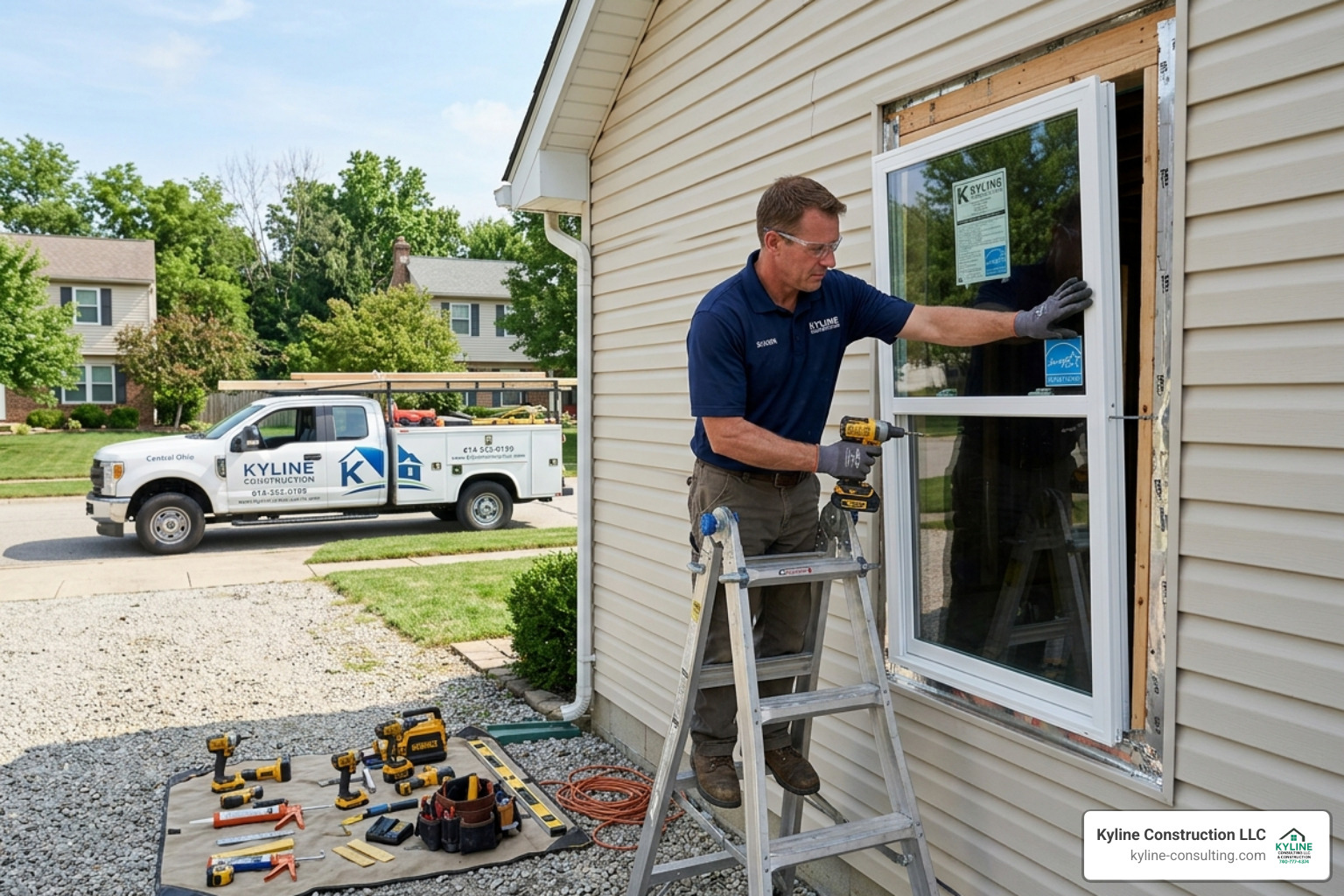
This is where I get a bit passionate. In this industry, there’s a massive difference between what I call “paper contractors” and “real contractors.”
A paper contractor is essentially a salesperson with a clipboard and a marketing budget. They sell you the job, take a significant cut, and then hire the cheapest subcontractors they can find to do the actual work. If those subs do a poor job or disappear, the paper contractor often lacks the tools or the technical skill to step in and fix it. You aren’t paying for expertise; you’re paying for a middleman.
At Kyline Construction LLC, we are real contractors. I’ve spent over 40 years on job sites, not behind a desk. We specialize exclusively in vinyl siding homes, ensuring every window is integrated perfectly with the exterior envelope. We don’t just “caulk and walk.” We ensure the flashing is correct so water never reaches your wall studs. When we’re working with composite materials or specialized trim, we use circular saws to ensure clean, factory-level edges. High-quality composite trim often has a lifespan of 25-50 years, matching the longevity of your new windows. Don’t settle for a paper contractor; schedule your complimentary window estimate with a team that actually knows how to build.
Budgeting and Avoiding Common Pitfalls
Let’s talk numbers. For a standard double pane window replacement in Central Ohio, you should expect to pay between $400 and $900 per window installed. If you’re doing a full house of siding at the same time, a full siding repair/replacement typically runs between $11k and $17k. For realism, vinyl siding usually costs around $4-$8 per square foot depending on the profile and insulation.
| Feature | Glass-Only Replacement | Full-Frame Replacement |
|---|---|---|
| Cost | Lower ($300 – $600) | Higher ($400 – $900+) |
| Labor | 1-2 hours | 3-5 hours |
| Best For | Failed seals, broken glass | Rotted frames, style changes |
| Energy Gain | Moderate | Maximum |
Common Pitfalls to Avoid:
- Ignoring the Frame: Replacing expensive glass into a rotted wood frame is like putting a new engine in a rusted-out car. It won’t last.
- Skipping Disposal Fees: Make sure your estimate includes the removal and haul-away of your old windows.
- Choosing the Lowest Bid: If an estimate is significantly lower than others, they are likely cutting corners on the sealant or using paper contractor labor—salespeople who hire the cheapest possible subs to maximize their own profit.
For more budgeting help, check out How to Estimate Your Window Replacement Budget.
Frequently Asked Questions about Window Upgrades
Can I replace just the glass unit instead of the whole frame?
Yes! If your frames are in great shape—meaning they aren’t warped, rotted, or drafty—you can perform an IGU swap. This is much more cost-effective and less invasive than a full-frame replacement. We simply pop the stops, remove the old “sandwich” of glass, and drop in a new, factory-sealed unit.
How long do modern double-pane windows typically last?
You can generally expect 20 to 30 years of peak performance. The lifespan depends heavily on the quality of the seal and the local weather. In Ohio, our extreme temperature swings (from -10°F to 95°F) put a lot of stress on window seals through thermal expansion and contraction.
Why is argon gas used between the panes?
Argon is used because it’s an “inert” gas, meaning it doesn’t react with the spacers or coatings. Its primary job is insulation. Because it is heavier than air, it slows down the convection currents inside the window, keeping your heat on the side of the glass where it belongs.
Conclusion
Mastering double pane window replacement is about choosing the right partner for your home. Whether you’re dealing with foggy glass in Columbus or upgrading the curb appeal of your vinyl-sided home in Circleville, the right windows are a “one-and-done” investment when handled by real contractors.
At Kyline Construction LLC, we bring over 40 years of hands-on experience to every project. We are the ones doing the work, not paper contractors who just manage subcontracts from an office. We believe in precision craftsmanship, safety, and quality that lasts for decades.
Ready to see clearly again?
Schedule your professional window consultation with Kyline Construction today!