Are There Government Programs That Help Pay for Energy-Efficient Windows?
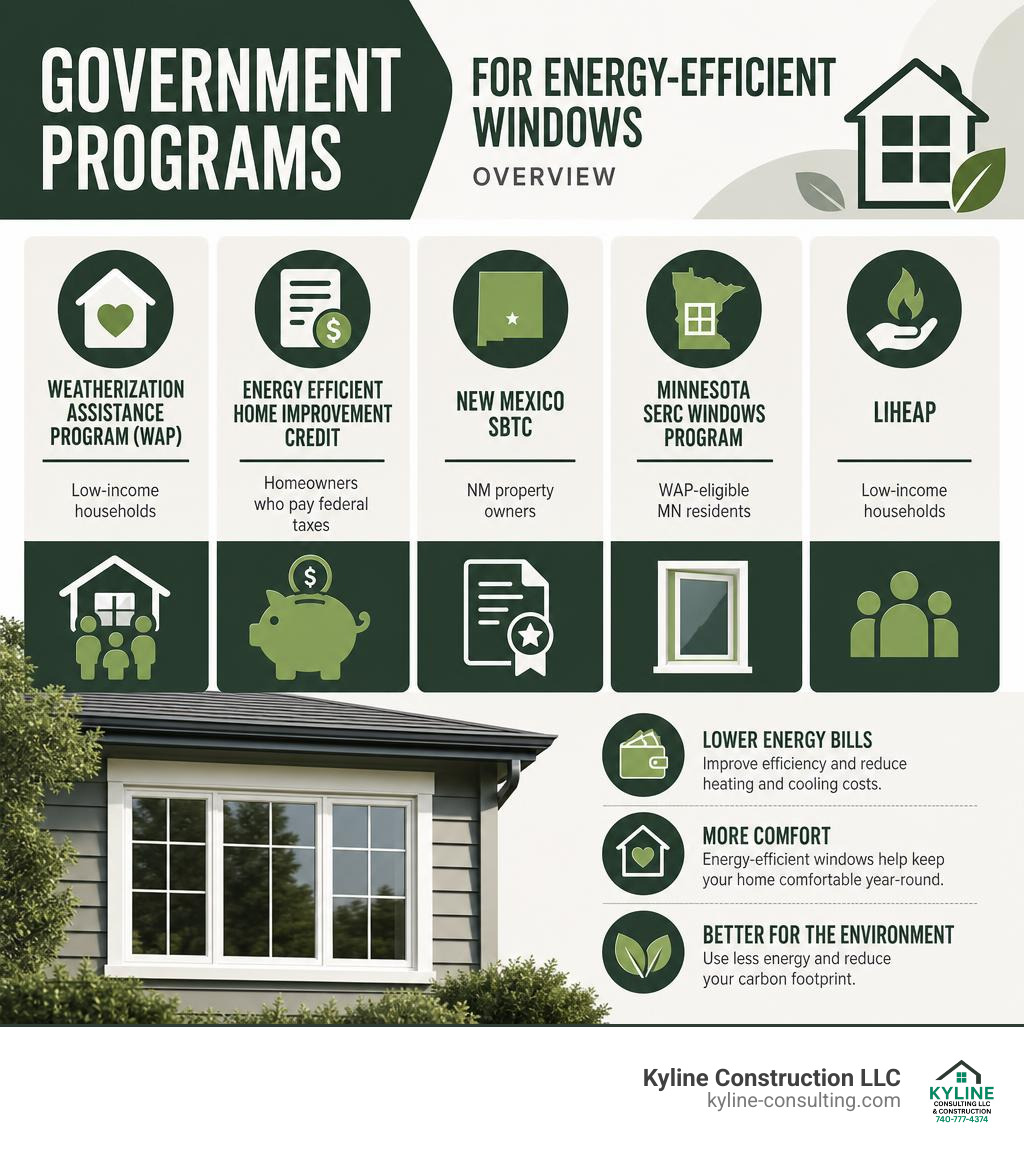
Yes. Several programs can help cover the cost of energy-efficient window upgrades — depending on your income, location, and tax situation. Here’s a quick breakdown:
| Program | Who It’s For | Benefit |
|---|---|---|
| Weatherization Assistance Program (WAP) | Low-income households | Free window upgrades and home energy improvements |
| Energy Efficient Home Improvement Credit | Homeowners who pay federal taxes | 30% tax credit, up to $600 for windows |
| New Mexico SBTC | NM property owners | State tax credit for ENERGY STAR windows |
| Minnesota SERC Windows Program | WAP-eligible MN residents | Targeted single-pane window replacement funding |
| LIHEAP | Low-income households | Energy bill help; some states cover efficiency upgrades |
If you’re a Central Ohio homeowner, the energy efficient windows government program landscape can feel overwhelming — but the money is real, and so is the potential to cut your heating and cooling bills significantly. The federal government’s Weatherization Assistance Program alone has helped more than 7.2 million families improve their homes since 1976, and eligible households save an average of $372 or more every year through these improvements.
The problem most homeowners face isn’t a lack of programs — it’s not knowing which ones apply to them, what the requirements are, or how to actually get started.
That’s exactly what this guide covers.
Energy efficient windows government program terms to learn:
- Energy efficient home improvements
- federal window replacement program application
- free window replacement program for seniors
Understanding the Weatherization Assistance Program (WAP)
The Weatherization Assistance Program (WAP) is the single largest residential energy efficiency program in the country. Created by Congress in 1976, this program is designed to help low-income households reduce their energy costs by improving the overall thermal performance of their homes.
From a contractor’s perspective, WAP is a game-changer. It doesn’t just hand out quick fixes; it funds a comprehensive, whole-house energy evaluation. The program supports roughly 8,500 jobs across the United States and funds weatherization services for approximately 32,000 homes every single year.
Many homeowners ask us if windows are automatically covered under WAP. It’s important to understand how the program operates. WAP does not simply replace windows because they look old. Instead, a certified energy auditor conducts a detailed energy diagnostic of your home, including a blower door test. If the audit reveals that your existing windows are major sources of energy loss, draftiness, or safety hazards, the program will cover the cost of upgrading them.
Because windows have a relatively low R-value compared to insulated walls, standard weatherization rules sometimes prioritize air sealing, attic insulation, or duct sealing first. However, when single-pane windows are exposed to outside ambient air and causing major thermal drafts, they are prime candidates for complete replacement.
When you qualify for window upgrades through this system, the services are 100% free. If you want to dive deeper into how these no-cost upgrades are structured, you can Learn more about free window upgrades.
How to Qualify for the WAP Energy Efficient Windows Government Program
To qualify for assistance under WAP, your household must meet specific income eligibility guidelines. Generally, households with incomes at or below 200% of the federal poverty guidelines are eligible. Additionally, if you or a family member receives Supplemental Security Income (SSI) or certain other federal assistance benefits, you may automatically qualify.
The program also prioritizes specific vulnerable groups, including:
- Older adults (60 years of age or older)
- Households with one or more individuals with disabilities
- Families with children
- High-energy users (homes with exceptionally high utility bills relative to income)
In our local area, this program is administered through the Ohio Home Weatherization Assistance Program (HWAP). HWAP coordinates with local community action agencies to deliver these free services directly to qualifying residents in Circleville, Columbus, and surrounding areas.
Navigating the Energy Efficient Windows Government Program Tax Credits
If your income exceeds the limits for free weatherization programs, you are not left out in the cold. The federal government offers substantial tax incentives for homeowners who invest in high-efficiency upgrades themselves.
Under the Energy Efficient Home Improvement Credit (established and expanded under the Inflation Reduction Act), homeowners can claim a federal tax credit of up to 30% of the cost of qualified energy-efficient home upgrades.

While the overall annual limit for various home envelope improvements is $1,200, there is a specific sub-limit of $600 per year for exterior windows and skylights. This means if you spend $2,000 on qualifying high-performance windows, you can claim the maximum $600 tax credit when you file your federal tax return.
To make the most of this tax credit, some homeowners choose to spread their window replacements over multiple calendar years. Because the $1,200 annual cap resets every January, you could replace a few windows this year, claim the $600 credit, and replace the remaining windows next year to claim another $600.
For a detailed walkthrough of the filing process, you can read our Guide to federal window assistance or visit the official ENERGY STAR Windows and Skylights Tax Credit page.
Eligible Products and Manufacturer Requirements
To claim the tax credit, the windows you buy must meet strict efficiency standards. For installations, the products must earn the ENERGY STAR Most Efficient certification.
This requirement marks a major shift from previous years. To meet these elite standards, manufacturers typically rely on advanced triple-pane window designs or highly optimized dual-pane windows with low-emissivity (Low-E) coatings and argon gas fills. While triple-pane windows can cost 30% to 50% more than standard dual-pane windows, they are often the only models that achieve the ultra-low U-factors required for the northern climate zones.
Additionally, to prevent fraud, the IRS has implemented strict documentation rules. Homeowners must obtain a Product Identification Number (PIN) from a Qualified Manufacturer for each eligible window installed. When you file IRS Form 5695 with your tax return, you will be required to enter this PIN to validate your credit. Always make sure your contractor provides the manufacturer’s specification sheets and official labels containing these details.
State-Specific Initiatives vs. Federal Programs
While federal tax credits provide a reliable baseline nationwide, state-specific programs and local utility rebates offer additional layers of savings. Depending on where you live, you can often “braid” or stack multiple funding sources to minimize your out-of-pocket costs.
For example, local electric and natural gas utilities in Central Ohio frequently offer direct rebates for installing ENERGY STAR-certified windows. These rebates are paid out as cash-back checks or utility bill credits, and they can be combined with the federal tax credit because they reduce your net purchase price before the tax credit is calculated.
To understand the full spectrum of frame materials, glass packages, and local efficiency standards, check out Everything you need to know about energy efficient windows.
State-Level Variations of the Energy Efficient Windows Government Program
Different states approach window efficiency incentives in unique ways, often reflecting their specific climate challenges:
- Minnesota SERC Windows Program: The Sustainable Energy Resources for Consumers (SERC) program in Minnesota created a dedicated window replacement initiative. Recognizing that single-pane windows drastically degrade a home’s thermal boundary, the program allows WAP-eligible homeowners in owner-occupied single-family homes to receive complete replacements using triple-pane or high-performance double-pane windows with a U-factor of 0.22 or less. You can review their strict administrative guidelines in the Minnesota SERC Windows Policy Manual.
- New Mexico Sustainable Building Tax Credit (SBTC): In warmer climates like New Mexico, state tax credits incentivize windows that excel at blocking solar heat. Their program requires strict adherence to Solar Heat Gain Coefficient (SHGC) limits to reduce air conditioning loads.
Here in Central Ohio, our weatherization and window programs are executed locally by county-level subrecipients. If you live in Columbus or Circleville, you will work with local agencies such as:
- IMPACT Community Action (serving Franklin County)
- PICCA (Pickaway County Community Action, serving Circleville and surrounding areas)
- Bridges Community Action Partnership (serving Delaware, Union, and surrounding counties)
These local agencies manage the intake, process the applications, and dispatch qualified local crews to perform the energy audits and physical window installations.
Technical Performance, Code Compliance, and Envelope Tradeoffs
When evaluating windows for government programs or building codes, you have to look past the aesthetics and focus on the technical metrics. The two most critical numbers are the U-factor and the Solar Heat Gain Coefficient (SHGC).
| Metric | What It Measures | Ideal for Cold Climates (Ohio) | Ideal for Hot Climates |
|---|---|---|---|
| U-factor | Rate of non-solar heat transfer (insulating value) | Low (typically $\le$ 0.22 to 0.27) | Moderate |
| SHGC | Amount of solar radiation admitted through the glass | Moderate to High (allows natural winter warmth) | Low (blocks solar heat) |
| Air Leakage | Air infiltration through the window assembly | Low ($\le$ 0.30 cfm/sq ft) | Low ($\le$ 0.30 cfm/sq ft) |
In Central Ohio, we experience bitter winters and hot, humid summers. Therefore, a low U-factor is our top priority to keep furnace heat inside during the winter.
High-performance windows also play a vital role in meeting modern building codes. Under the International Energy Conservation Code (IECC), builders can utilize “envelope tradeoffs.” If a home uses ultra-efficient windows (like ENERGY STAR Version 7 models), the overall thermal envelope improves so much that the builder can legally reduce insulation requirements elsewhere.
For instance, in cold climate zones, using high-performance windows can allow a builder to reduce attic insulation from R-60 down to R-38, or eliminate continuous exterior wall insulation while still achieving code compliance. This design flexibility can save thousands of dollars in construction costs.
The Federal Energy Management Program (FEMP) has calculated that ENERGY STAR-qualified residential windows save up to $4 per square foot in lifetime energy costs compared to standard clear-glass models. To learn how to select the perfect ratings for your home’s layout, read the Smart homeowner’s guide to energy efficient windows or read the DOE’s technical brief on How DOE Efficient New Homes Leverage High-Performance Windows.
How to Apply: Step-by-Step Process and Documentation
Applying for a government-backed window replacement program requires organization and attention to detail. Whether you are seeking a free weatherization grant or preparing to claim a tax credit, following the correct sequence is essential.
Step 1: Establish Contact
If applying for free weatherization, contact your county’s local agency (like PICCA in Circleville or IMPACT in Columbus). If you are planning to claim the federal tax credit, select a qualified local contractor who can supply ENERGY STAR Most Efficient products.
Step 2: The Energy Audit
For weatherization programs, a certified technician must perform a blower door test and infrared thermal imaging to document your home’s heat loss. This step determines if window replacement is the most cost-effective measure.
Step 3: Gather Documentation
You will typically need to provide:
- Proof of property ownership (copy of deed or property tax statement)
- Proof of household income for the past 12 months (pay stubs, tax returns, or benefit statements)
- Recent utility bills (gas and electric)
Step 4: Landlord Permission
If you are a tenant renting a home in Central Ohio, you can still qualify for weatherization assistance, but your landlord must sign a formal agreement permitting the work.
Step 5: Professional Installation
Once approved, the installation must be carried out according to strict building standards. For weatherization projects, post-installation blower door testing is conducted to ensure the house is sealed properly without compromising indoor air quality.
Step 6: Final Inspection and Filing
For tax credits, ensure your itemized invoice clearly lists the window costs separate from labor (as labor costs for building envelope components do not qualify for the tax credit). Retain the manufacturer’s specification sheets, NFRC labels, and PINs. File IRS Form 5695 with your annual tax return.
To calculate your potential return on investment, you can refer to our Guide to window energy savings.
Frequently Asked Questions About Government Window Programs
What are the exact U-factor and SHGC requirements for federal tax credits?
To qualify for the federal tax credit, windows must be certified as ENERGY STAR Most Efficient. In the Northern Climate Zone (which includes Ohio), windows must have a U-factor of $\le$ 0.20. In the South-Central zone, the requirement is a U-factor of $\le$ 0.28 and an SHGC of $\le$ 0.23. You can verify your product’s compliance by searching its Certified Product Directory (CPD) number on the National Fenestration Rating Council (NFRC) website.
Can renters apply for government window replacement assistance?
Yes, renters can apply for the Weatherization Assistance Program (WAP). However, the landlord must provide written consent, and some states require a small financial contribution from the landlord. Renters cannot claim the federal Energy Efficient Home Improvement Credit for windows, as that tax credit is strictly reserved for the primary homeowner who paid for the installation.
What is the difference between a tax credit and a weatherization grant?
A weatherization grant (like WAP) provides upfront, 100% free home improvements for low-income families. No money is paid by the homeowner. A tax credit, on the other hand, requires you to pay for the window installation out of pocket. You then claim 30% of the product cost (up to $600) to reduce your federal tax liability when you file your taxes.
Conclusion
Navigating government energy programs doesn’t have to be a headache. Whether you qualify for free upgrades through Ohio’s HWAP or are planning to claim the 30% federal tax credit on premium vinyl windows, the key is working with a team that knows the ropes.
As a construction professional, my biggest piece of advice is to understand the massive, critical difference between “paper contractors” and “real contractors.” Paper contractors are merely sales offices. They don’t own tools, they don’t know how to swing a hammer, and they have absolutely no hands-on building experience. They write up a contract, take your money, and then subcontract 100% of the work to the cheapest crews they can find—crews they’ve often never met. If those subcontractors walk off the job or perform substandard work, a paper contractor is completely helpless to correct it.
At Kyline Construction LLC, we are real contractors. We have over 40 years of hands-on, real-world experience in Circleville, Columbus, and across Central Ohio. If our crew ever runs into an issue, I have the actual skills, tools, and expertise to jump in and complete the job myself. We focus exclusively on high-quality vinyl siding installations (which cost around $11,000 to $17,000 for a full exterior remodel, utilizing durable vinyl siding that runs a few dollars per square foot) and professional, energy-efficient window replacements ranging from $400 to $900 per window depending on the glass package. By specializing strictly in vinyl siding and windows, we ensure your home’s exterior is handled by true craftsmen, not paper-pushing sales reps.
If you’re ready to lower your energy bills, protect your home from the Ohio elements, and make the most of active government programs, we are here to help. Contact us today for a free, no-obligation estimate on your next exterior project.