How Energy Efficient Tax Credit Windows Can Cut Your Upgrade Costs
If you’re replacing windows and wondering how to lower the bill, energy efficient tax credit windows are one of the best tools available to Ohio homeowners right now.
Here’s the quick answer:
| What You Want to Know | The Answer |
|---|---|
| Credit amount | 30% of window product cost |
| Maximum credit for windows | $600 per year |
| Overall annual credit limit | $1,200 (envelope improvements) |
| Windows that qualify | ENERGY STAR Most Efficient certified |
| Eligible home | Your primary residence in the U.S. |
| How to claim | IRS Form 5695, filed for the year windows are installed |
| Credit expires | December 31, 2025 |
| Labor costs included? | No — product cost only |
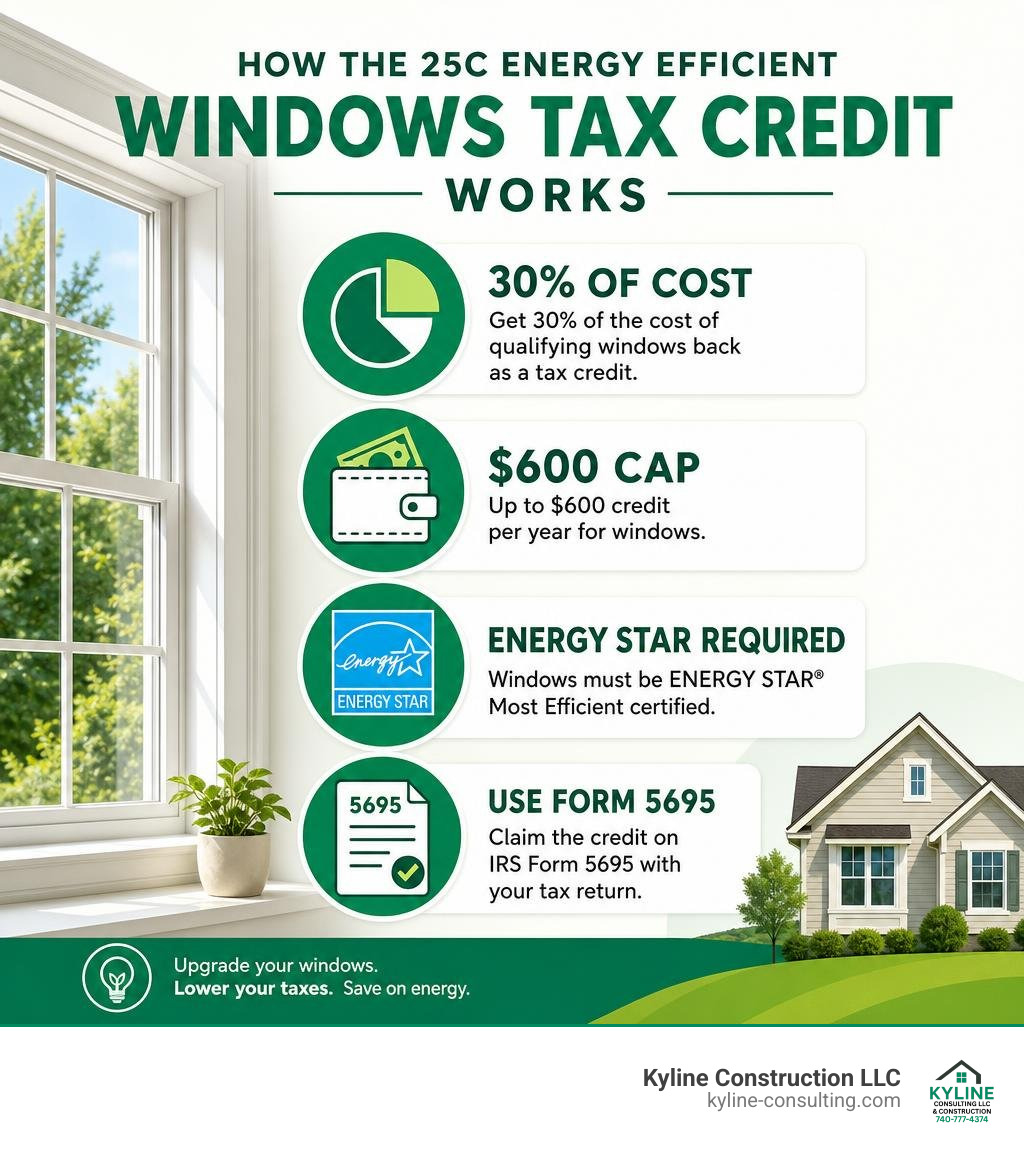
That’s the core of it. The federal government gives you back 30% of what you spend on qualifying windows, up to $600 a year. It’s not a rebate — it comes off your tax bill. And it only applies if the windows meet ENERGY STAR Most Efficient standards.
Energy costs in Central Ohio aren’t getting cheaper. Old, drafty windows bleed heat in January and let summer humidity pour in by July. New energy-efficient windows help with both — and the tax credit makes the upfront cost a lot easier to swallow.
Energy efficient tax credit windows terms at a glance:
- Energy efficient home improvements
- Window efficiency ratings
- average energy savings with new windows
Understanding the 25C Energy Efficient Home Improvement Credit
When we talk about saving money on home upgrades using federal incentives, the conversation begins and ends with Section 25C of the Internal Revenue Code. This portion of the tax code was substantially updated under the Inflation Reduction Act to provide homeowners with robust, multi-year incentives to modernize their properties.
Unlike older versions of the tax credit that had a lifetime cap—meaning once you claimed a few hundred dollars, you were shut out forever—the current iteration of the credit resets annually. This annual reset is a massive advantage for strategic homeowners, allowing you to plan improvements over several tax years.
However, we must understand how a tax credit actually functions. A credit is not a check mailed to you by the government, nor is it a point-of-sale discount. It is a direct reduction of your federal tax liability. If you owe $3,000 in federal income taxes for the year and qualify for a $600 window tax credit, your tax liability drops to $2,400.
Because the 25C credit is nonrefundable, it can only reduce your tax liability to zero. If you do not owe any federal income tax, you cannot receive the credit as a refund, and the IRS does not allow you to carry any excess credit forward to future tax years. To explore the full spectrum of these federal incentives, you can consult the official guide on Federal Tax Credits for Energy Efficiency.
What is the 25C Tax Credit?
The 25C Energy Efficient Home Improvement Credit allows taxpayers to claim a credit equal to 30% of the qualified expenses for certain energy-efficient upgrades. When it comes to energy efficient tax credit windows, this 30% calculation applies strictly to the material costs of the windows themselves.
This is a critical distinction that catches many homeowners off guard: labor and installation costs do not qualify for the tax credit when installing building envelope components like windows, doors, or insulation.
For example, if you purchase a set of qualifying high-efficiency vinyl windows for $2,000 and pay a professional contractor an additional $800 to install them, your tax credit is calculated solely on the $2,000 product cost. Thirty percent of $2,000 is $600, which perfectly hits the maximum annual cap allowed for windows. The $800 installation labor cannot be factored into the credit calculation.
Understanding these nuances is key to planning a successful upgrade. If you want to dive deeper into how modern window design impacts home efficiency beyond just the tax benefits, check out The Smart Homeowner’s Guide to Energy Efficient Windows.
Annual Limits and Per-Item Caps
While the 25C credit offers a generous 30% rate, the IRS imposes both overall annual limits and specific per-item caps on different categories of home upgrades. The maximum total credit you can claim in a single tax year for “building envelope components” (which include windows, doors, and insulation) plus home energy audits is $1,200.
However, within that $1,200 overall limit, individual caps apply:
- Exterior Windows and Skylights: Capped at a maximum of $600 total per year.
- Exterior Doors: Capped at $250 per door, with an aggregate limit of $500 total per year.
- Home Energy Audits: Capped at $150 per year.
To help visualize how these limits interact, we have put together a comparison of the tax limits for common envelope improvements:
| Improvement Type | Credit Percentage | Maximum Annual Limit | Labor Included? |
|---|---|---|---|
| Exterior Windows & Skylights | 30% | $600 | No |
| Exterior Doors | 30% | $250 per door ($500 total) | No |
| Insulation & Air Sealing | 30% | $1,200 | No |
| Home Energy Audits | 30% | $150 | Yes |
As you can see, you cannot simply spend $4,000 on windows and expect a $1,200 credit. Your window credit will always top out at $600. To maximize your tax savings, you have to look at the bigger picture and plan your upgrades strategically.
How to Qualify for Energy Efficient Tax Credit Windows
Not every window sitting on a showroom floor or in a lumberyard qualifies for a tax write-off. In fact, the standards are incredibly strict. To qualify for the tax credit, any exterior window or skylight you install must meet the prescriptive criteria established by the IRS under 26 USC 25C: Energy efficient home improvement credit.

When we install replacement windows for our clients in Circleville and Columbus, we always ensure the product labels are fully verified. The window must feature performance ratings that match your specific climate zone, and you must retain these labels for your tax records.
ENERGY STAR Most Efficient Requirements
To qualify for the 25C tax credit, exterior windows and skylights must meet the ENERGY STAR Most Efficient certification requirements. This is a higher tier of certification than the standard ENERGY STAR label. The “Most Efficient” designation recognizes the absolute best-performing products in terms of energy savings and technological innovation.
These windows utilize advanced multi-pane glass, specialized low-emissivity (Low-E) coatings, and non-conductive gas fills (like argon) to drastically reduce heat transfer. If you are curious about why high-quality frame materials make a massive difference in meeting these standards, you can read more about it in Go Green Save Green: Why Energy Efficient Vinyl Windows Are a Smart Choice.
The Role of NFRC Ratings and Climate Zones
The National Fenestration Rating Council (NFRC) is the non-profit organization that independently tests, certifies, and rates the energy performance of windows, doors, and skylights. When evaluating a window, the NFRC looks at several critical metrics, but the two most important for tax credit eligibility are:
- U-Factor: This measures how well the window prevents heat from escaping your home. The lower the U-factor, the better the window is at keeping heat inside during our freezing Central Ohio winters.
- Solar Heat Gain Coefficient (SHGC): This measures how well the window blocks heat from the sun. A lower SHGC means less solar heat enters your home, keeping your air conditioning bill lower during hot, humid Ohio summers.
Because weather varies wildly across the United States, ENERGY STAR performance criteria are divided into distinct climate zones. Central Ohio sits squarely in the Northern or North-Central zone, depending on the exact county line, which means windows must have a very low U-factor to combat our freezing winter temperatures.
To verify if a window qualifies, you can look up its Certified Product Directory (CPD) number on the NFRC label and check it against the official directory. To learn more about reading these labels like a pro, check out the Smart Shopper’s Guide to Window Performance Ratings.
Strategic Upgrades: Maximizing Your Annual Tax Savings
If you need to replace all the windows in your home, doing them all at once can be a major financial hit. In Central Ohio, high-quality replacement windows typically cost between $400 and $900 per window, depending on the size, style, and specific glass options. If you are replacing fifteen windows, your project cost could easily range from $6,000 to over $13,000.
If you install all fifteen windows in a single calendar year, your federal tax credit is still capped at a maximum of $600. However, with some smart project planning, you can maximize your tax savings by spreading the project out. To understand the long-term financial return of these upgrades, take a look at our resource on Crunching the Numbers: Your Guide to Energy Savings with New Windows.
Phasing Your Energy Efficient Tax Credit Windows Installation
Because the 25C tax credit resets every calendar year, you can phase your window replacements over multiple years to claim the $600 maximum credit multiple times.
For example, instead of replacing all your windows in 2024, you could split the project:
- Phase 1 (Year 1): Replace the draftiest windows on the north side of your house. If the qualified product cost is $2,000, you claim a $600 tax credit on your tax return.
- Phase 2 (Year 2): Replace the remaining windows on the south and west sides. With another $2,000 in product costs, you claim another $600 tax credit the following year.
By phasing the project, you receive a total of $1,200 in federal tax credits instead of capping out at $600. This multi-year strategy makes the overall investment much more manageable. For more tips on planning your home upgrades, read Window Wisdom: Maximizing Energy Savings in Your Home.
Combining Windows with Other Envelope Improvements
Another way to maximize your annual savings is to combine window replacements with other eligible energy-efficient upgrades. Since the overall annual limit for building envelope improvements is $1,200, you can mix and match different projects in the same tax year.
For instance, you could replace a few key windows (claiming the $600 window cap) and simultaneously upgrade your front and back exterior doors. Since doors qualify for a 30% credit up to $250 each ($500 total), combining these projects allows you to maximize your tax savings.
If you are already doing exterior work, it is also the perfect time to look at your siding. While vinyl siding itself does not qualify for the 25C tax credit, adding high-density insulation behind new siding can qualify under the insulation category (which has a $1,200 annual cap).
For a complete exterior overhaul, a full vinyl siding repair or replacement in our region typically ranges from $11,000 to $17,000, and we often quote vinyl siding based on a realistic cost per square foot to ensure absolute transparency. Combining new siding with high-performance windows is the ultimate way to seal your home’s envelope. To see how these upgrades work hand-in-hand, check out Double the Panes, Double the Gains with Low-E Windows.
Crucial Requirements for Claiming Your Credit
To ensure your tax return is fully compliant and passes any IRS scrutiny, you must strictly adhere to federal guidelines. The IRS has steadily increased its reporting requirements to prevent fraud, meaning you need specific, verifiable details about the products you purchase. To stay updated on the latest rules, always refer to the official Energy Efficient Home Improvement Credit | Internal Revenue Service page.
The Qualified Manufacturer Identification Number (QMID) Rule
A major change that took effect for installations is the Qualified Manufacturer Identification Number (QMID) rule. To claim a tax credit for windows, doors, or other qualified energy property, the product must be produced by an IRS-registered “qualified manufacturer.”
When you purchase your windows, the manufacturer must provide a product identification number or a unique PIN code. This QMID must be included directly on your federal tax return when you file. If you buy windows from a manufacturer that is not registered with the IRS, or if you cannot provide the QMID on your return, the IRS will disallow your credit.
Before signing any contract or purchasing materials, always confirm that the manufacturer is registered and will provide this code. For step-by-step guidance on navigating these manufacturer rules, read Seal the Deal: How to Apply for Federal Window Assistance.
Eligible Properties: Primary Residences vs. Second Homes
Another common point of confusion is which properties qualify for the credit. Under Section 25C, the tax credit for building envelope components—including windows, doors, and insulation—is strictly limited to your principal residence.
- What qualifies: Your main home where you live most of the year. This can be a house, houseboat, mobile home, cooperative apartment, condominium, or manufactured home, provided it is located in the United States.
- What does NOT qualify: Second homes, vacation homes, and rental properties that you own but do not live in. Landlords cannot claim the 25C credit for improvements made to tenant-occupied rental properties.
If you are a renter, you may actually claim the credit for qualified energy-efficient improvements you make to your rented primary residence, though this is less common for major structural items like windows. For specialized advice on how seniors or those on fixed incomes can access local assistance programs, see Don’t Get Drafted: How Seniors Can Get Free or Low Cost Window Replacements.
How to Claim the Credit on Your Federal Tax Return
Claiming your tax credit is a straightforward process, but it requires careful attention to detail when filing your annual federal tax return. You will claim the credit for the tax year in which the windows were actually installed, not when they were purchased. If you bought windows in November of one year but the installation wasn’t completed until January of the following year, you must claim the credit on the second year’s tax return. To learn more about the basic filing requirements, visit the official Windows & Skylights Tax Credit | ENERGY STAR portal.
Step-by-Step Filing with IRS Form 5695
To claim the credit, you must complete IRS Form 5695, Residential Energy Credits, and attach it to your Form 1040 federal income tax return.
Here is the general process for filling out the form for windows:
- Locate Part II: Part II of Form 5695 is dedicated to the Energy Efficient Home Improvement Credit (Section 25C).
- Enter Qualified Costs: Enter the total qualified product cost of your exterior windows on the designated line. Do not include labor or installation costs here.
- Calculate the Credit: Multiply the cost by 30%.
- Apply the Limit: Apply the $600 maximum window limit. Even if 30% of your cost is higher, you must cap the entry at $600.
- Transfer to Form 1040: Carry the final calculated credit over to the appropriate schedule on your Form 1040 to reduce your total tax liability.
For a detailed look at navigating this form without making costly mistakes, consult our guide on No Cost Comfort: How to Get Free Energy Efficient Windows.
Essential Documentation and Record-Keeping
If the IRS ever audits your return, you must be able to prove that your windows met all federal requirements. You should keep a dedicated file containing the following documents for at least three years after filing:
- Detailed Sales Receipts: The receipt must clearly break down the cost of the window materials separately from the labor and installation costs.
- NFRC Performance Labels: Save the temporary stickers peeled off the glass that show the U-factor, SHGC, and CPD numbers.
- Manufacturer’s Certification Statement: This is a signed document from the manufacturer certifying that the specific model of window meets the ENERGY STAR Most Efficient criteria for your climate zone.
- The QMID/PIN Code: Ensure you have the manufacturer’s IRS registration number handy.
Keeping organized records is the best way to protect your financial savings. For a comprehensive checklist of everything you need to keep during a window replacement project, read Beyond the Pane: Everything You Need to Know About Energy Efficient Windows.
Frequently Asked Questions
Navigating tax codes and home improvements can raise plenty of questions. Here are some of the most common queries we hear from homeowners in Central Ohio.
Do all energy efficient tax credit windows require professional installation?
The IRS does not strictly require professional installation to qualify for the 25C tax credit. According to the Frequently asked questions about energy efficient home improvements and residential clean energy property credits | Internal Revenue Service, taxpayers can claim the credit for qualified property they install themselves.
However, there is a massive difference between what is legal on a tax return and what is smart for your home. This is where the critical distinction between “paper contractors” and “real contractors” becomes incredibly important—and it can make or break your entire project.
A paper contractor is essentially a marketing and sales office masquerading as a builder. They employ smooth-talking salespeople who bid your job, sign the contract, and then immediately sub-contract the entire project out to the cheapest, unvetted crew they can find on short notice. These paper contractors rarely, if ever, step foot on your job site, and they lack the actual trade skills to evaluate the quality of the work. If that subcontractor walks off the job, cuts corners, or performs a sloppy installation, the paper contractor has absolutely no technical expertise to fix it. You are left dealing with a middleman who only knows how to push paper, not how to install a window.
In stark contrast, a real contractor—like our team at Kyline Construction LLC—is comprised of actual builders and career construction professionals. We possess the hands-on trade skills, tools, and deep technical knowledge required to personally execute and oversee every phase of the installation. If a crew member falls short, a real contractor can step in, grab a hammer, and personally complete the work to perfection. When it comes to high-efficiency windows, proper installation is everything. If a window is installed even slightly out of plumb, or if the flashing and insulation are poorly sealed, the window will leak air and moisture. This completely voids your energy savings, risks severe water damage to your walls, and can even void your manufacturer warranty. Choosing a real contractor ensures your investment is protected by true craftsmanship.
Can I claim the credit for window treatments like blinds or tinting?
No. The IRS has explicitly stated that window treatments, including blinds, interior shutters, shades, and aftermarket window tinting films, do not qualify for the 25C tax credit. These products do not meet the prescriptive criteria of the International Energy Conservation Code (IECC) required for building envelope components. To qualify, you must replace the actual window unit itself.
What happens if my window tax credit exceeds my total tax liability?
Because the 25C tax credit is nonrefundable, it cannot exceed the total amount of federal income tax you owe for that year. If your tax liability for the year is $400, and you qualify for a $600 window tax credit, your tax bill will be reduced to $0, but you will forfeit the remaining $200 of the credit. It cannot be refunded to you as a check, nor can it be carried forward to offset your taxes in the next tax year.
Conclusion
Upgrading your home with energy efficient tax credit windows is a fantastic way to lower your monthly utility bills, improve your indoor comfort, and save money on your federal taxes. However, maximizing these benefits requires careful planning, strict documentation, and choosing the right products.
At Kyline Construction LLC, we have spent over 40 years helping homeowners throughout Circleville, Columbus, and the surrounding Central Ohio regions transform their properties with precision craftsmanship. We don’t believe in high-pressure sales tactics or cutting corners. When you work with us, you get experienced professionals who know how to get the job done right—ensuring your new vinyl windows meet the highest standards of energy efficiency.
If you are ready to upgrade your home’s exterior, we are here to help. Contact us today to get a free estimate on energy-efficient windows and let’s discuss how we can make your home more comfortable, beautiful, and energy-efficient.