How the Energy Efficient Home Improvement Credit Can Cut Your Tax Bill in 2026
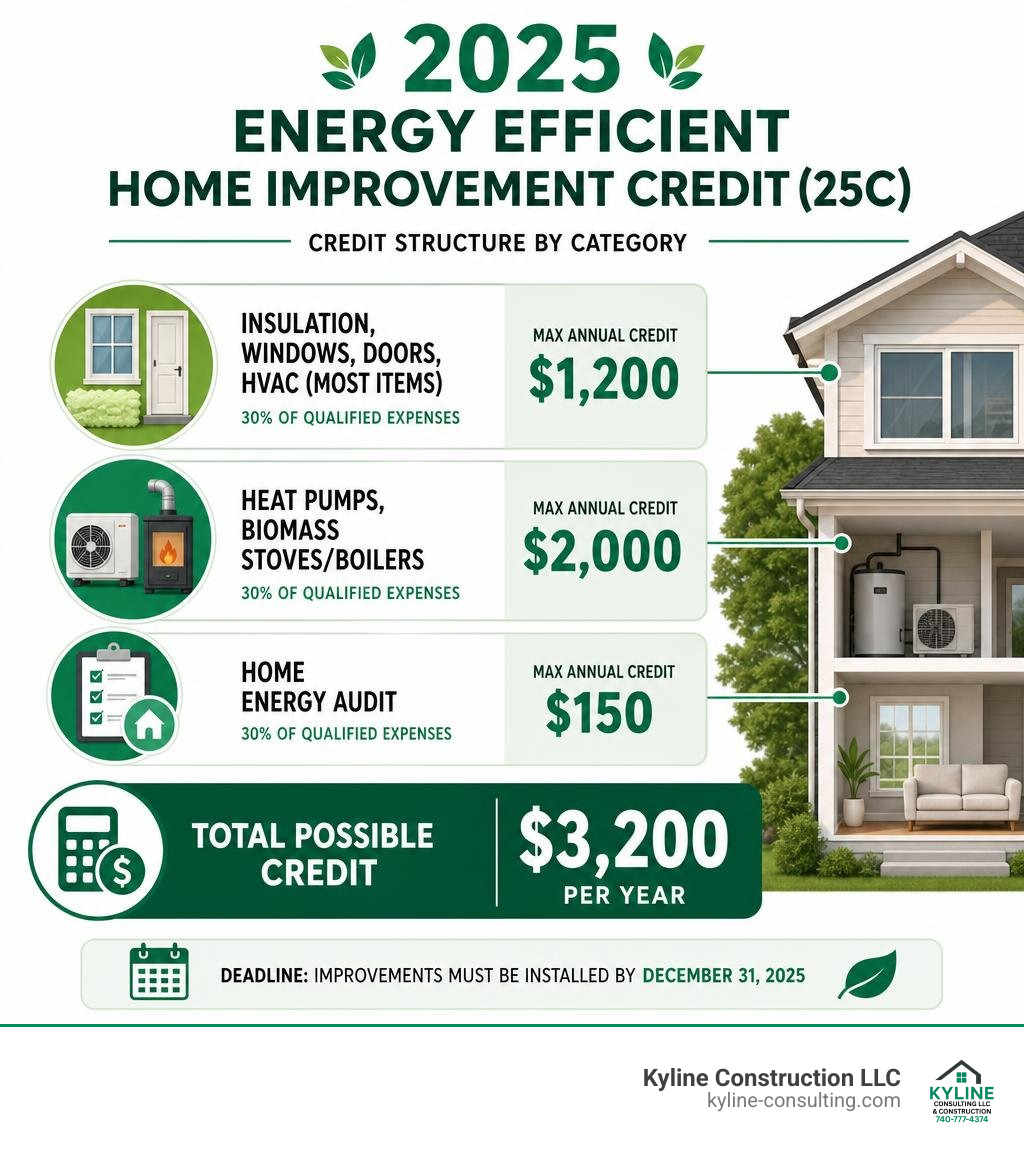
The energy efficient home improvement credit is a federal tax credit that lets homeowners claim back 30% of what they spend on qualifying energy upgrades — up to $3,200 per year.
Here’s the quick version:
| Improvement Type | Max Annual Credit |
|---|---|
| Insulation, windows, doors, HVAC (most items) | $1,200 |
| Heat pumps, biomass stoves/boilers | $2,000 |
| Home energy audit | $150 |
| Total possible credit | $3,200 |
Key facts at a glance:
- Credit rate: 30% of qualified expenses
- Available for: existing homes you own or rent (primary residence required for windows, doors, and insulation)
- Not available for: new construction, rental properties you don’t live in
- Claim using: IRS Form 5695
- Deadline: improvements must be installed by December 31, 2025
- The credit is nonrefundable — it reduces your tax bill but won’t generate a refund
If you own a home in Central Ohio, you already know what heating and cooling bills look like when January hits or August drags on. Older windows, drafty doors, and outdated HVAC systems quietly drain your wallet every month. The good news? The federal government has been paying homeowners back — literally — for making those upgrades. In 2023 alone, over 62,000 North Carolina families used this credit and saved an average of $1,008 on their taxes. Ohio homeowners have the same opportunity, and with the credit set to expire after 2025, the window to act is closing fast.
Glossary for energy efficient home improvement credit:
What is the Energy Efficient Home Improvement Credit?
The energy efficient home improvement credit, governed by Section 25C of the Internal Revenue Code, was significantly expanded by the Inflation Reduction Act. Before this expansion, homeowners faced a meager $500 lifetime limit. If you used up that $500 on a single drafty door years ago, you were out of luck.
Today, the 25C credit operates on an annual limit rather than a lifetime limit. This means you can claim up to $3,200 in tax credits year after year for qualifying improvements installed in your home. The credit covers 30% of the cost of qualifying energy-efficiency upgrades.
Because it is a nonrefundable tax credit, it can reduce your federal tax liability down to zero, but the IRS won’t send you a check for the difference if your credit exceeds what you owe. Furthermore, unlike some renewable energy credits, any unused portion of the 25C credit cannot be carried forward to future tax years. If you don’t use it in the tax year the property was placed in service, you lose it.
For Central Ohio homeowners, this credit represents a massive financial tool. Whether you are battling Columbus humidity or Circleville winter winds, upgrading your home’s envelope makes immediate economic sense. You can read the official IRS guidelines on the IRS Energy Efficient Home Improvement Credit Guide to see how the federal framework supports these local upgrades.
Qualifying Upgrades and Annual Limits for Central Ohio Homes
To maximize your tax savings, you have to understand how the IRS groups these credits. The total maximum credit you can claim in a single year is $3,200, which is split into two distinct baskets:
- The $1,200 Annual Limit: This covers building envelope components (windows, doors, insulation), home energy audits, and general residential energy property (like central air conditioners, furnaces, and boilers).
- The $2,000 Annual Limit: This is a separate cap reserved specifically for electric or natural gas heat pumps, heat pump water heaters, and biomass stoves or boilers.
By strategically combining these two categories, you can claim the full $3,200 in a single tax year.
_compressed.webp?alt=media&token=e53af31d-a8ba-4c7b-9e44-4905f6db65ef "Kyline contractor installing soffit and siding on a Central Ohio home exterior")
Below is a detailed breakdown of the individual limits and standards:
| Upgrade Category | Maximum Annual Credit | Key Efficiency Standards Required | Labor Costs Covered? |
|---|---|---|---|
| Exterior Windows & Skylights | $600 | Energy Star Most Efficient | Yes |
| Exterior Doors | $250 per door ($500 total) | Energy Star Requirements | No (Materials only) |
| Insulation & Air Sealing | $1,200 | 2021 IECC Prescriptive Criteria | No (Materials only) |
| Home Energy Audit | $150 | Certified Auditor, Written Report | Yes |
| Central Air Conditioners | $600 | CEE Highest Efficiency Tier | Yes |
| Furnaces & Boilers (Gas/Oil) | $600 | CEE Highest Efficiency Tier | Yes |
| Heat Pumps & Heat Pump Water Heaters | $2,000 | CEE Highest Efficiency Tier | Yes |
| Biomass Stoves & Boilers | $2,000 | Thermal Efficiency $ge$ 75% | Yes |
Windows and Skylights Under the Energy Efficient Home Improvement Credit
Windows are the soul of your home’s thermal defense system. Under the 25C credit, you can claim 30% of the cost of new windows and skylights, up to a maximum of $600 per year.
However, the IRS doesn’t let you install just any cheap glass. To qualify, the windows must meet strict Energy Star requirements. For installations in 2025 and 2026, the standard has been raised to Energy Star Most Efficient certification.
At Kyline Construction LLC, we install high-quality, energy-efficient vinyl windows ranging from $400 to $900 per window, depending on size and style. When you choose premium vinyl windows, you are investing in multi-chambered frames, low-E glass coatings, and argon gas fills that keep your conditioned air inside.
If you are looking to replace all the windows in your Columbus home, doing them all at once might exceed the annual $600 limit quickly. A smart strategy is phased replacement. By replacing a few windows each year, you can claim the $600 credit multiple times across different tax years.
To learn more about how window engineering affects your wallet, check out The Smart Homeowner’s Guide to Energy Efficient Windows and read why making the switch is a smart choice in Why Energy Conserving Windows Are a Pane-Less Way to Save.
Exterior Doors and Insulation Requirements
Your home’s exterior doors and insulation are the unsung heroes of energy bills. The tax credit allows you to claim:
- Exterior Doors: Up to $250 per door, with a total annual cap of $500. The doors must meet Energy Star requirements. Labor costs for installing doors do not qualify for the credit; only the cost of the door itself can be used to calculate the 30% credit.
- Insulation and Air Sealing: Up to $1,200 per year. This includes rolls of fiberglass, blown-in cellulose, spray foam, and weather-stripping materials designed to stop air leaks. To qualify, these materials must meet the prescriptive criteria of the 2021 International Energy Conservation Code (IECC). Like doors, the labor costs for installing insulation do not qualify—only the materials do.
One of the best ways to tackle insulation and air sealing is during a siding replacement. When we perform a full siding repair (which typically ranges from $11,000 to $17,000 depending on the home’s size), we install high-performance vinyl siding. Vinyl siding costs vary by style and insulation backing (often calculated per square foot for realism, ranging from $4 to $9 per square foot installed).
By wrapping your home in modern house wrap and insulated vinyl siding, you are drastically reducing thermal bridging. To explore more about sustainable home upgrades, read Go Green Save Green: Smart Home Upgrades for a Sustainable Future.
Heat Pumps and Biomass Stoves
If you want to make a massive dent in your energy consumption, upgrading to a heat pump is the gold standard. Traditional electric resistance heating is notoriously expensive. In fact, over 969,000 North Carolina households using costly fuels or inefficient electric resistance save an average of $2,530 a year by transitioning to efficient systems. Ohioans face similarly brutal winters and can reap massive utility savings.
The tax credit offers up to $2,000 per year for qualifying biomass stoves, biomass boilers, electric or natural gas heat pumps, and heat pump water heaters. To qualify, the equipment must meet or exceed the highest efficiency tier established by the Consortium for Energy Efficiency (CEE) in effect at the start of the year the system is placed in service.
For split-system heat pumps, both the indoor and outdoor components must be installed together and certified as a matched system to meet CEE guidelines. Fortunately, unlike doors and insulation, labor costs for installing HVAC systems and heat pumps do qualify for the 30% credit calculation.
To find more localized assistance and state-level rebates that can be paired with federal credits, visit the Home Energy Savings Program – Ohio Department of Development.
Key Eligibility Rules: Who Can Claim the Credit?
Not everyone can claim every part of the energy efficient home improvement credit. The IRS has established strict rules regarding who can claim the credit based on ownership and how the home is used:
- Principal Residence vs. Second Homes:
- To claim the credit for building envelope components (windows, doors, insulation) and home energy audits, the property must be your principal residence (the main home where you live most of the time). You cannot claim these upgrades on a vacation home or a second home.
- For residential energy property (heat pumps, water heaters, central air conditioners, furnaces), the property only needs to be used as a residence by the taxpayer. This means you can claim the heat pump credit for a second home or vacation home that you personally use, provided you do not rent it out to others.
- Renters: Renters can actually claim the credit for certain qualifying upgrades, such as a heat pump or water heater they pay for themselves, but they cannot claim the credit for building envelope components like windows, doors, or insulation.
- No Landlords: Landlords cannot claim the credit for rental properties they own but do not personally reside in. The credit is strictly designed for residential occupants.
- Existing Homes Only: The credit is exclusively available for existing homes, historic homes, or additions/renovations to existing homes. It is completely unavailable for newly constructed homes.
- Business Use: If you run a business out of your home, you must look at the percentage of business use. If the business use of the home is 20% or less, you can claim the full credit. If business use exceeds 20%, you must allocate the expenses and can only claim the credit on the residential portion of the expenditures.
For a complete breakdown of these residency scenarios, refer to the IRS FAQ on Qualifying Residences.
Crucial 2025-2026 Changes: Manufacturer QMIDs and PINs
If you are filing your taxes in 2026 for upgrades installed during the 2025 tax year, you must be aware of a major administrative shift implemented by the IRS.
Starting in 2025, any qualifying energy-efficient property (including windows, doors, heat pumps, and water heaters) must be produced by an IRS-registered Qualified Manufacturer.
These manufacturers must provide a Qualified Manufacturer Identification Number (QMID) and a unique Product Identification Number (PIN) for each eligible product. When you or your CPA file your tax return, you must explicitly enter these QMIDs and PINs on your Form 5695. If your contractor installs a product from a manufacturer that isn’t registered with the IRS, or if they fail to provide you with the PIN, your tax credit will be rejected.
Note: Insulation and air sealing materials are exempt from the QMID and PIN reporting requirements, but they must still meet the 2021 IECC prescriptive standards.
Keep this in mind when purchasing products. Always ask your contractor for the manufacturer’s IRS registration status and the specific PINs for your files. You can verify technical specifications and QMID rules on the IRS FAQ on Energy Efficiency Requirements.
How to Claim the Credit and Maximize Your Savings
To claim the energy efficient home improvement credit, you must fill out IRS Form 5695, Residential Energy Credits, Part II, and submit it alongside your federal income tax return.
Shawn’s Advice: Real Contractors vs. Paper Contractors
When you are planning these upgrades, who you hire matters just as much as the products you buy. In the home improvement industry, there is a massive, non-negotiable distinction between “paper contractors” and “real contractors” — and choosing the wrong one can cost you thousands in lost tax credits and failed installations.
A paper contractor is essentially a glorified sales broker. They operate out of clean offices, use slick digital presentations, and bid on your job only to immediately outsource 100% of the actual labor to the lowest-bidding crew they can find on the internet. They do not own tools, they do not have dirt under their fingernails, and they do not know how to physically install the products they sell. If their subcontractors walk off the job halfway through, or if the installation fails to meet the strict energy efficiency standards required for your tax credit, the paper contractor is left completely helpless and unable to correct the issue.
A real contractor, on the other hand, is a true builder with hands-on expertise. At Kyline Construction LLC, we are real contractors. We have over 40 years of hands-on, professional experience in the field. If a subcontractor walks off a job, we don’t panic — we have the actual trade skills, tools, and physical experience to step in, pick up a hammer, and finish the job personally to the highest standards.
When you hire a real contractor, you aren’t just buying materials; you are securing peace of mind. You get accurate, expert advice on product certifications, flawless installation (which ensures your windows and vinyl siding actually achieve their rated energy efficiency), and the proper, verified documentation — including those crucial manufacturer QMIDs and PINs — needed to ensure your IRS tax filing is approved.
Maximizing Your Savings
- Subtract Rebates First: If you receive a utility rebate or a state subsidy at the time of purchase, you must subtract that rebate from the total cost before calculating your 30% tax credit. You can read more about this calculation on the IRS FAQ on Qualifying Expenditures.
- Spread the Work: If you are planning a large exterior remodel, do not do it all in one calendar year. Install your front door and a few windows this year, then finish the rest next year to claim the maximum annual credit caps multiple times. For local tips on budget-friendly window strategies, read Buckeye Bargains: Finding Affordable Window Replacement in Ohio.
Frequently Asked Questions
How Does the Energy Efficient Home Improvement Credit Differ from the Residential Clean Energy Credit?
The Energy Efficient Home Improvement Credit (Section 25C) covers energy-efficiency upgrades to an existing home’s structure and mechanical systems (windows, doors, insulation, heat pumps, audits). It is capped at an annual limit of $1,200 or $2,000 (up to $3,200 total) and is nonrefundable with no carryforward.
The Residential Clean Energy Credit (Section 25D) covers alternative energy generation equipment, such as solar panels, solar water heaters, wind turbines, geothermal heat pumps, and battery storage systems. It provides a 30% credit with no annual or lifetime dollar limits. Furthermore, unlike the 25C credit, unused portions of the 25D credit can be carried forward to offset your tax liability in future years.
Can Renters Claim the Credit for Upgrades?
Yes, but only for certain items. Renters can claim the credit for residential energy property they pay for themselves, such as a qualifying heat pump, heat pump water heater, or biomass stove, provided they have their landlord’s permission to install it. However, renters cannot claim the credit for building envelope components like windows, doors, insulation, or air sealing.
When Does the Credit Expire?
Under the original Inflation Reduction Act, these credits were set to run through 2032. However, due to a federal budget reconciliation bill signed on July 4, 2025, the energy efficient home improvement credit is scheduled to expire. Qualifying upgrades must be fully installed and placed in service by December 31, 2025 to be claimed on your tax returns.
Conclusion
Upgrading your home’s energy efficiency isn’t just about saving the planet; it’s about keeping your hard-earned money in your pocket. With the 2025 deadline rapidly approaching, now is the time to plan your exterior upgrades and secure your tax credits before they expire.
At Kyline Construction LLC, we serve Circleville, Columbus, and the surrounding Central Ohio communities. We specialize in precision-crafted vinyl windows, high-performance vinyl siding, and custom decks. We don’t do paper contracting, and we don’t cut corners. We bring over 40 years of hands-on experience to ensure your home is beautiful, safe, and highly energy-efficient.
Ready to upgrade your home and lower your tax bill? Contact us today for a free, no-obligation estimate on your next window or siding project. Visit our Kyline Construction Windows Services page to get started!