What Do Energy Saving Windows Actually Cost in 2026?
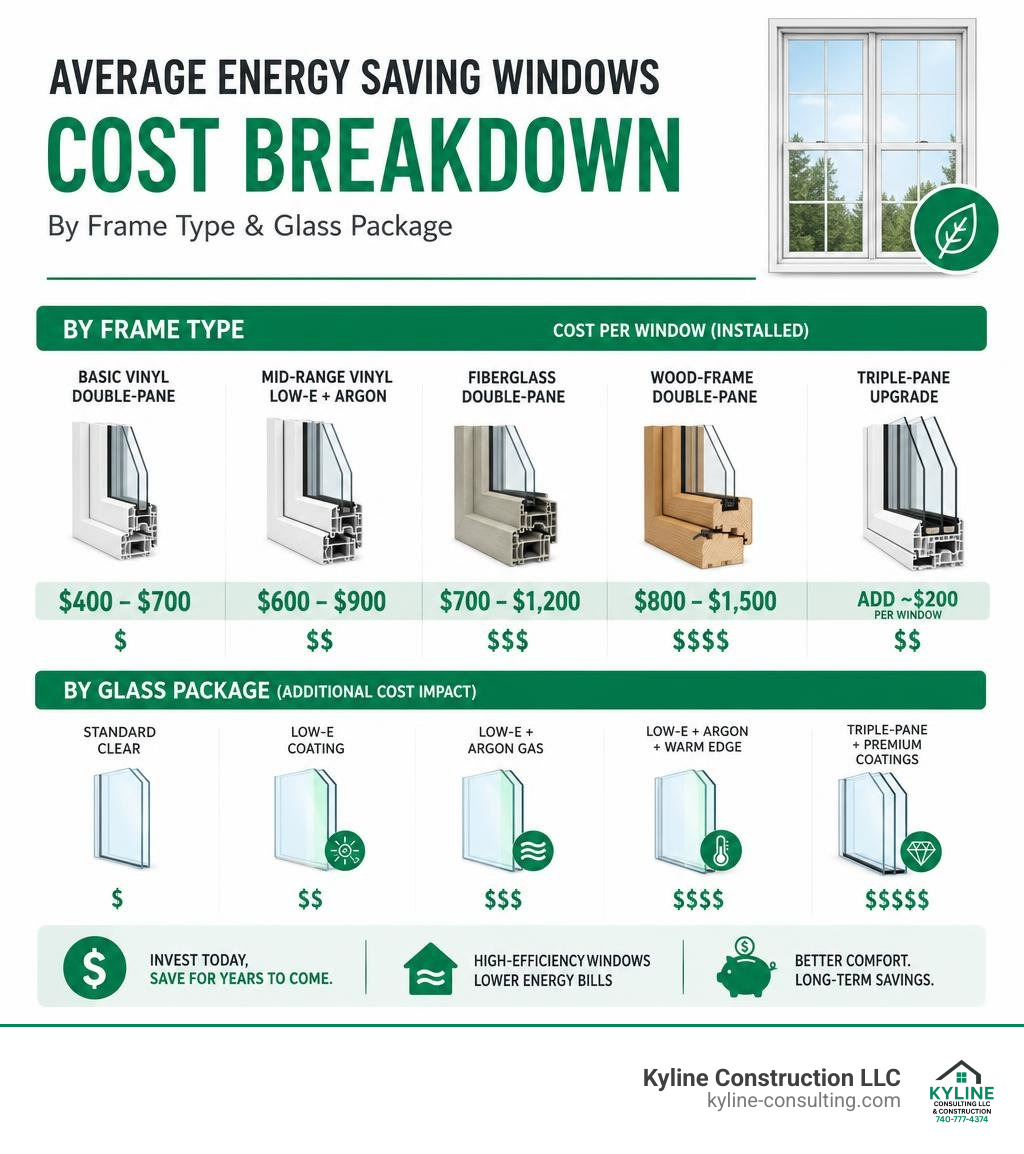
Energy saving windows cost between $400 and $900 per window installed for most Central Ohio homeowners in 2026. Here’s a quick snapshot before we dig in:
| Window Type | Cost Per Window (Installed) |
|---|---|
| Basic vinyl double-pane | $400 – $700 |
| Mid-range vinyl + Low-E + argon | $600 – $900 |
| Fiberglass double-pane | $700 – $1,200 |
| Wood-frame double-pane | $800 – $1,500 |
| Triple-pane upgrade | Add ~$200 per window |
For a whole house:
- Small home (8–10 windows): roughly $3,200 – $9,000
- Average home (12–16 windows): roughly $7,200 – $14,400
These numbers assume standard sizing and a straightforward install. Custom sizes, structural repairs, or specialty glass can push costs higher.
If you’ve ever stood next to a window on a January morning in Central Ohio and felt that cold air radiating off the glass — you already know what inefficient windows feel like. According to the U.S. Department of Energy, inefficient windows can account for 25–30% of a home’s heating and cooling energy loss. For a drafty older home in Circleville or Columbus, that’s real money walking right out through the glass every month.
The challenge most homeowners face isn’t just figuring out what windows cost — it’s understanding why prices vary so much, and whether replacing windows is actually worth the investment compared to other upgrades.
Energy saving windows cost vocabulary:
- Window efficiency ratings
- average energy savings with new windows
- Energy efficient home improvements
Breaking Down the Average Energy Saving Windows Cost
When you start shopping for replacement windows, the sheer range of prices can make your head spin. You might see a budget vinyl insert advertised online for $300, while a high-end wood-clad window quote comes in at $1,500 for the exact same opening.
To help you make sense of the market, we have compiled a detailed breakdown of the average energy saving windows cost in 2026. This data reflects actual material and labor costs across the Central Ohio region, including Columbus and Circleville.
Understanding the raw numbers is the first step toward building a realistic budget. If you want to dive deeper into general pricing structures, check out The Ultimate Guide To Window Replacement Costs and learn how to map out your finances with our guide on How To Estimate Your Window Replacement Budget.
To see how these costs scale when you look at the industry’s baseline, check out the data compiled in the How Much Does Window Replacement Cost in 2026? | GetWindowCost guide. Generally, a typical whole-house project consisting of 10 to 15 windows runs anywhere from $6,500 to $18,650, depending heavily on the frame material and glass package you choose.
Understanding the Base Energy Saving Windows Cost per Unit
The retail price of the window unit itself makes up about 55% of your total invoice. If you are ordering standard, off-the-shelf sizes (such as a standard double-hung 24-by-36-inch window), the manufacturing costs remain relatively low. However, if your home has older, non-standard window openings, custom manufacturing can add a 20% to 40% premium to the base price.
For example, a standard mid-range double-pane tilt-and-turn window (like a Denco 36×60-inch unit) with laminated and tempered glass typically costs around $640 for the unit alone. If you require specialized architectural shapes or custom dimensions, that price will climb. To get a closer look at how individual unit sizes and styles affect your bottom line, you can play with the Window Replacement Cost Calculator 2026 — Cost Per Window | CostPrism to estimate costs based on your home’s unique layout.
How Frame Materials Impact Your Energy Saving Windows Cost
The material your window frames are made of plays a massive role in both the upfront price and the long-term thermal performance of your home. Here is how the three most common materials stack up:
- Vinyl Frames ($400 – $800 installed): Vinyl is the undisputed value leader in Central Ohio, accounting for the vast majority of residential replacements. It is naturally rot-resistant, requires virtually zero maintenance, and features internal honeycombed chambers that trap air to provide excellent insulation. If you want to know why so many of our clients go this route, take a look at our article Go Green Save Green Why Energy Efficient Vinyl Windows Are A Smart Choice.
- Fiberglass Frames ($700 – $1,600 installed): Fiberglass is incredibly strong and shares the same expansion and contraction rate as the glass panes themselves. This means the seals are far less likely to fail over decades of hot Ohio summers and freezing winters. It is a premium option, but the durability is unmatched.
- Wood Frames ($800 – $1,500+ installed): Wood offers a classic, high-end aesthetic that is highly sought after in historic Columbus neighborhoods. However, wood conducts more heat than vinyl or fiberglass if not properly clad, and it requires regular painting or staining to prevent rot.
Key Features That Drive Window Efficiency and Price
A window isn’t just a piece of glass stuck in a frame anymore. Modern energy-saving units are highly engineered systems designed to block thermal transfer while letting in maximum natural light.
When you look at a window’s spec sheet, you will see a few key technical ratings:
- U-Factor: This measures the rate of non-solar heat transfer. The lower the U-factor, the better the window insulates. For ENERGY STAR 7.0 certification in our Northern/Central climate zone, you want a U-factor of 0.27 or lower.
- Solar Heat Gain Coefficient (SHGC): This measures how much solar radiation passes through the window. In Central Ohio, we experience cold winters and hot summers, so a balanced SHGC (around 0.20 to 0.40) is ideal to let in some winter warmth while blocking harsh summer heat.
To understand how these ratings are determined, read our Smart Shoppers Guide To Window Performance Ratings.
The components that drive these ratings — and the overall energy saving windows cost — include:
- Low-E (Low-Emissivity) Coatings: This is an microscopically thin, invisible metallic oxide layer applied to the glass. It reflects infrared heat back to its source (keeping heat inside during winter and outside during summer) while allowing visible light to pass through. Adding a Low-E coating typically adds $40 to $80 per window, but it is the single most important efficiency upgrade you can make. Learn more about how this works in Double The Panes Double The Gains With Low E Windows.
- Gas Fills (Argon vs. Krypton): Instead of regular air, high-performance windows feature dense, non-toxic gases pumped between the glass panes to slow down heat transfer. Argon gas is the industry standard and is highly cost-effective. Krypton gas is denser and performs better in thinner spaces (like triple-pane configurations), but it carries a higher price tag.
- Warm-Edge Spacers: Older windows used highly conductive aluminum spacers to hold the glass panes apart, which caused cold spots and condensation along the edges. Modern energy-efficient windows use non-conductive composite or silicone spacers to maintain seal integrity and prevent edge-of-glass heat loss.
Double-Pane vs. Triple-Pane Glass
One of the most common questions we get at Kyline Construction LLC is whether triple-pane glass is worth the extra money.
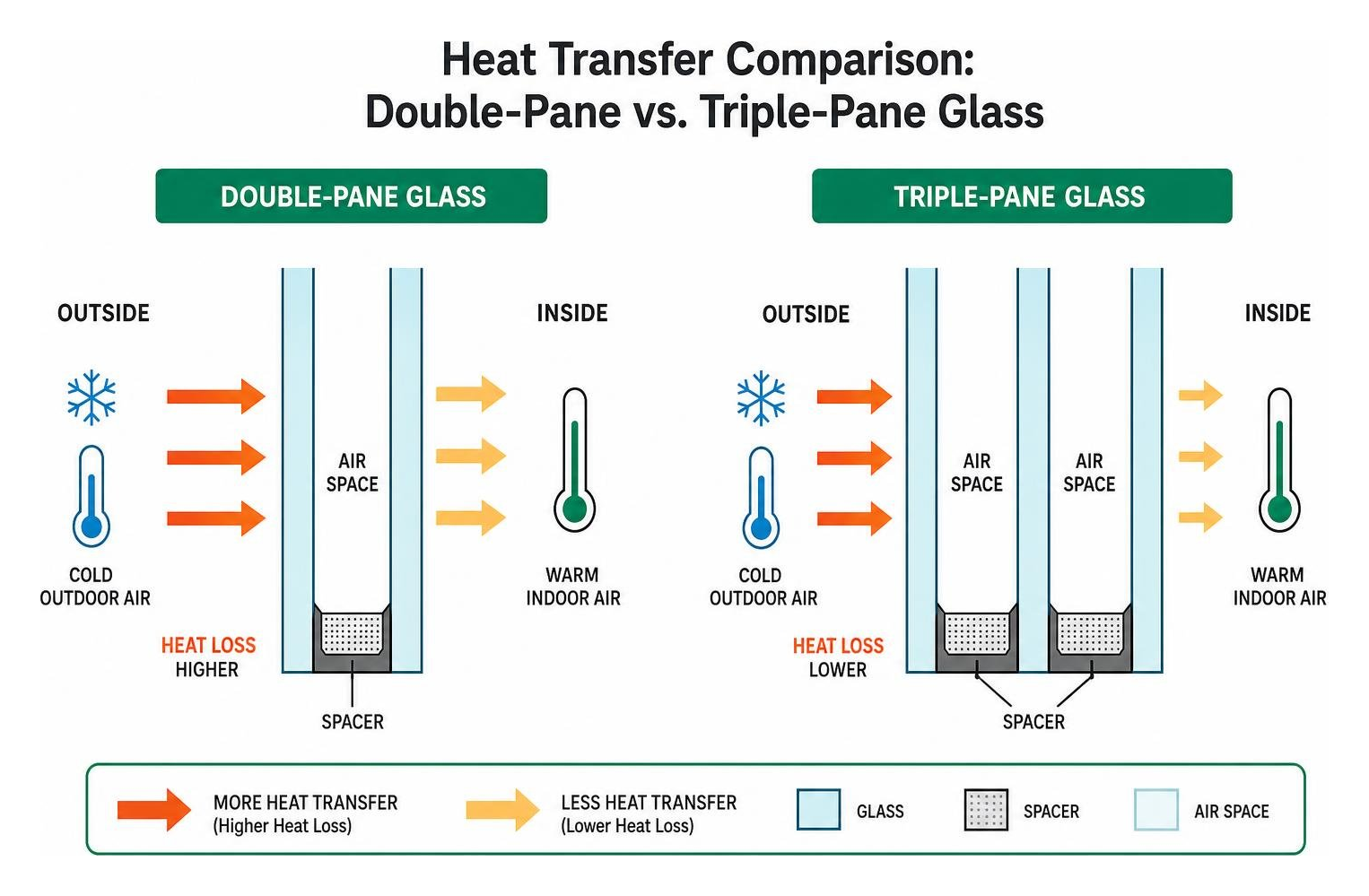
Double-pane windows (featuring two layers of glass and one gas-filled chamber) are the standard baseline for modern energy efficiency. Upgrading to triple-pane (three layers of glass and two gas-filled chambers) drops the window’s U-factor significantly, often down to 0.18 to 0.22.
However, triple-pane windows typically cost about $200 to $400 more per window than double-pane units, and they add roughly 25% more weight to the sash. In extremely cold northern climates, triple-pane is highly recommended. In Central Ohio’s mixed climate, high-quality double-pane windows with Low-E and argon gas usually offer the best balance of cost and performance. If you are planning a DIY project or want to understand the mechanical process of handling these units, check out our guide on How To Master The Art Of Double Pane Window Replacement.
Real-World Savings, Payback Periods, and Tax Credits
Let’s address the elephant in the room: Will energy-saving windows pay for themselves through lower utility bills?
If you are replacing old, drafty, single-pane windows with ENERGY STAR-certified double-pane windows, you can expect to reduce your heating and cooling bills by up to 13%. For an average home in Columbus, that translates to roughly $125 to $465 in annual savings.
However, because a whole-house window replacement is a significant investment (often exceeding $10,000 for a standard home), the payback period through energy savings alone is typically 15 to 20 years. That is why we always tell our clients: Do not replace your windows solely for the energy savings. You should replace them because your current frames are rotting, your sashes are drafty, the glass is constantly foggy, or you want to improve your home’s comfort and curb appeal. The energy savings are a fantastic bonus that offsets the cost over time.
To get a detailed look at the financial math behind these upgrades, read Cost of ENERGY STAR Windows: 2026 Prices, Install & Credits.
Fortunately, there are excellent federal incentives available to help offset your upfront energy saving windows cost. Under the Section 25C Energy Efficient Home Improvement Credit, homeowners can claim a federal tax credit of 30% of the window material costs, up to $600 per year, for windows that meet ENERGY STAR Most Efficient certification requirements.
If you want to maximize this credit, you can strategically phase your window replacement project over two tax years (for example, replacing half the windows in November and the other half in January), allowing you to claim up to $1,200 in total tax credits.
For a complete breakdown of how to qualify and apply for these incentives, read our articles on Windows Of Opportunity For Federal Energy Savings and Seal The Deal How To Apply For Federal Window Assistance.
When to Choose Windows Over Insulation
If your primary goal is to lower your energy bills on a tight budget, window replacement might actually not be your best first step.
From a pure return-on-investment (ROI) perspective, sealing air leaks around your doors and adding high-quality insulation to your attic and exterior walls offers 5 to 10 times better energy savings per dollar spent than replacing windows.
If you want to read more about how to prioritize your home improvement budget for maximum efficiency, check out Go Green Save Green Smart Home Upgrades For A Sustainable Future.
However, if your window frames have visible structural rot, or if water is actively leaking into your walls, no amount of attic insulation will save your home from structural damage. In those cases, replacing the windows is an absolute necessity.
Professional Installation: Pocket vs. Full-Frame Replacement
The quality of your window’s installation matters just as much as the quality of the window itself. Even a premium, high-performance window will leak air and water if it isn’t properly flashed and sealed.
Professional installation typically adds $100 to $400 per window to your total project cost. There are two primary installation methods:
- Pocket (Insert) Installation: If your existing wood window frames are structurally sound, square, and free of rot, we can slide a new window unit directly into the existing frame. This is faster, preserves your interior trim, and keeps labor costs low.
- Full-Frame Replacement: If your existing frames are rotting, out of square, or water-damaged, we must strip everything down to the rough structural opening. This allows us to inspect for hidden rot, install proper sill flashing, and apply modern insulation before installing the new window. It is more expensive, but it is the only way to ensure a continuous, leak-free barrier on an older home.
If you are looking for trusted local contractors to handle this process, read our guide on Window Installation Find Local Installers Near You.
The Critical Distinction: ‘Paper Contractors’ vs. ‘Real Contractors’
I want to give you a serious warning here. The home improvement industry is heavily saturated with what we call “paper contractors,” and understanding the massive, high-stakes difference between them and a “real contractor” is the single most important factor in the success of your project.
Paper contractors are essentially marketing and sales firms disguised as builders. They employ slick salespeople with fancy clipboards, polished digital presentations, and aggressive sales tactics backed by massive advertising budgets. However, they do not own trucks, they do not buy tools, and they do not know how to swing a hammer. Once they lock you into a high-priced contract, they immediately turn around and subcontract the entire project to the cheapest, lowest-bidding crew they can find on Craigslist, pocketing the massive markup. If that subcontractor walks off the job, cuts corners, or improperly seals your windows, the paper contractor has absolutely no hands-on skills or technical knowledge to step in and fix the issue. You are left dealing with a middleman who can only offer excuses, not solutions.
Real contractors, by contrast, are actual craftsmen and builders. At Kyline Construction LLC, we are proud to be real, hands-on contractors with over 40 years of professional, on-the-job experience. We own the trucks, we own the tools, and we possess the deep technical expertise required to execute flawless installations. If a subcontractor ever leaves a job site or encounters an unexpected structural challenge, we don’t make excuses—we have the tools, the knowledge, and the physical skills to step right in and finish the job personally to our exact, uncompromising quality standards. When you hire a real contractor, you are paying for direct accountability, decades of refined skill, and genuine peace of mind, rather than a salesperson’s commission. When you are hiring a team, make sure you know who is actually doing the work. For more tips on finding the right team, read our guide on the Best Window Contractors For Beginners.
Frequently Asked Questions about Energy-Efficient Windows
How much can I save on my energy bills with new windows?
Replacing old single-pane windows with ENERGY STAR-certified double-pane windows can reduce your heating and cooling bills by up to 13%, saving you roughly $125 to $465 per year depending on the size of your home and your local climate. To see a detailed breakdown of the math, check out Crunching The Numbers Your Guide To Energy Savings With New Windows.
Is there a federal tax credit for energy-efficient windows in 2026?
Yes! Under the Section 25C Energy Efficient Home Improvement Credit, homeowners can claim a federal tax credit equal to 30% of the window material costs, capped at $600 per year, for windows that meet ENERGY STAR Most Efficient requirements.
Should I replace all my windows at once or in phases?
Whenever possible, we recommend replacing your windows all at once. Contractors can offer volume discounts on materials, and the crew only has to mobilize to your home once, which significantly lowers your per-window labor cost compared to doing them one or two at a time. For an honest look at the financial trade-offs, read Average Cost Of Window Replacement A Guide To Not Throwing Money Out The Window.
Conclusion
Upgrading to energy-efficient windows is a significant investment, but it is one of the most impactful ways to improve your home’s comfort, curb appeal, and long-term structural integrity.
While we are discussing exterior upgrades, it’s worth noting how other components of your home’s envelope tie together. For instance, if you are looking to completely transform your home’s exterior, a full vinyl siding repair or replacement for a standard home typically runs between $11,000 and $17,000. High-quality vinyl siding materials generally cost around $5 to $9 per square foot, making it a highly realistic and durable pairing with your new windows. (And if you are working with composite trim or siding materials on your project, we always use dedicated circular saws to ensure perfectly clean cuts, ensuring a beautiful finished look that lasts for its full 25-to-50-year lifespan).
At Kyline Construction LLC, we have spent over 40 years helping homeowners across Columbus, Circleville, and Central Ohio transform their homes with precision craftsmanship. We don’t believe in high-pressure sales tactics or confusing jargon — just honest, high-quality work backed by decades of hands-on experience.
If you are ready to get an honest, accurate estimate for your home’s project, Get a free window estimate from Kyline Construction LLC today. We will walk you through your options, measure your openings, and provide a clear, no-obligation quote tailored to your budget.